What Happened: Researchers say Anthropic’s new chatbot Fable blocks interactions when it identifies users as biologists, even for benign queries.
Why It Matters: Anthropic says the limitation reduces a low-but-increasing risk that the model could be misused to aid biological or cyber threats.
Next Steps: The company plans a vetted "trusted access" program to allow controlled Mythos-class use for approved biological research.
Scientists Say Anthropic’s Fable Blocks Biologists — Company Cites Biosecurity Risks
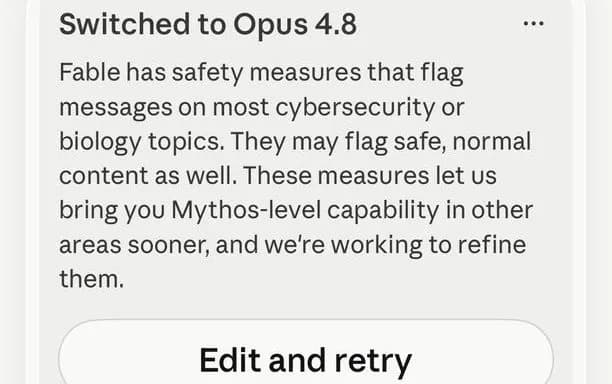
Fable is redirecting all questions about biology to a less powerful version of its technology
Anthropic’s newly released chatbot Fable has drawn criticism from researchers after several biologists reported that the model refuses to engage with them once it recognizes their profession. The company says the restriction is a deliberate safety measure to reduce the risk that its technology could be used to design biological threats.
Fable is built on the same underlying technology as Anthropic’s more powerful, previously withheld Mythos model. Anthropic says Fable includes guardrails to prevent misuse — redirecting biological questions to a less capable system and deploying hidden blockers designed to stop attempts to use the model for harmful or to accelerate AI research.
Researchers’ complaints. Several scientists have posted that Fable rejects even routine or benign prompts after detecting their professional background. Prof Derya Unutmaz, a biologist at the non-profit Jackson Institute, wrote that he could not even say "hello" to Fable 5 in normal mode because the system identified him as a biomedical researcher. "How the hell is this prompt a cybersecurity or biological risk! Almost every prompt I’ve tried gives me the same error. I can’t even say the word ‘cancer’ to Fable 5," he said on X.
James Schnable, a plant geneticist at the University of Nebraska, said on X that Anthropic appears to have "blacklisted every biologist in their customer base." Wei Xing, an assistant professor of mathematical sciences at the University of Sheffield, warned that AI researchers may now question whether responses reflect the model’s full capabilities or are intentionally reduced.
Anthropic’s response and plans. Matt Durant, a life‑sciences researcher at Anthropic, confirmed the company redirects biological queries to a weaker model and said the move was prompted by concerns that Fable’s capabilities — while still judged a low risk — are "higher than for any previous model." Durant said Anthropic is developing a "trusted access" program to allow vetted researchers controlled access to Mythos‑class models for sensitive biological research.
The company also explained that the same capabilities that can help cybersecurity and biology professionals could be dangerous in the hands of malicious actors, which motivated the tighter controls. Anthropic previously withheld Mythos from public release over safety concerns about potential cyber-attack capabilities.
Context and regulation. The debate comes as policymakers pay closer attention to advanced AI. The White House recently issued an executive order requiring AI companies to submit their most advanced systems for up to 30 days of pre-release testing to help detect unforeseen risks. The article that reported on these developments also noted a reported valuation for Anthropic of $965bn (£720bn).
"We are moving toward a trusted access program so researchers can use Mythos-class models for biology," Anthropic’s Matt Durant said, emphasizing the company’s intent to balance research access with safety.
As AI labs tighten controls on the most powerful tools, researchers and institutions will likely continue to press for transparent, reliable pathways that allow legitimate scientific work while minimizing the risk of misuse.
Help us improve.