
Using JWST and a natural gravitational lens, astronomers have measured the mass of a dormant supermassive black hole in galaxy MRG‑M0138 about 10 billion light‑years away, finding it to be roughly 6 billion times the Sun’s mass. The team used stellar dynamics—tracking the motions of stars—to make the measurement, extending the technique about 15× farther than previous attempts. Gravitational lensing magnified the distant galaxy by roughly 30×, enabling the detailed measurement, and the host galaxy appears quiescent, likely quenched after an earlier quasar phase.
James Webb Weighs a 'Sleeping Giant' — 6 Billion-Sun Black Hole 10 Billion Light-Years Away
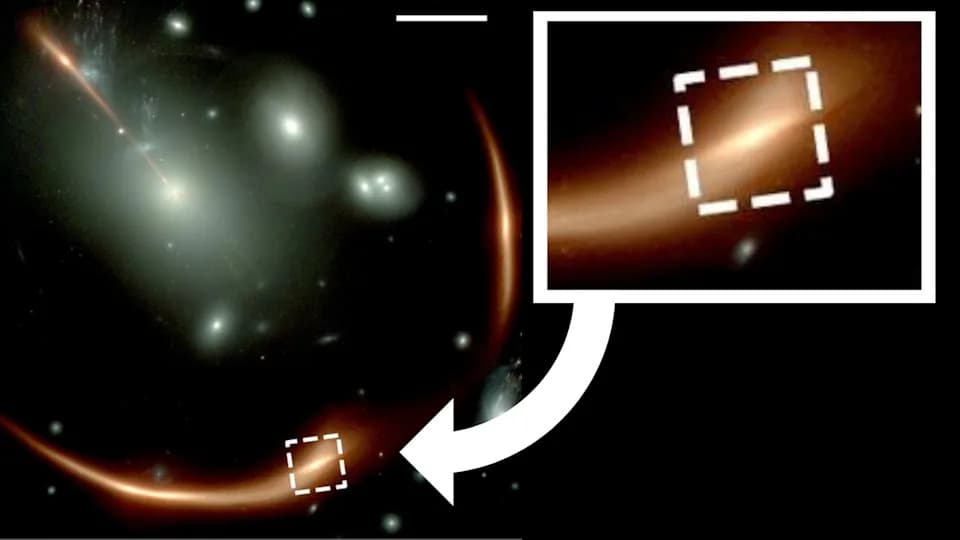
The lensed galaxy MRG-M013 which the JWST used to weigh a distant supermassive black hole. | Credit: NASA/JWST
Using the James Webb Space Telescope (JWST), astronomers have for the first time measured the mass of a dormant supermassive black hole located roughly 10 billion light‑years from Earth. The black hole sits at the centre of the galaxy MRG‑M0138, seen as it appeared when the universe was about 4 billion years old, and its mass is estimated at approximately 6 billion times that of the Sun.
Active supermassive black holes are often easy to spot when they are feeding: infalling gas and dust form luminous accretion disks and power active galactic nuclei (AGN). Dormant black holes, by contrast, lack that bright glow and are essentially invisible directly because of their event horizons. However, their gravity still affects the motions of nearby stars, and those stellar motions can be used to infer the black hole’s mass.
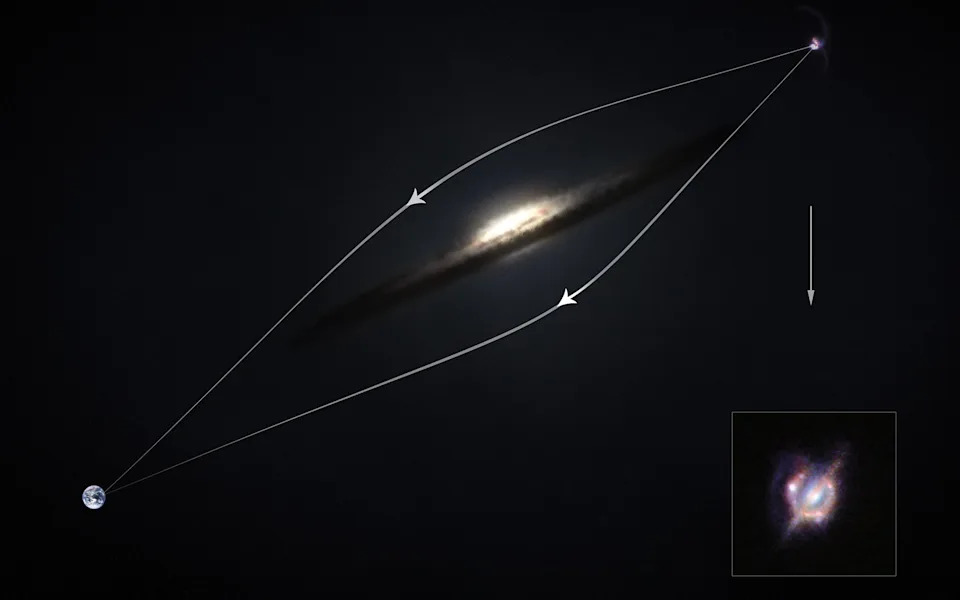
This diagram shows how the effect of gravitational lensing around a normal galaxy focuses the light coming from a very distant star-forming galaxy merger to created a distorted, but brighter view. | Credit: ESA/ESO/M. Kornmesser
To weigh the distant "sleeping giant," the research team used JWST to trace the motions of stars at the core of MRG‑M0138. This method, known as stellar dynamics, has been used for nearby galaxies — for example, to weigh Sagittarius A* (Sgr A*), the Milky Way’s 4.3‑million‑solar‑mass black hole about 26,000 light‑years away. Until now, the furthest distance at which stellar dynamics had been successfully applied was roughly 700 million light‑years; the new JWST measurement extends that reach by about 15 times.
Cosmic Magnification: Gravitational Lensing
Resolving stellar motions in a galaxy so remote required a fortuitous cosmic assist: gravitational lensing. As predicted by Albert Einstein’s general relativity, a massive foreground object bends and magnifies light from background sources. In this case, a galaxy located between MRG‑M0138 and Earth acted as a lens, magnifying the distant galaxy by roughly 30× and allowing the team to reconstruct internal details that would otherwise be far too faint and small to measure.
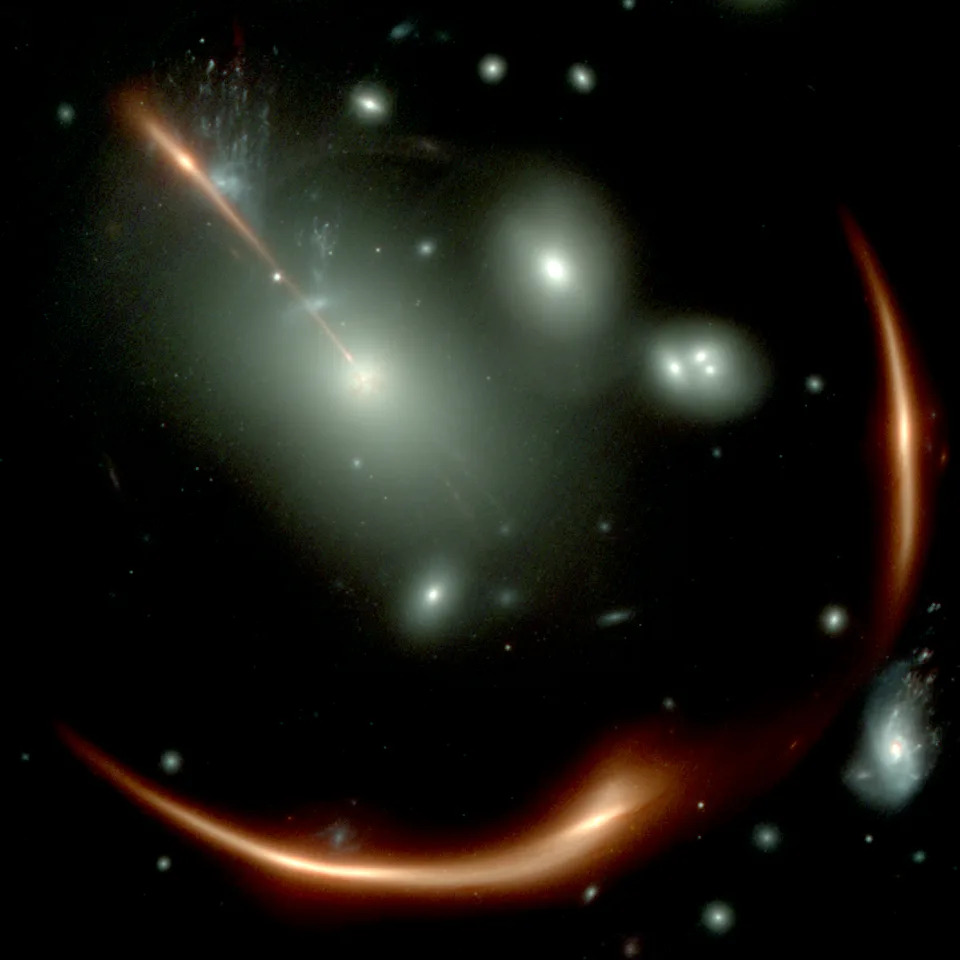
The lensed galaxy MRG-M013 which the JWST used to weigh a distant supermassive black hole determining it to have 6 billion solar masses. | Credit: NASA/JWST
"Determining how stars collectively move within the core of this distant galaxy has allowed us to measure the mass of its otherwise undetectable supermassive black hole," said team leader Richard Ellis of University College London. "By demonstrating the feasibility of such a technique for galaxies in the early universe, we can now undertake a more complete census of how black holes develop over time and infer their role in shaping galaxy evolution."
Andrew Newman of Carnegie Science added:
"By combining JWST data with gravitational lensing, we could peer inside the black hole’s sphere of influence, where its gravity boosts the speeds of stars. This is one of the best techniques we have to weigh a black hole, so we were excited to extend it to a much earlier period in cosmic history."
Galaxy Quenching and Cosmic Context
In addition to measuring the black hole’s mass, the researchers found that MRG‑M0138 itself is quiescent: it is no longer forming stars. The team suggests this quenching is consistent with an earlier epoch when the central black hole fed intensely and shone as a quasar. The energetic output during that active phase would have driven gas and dust away from the nucleus and the galaxy at large, removing the raw material needed for new stars and effectively shutting down star formation.
These observations demonstrate that JWST, especially when combined with gravitational lensing, can extend stellar‑dynamics mass measurements deep into the early universe. With additional measurements of dormant supermassive black holes at high redshift, astronomers can build a fuller picture of how black holes and their host galaxies coevolved and assess the role of black holes in halting star formation in massive galaxies.
The team’s results were published on Thursday, June 4, in the journal Science.
Help us improve.





















