
A team from the SETI Institute and Breakthrough Listen used the Allen Telescope Array to search the interstellar object 3I/ATLAS for radio technosignatures. From nearly 74 million narrowband hits across 7.25 hours, they filtered to roughly two million candidates and then flagged 211 signals for detailed review. None showed signs of artificial origin; all were attributed to human-made radio-frequency interference. The null result validates current search methods and supports continued monitoring of interstellar objects.
Scientists Report No Alien Transmissions From Interstellar Object 3I/ATLAS After Wideband Radio Scan
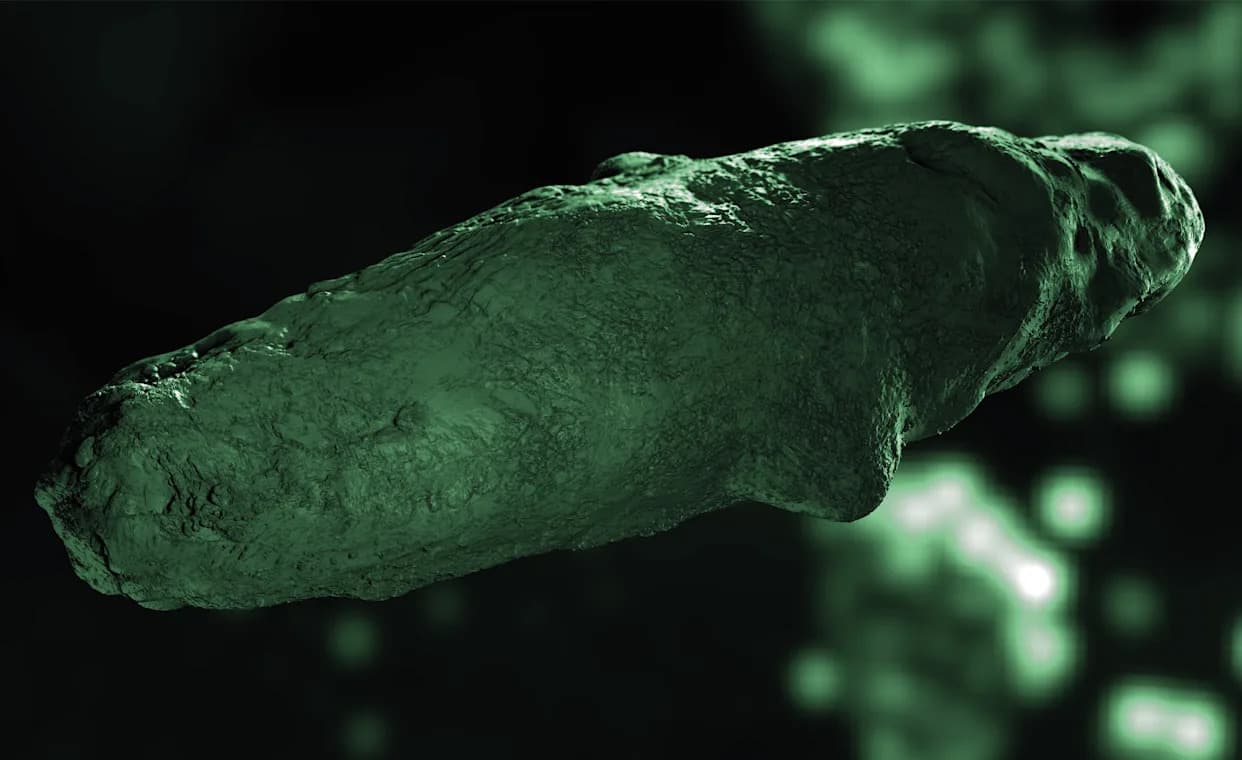
A 3D Rendering of 3I/ATLAS
In July 2025 astronomers detected a fast-moving object that passed through the Solar System from interstellar space. Named 3I/ATLAS, the object prompted intense interest: researchers wanted to learn about material from another star system, while some, including Harvard astronomer Avi Loeb, highlighted unusual features and suggested a remote possibility that it might be artificial.
Most scientists favor a natural origin — likely a comet — but a new study published in The Astronomical Journal set out to test the artificial-probe hypothesis directly. A team from the SETI Institute, working with the Breakthrough Listen project (based at UC Berkeley), performed a broad radio-frequency search of 3I/ATLAS to look for technosignatures — radio transmissions that would indicate technology.
How the search was done
Using the Allen Telescope Array near San Francisco, the researchers began with a dataset described as nearly 74 million narrowband hits gathered in 7.25 hours of observations. After removing obvious contamination and known sources of radio-frequency interference (RFI) — electromagnetic emissions from human-made systems such as communications equipment — the team reduced that pool to roughly two million candidate signals.
Those candidates were then processed by algorithms designed to find outliers: signals that are unusually narrow, strong, or inconsistent with natural backgrounds. The automated pipeline flagged 211 signals for detailed human review.
Results: No Technological Signals Found
After careful inspection, the authors report that none of the 211 flagged signals exhibited characteristics suggestive of an artificial origin. The paper states that each was "easily attributable to RFI." Earlier observations by Breakthrough Listen with the Green Bank Telescope had likewise produced no credible candidate transmissions from 3I/ATLAS.
“The results from 3I/ATLAS show how realistic it is to detect a signal with the technology we have today,” said coauthor Valeria Garcia Lopez, a Breakthrough Listen member and physics professor at Furman University. “That is why it is important to keep searching for technosignatures, even from objects we might not expect to have signals.”
The team stresses that a null detection is still scientifically valuable: it validates search techniques, demonstrates the sensitivity of current facilities, and improves methods for filtering RFI from wide-band radio data.
Why the search matters
Researchers note that interstellar artifacts cannot be completely ruled out as a general possibility — after all, humanity has launched probes that will one day become artifacts in other star systems. "Eventually, our own Voyager spacecraft will be extraterrestrial artifacts in other stellar systems," said lead author Sofia Sheikh of the SETI Institute. Understanding the natural population and behavior of interstellar objects will help astronomers identify anomalies that might indicate an artificial origin in the future.
Although 3I/ATLAS produced no evidence of technology, the study reinforces the utility of systematic technosignature searches and encourages continued monitoring of future interstellar visitors.
Help us improve.





















