China's Chang'e-7, slated for 2026, will directly search for water ice at the lunar south pole and map local resources near Shackleton Crater. The mission aims for ~100-meter landing accuracy and carries cameras, infrared and hyperspectral sensors, a seismograph, topography camera and drills. Solar-powered elements can "hop" between sunlit patches to reach sampling sites. Finding usable ice would reduce the need to ferry water from Earth and enable long-term lunar infrastructure and ISRU.
China's Chang'e-7 Will Hunt for Water Ice at the Lunar South Pole in 2026
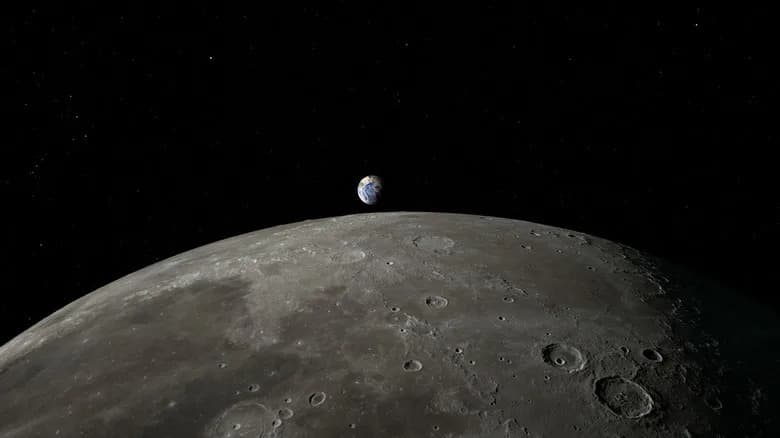
surface of the moon with the earth visible in the background - Gettinthere/Getty Images
The Moon is once again central to major international space ambitions. While NASA advances plans for a sustained human presence, China is directing part of its next mission to a practical objective: finding usable water on the lunar surface.
China's Chang'e-7, currently scheduled to launch in 2026, will make a focused, first direct search for accessible water ice at the lunar south pole. Like NASA's Artemis program, Chang'e-7 is concentrating on the south-polar region — the same area NASA plans to visit with crewed missions later this decade. Because Chang'e-7 is expected to fly before NASA's VIPER rover, it could gain an early advantage in mapping valuable local resources.
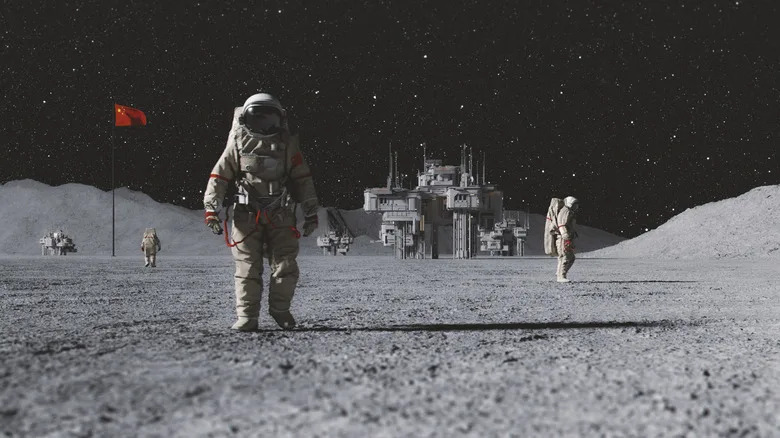
Rendering of Chinese astronauts on the moon - Gremlin/Getty Images
Mission Goals and Landing
The mission aims to map regional resources and to locate water ice trapped in permanently shadowed craters. China has indicated the mission will target the vicinity of Shackleton Crater, though officials have not confirmed a final touchdown site. The program is pursuing a demanding landing precision of about 100 meters or better to maximize the chances of reaching shadowed, ice-bearing terrain — a technically challenging but important goal after the success of Chang'e-6 on the lunar far side.
Scientific Payloads and Capabilities
Chang'e-7 will carry multiple scientific instruments across several spacecraft components. Key payloads include a high-resolution mapping camera, a wide-band infrared spectrometer, and a hyperspectral imager to identify and characterize potential ice deposits inside dark craters. The mission package also includes a lunar seismograph to monitor moonquakes and a topography camera to chart the surrounding terrain.
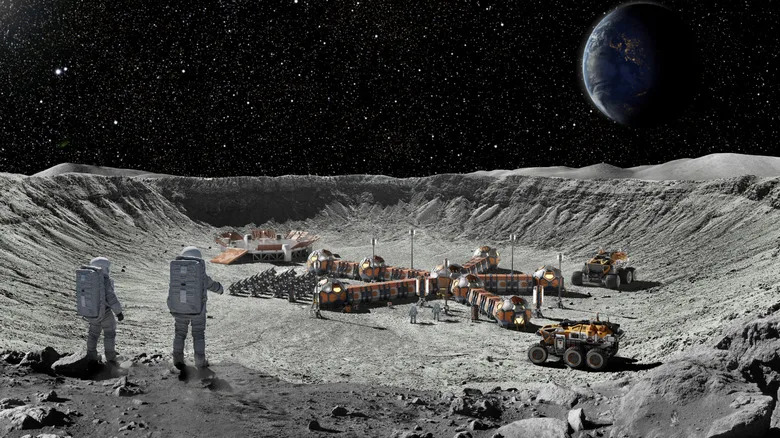
moon base concept, two astronauts looking over a base on the moon, earth visible in the background - Peepo/Getty Images
Because much of the lunar south pole is in near-perpetual shadow due to the Sun’s low angle on the horizon, some solar-powered elements of Chang'e-7 are designed to "hop" between sunlit patches. After touchdown, the lander is expected to move to an undisturbed site and drill into the regolith to search for and analyze subsurface ice.
Why This Matters
Confirming usable water ice on the Moon would be a major milestone for sustained lunar operations. Local water could be processed for crew consumption, converted into oxygen and hydrogen for rocket fuel and life support, and reduce the amount of consumables that must be launched from Earth — a core element of in-situ resource utilization (ISRU).
Observations from missions and telescopes, including detections of water in various space environments, make the presence of lunar ice likely in certain shadowed regions. Chang'e-7 is intended not to prove that water exists on the Moon, but to locate deposits that can be practically exploited to support future bases and infrastructure.
Bottom line: Chang'e-7 represents a strategic, science-driven step toward making the Moon a usable, sustainable platform for exploration and industry. A successful detection of accessible ice could reshape logistics for future lunar missions and international plans for long-term presence on the surface.
Help us improve.