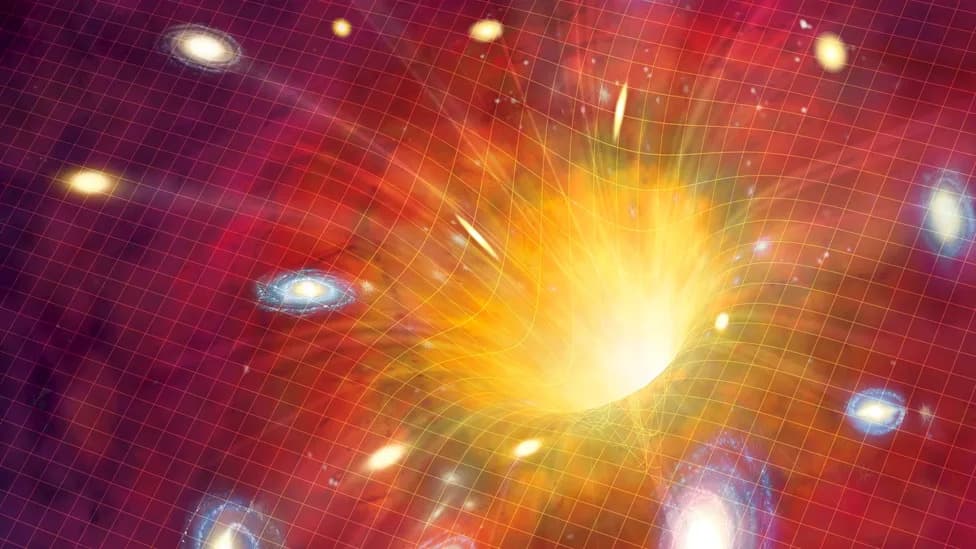
The universe doesn’t expand into a preexisting space — space itself stretches, so expansion means increasing distances between objects. The Big Bang about 13.8 billion years ago and a brief period of rapid inflation set this expansion in motion. Observations since Hubble (1929) show the universe is expanding and that expansion is accelerating, attributed to mysterious dark energy (≈68% of the universe’s energy). Theories such as string theory or multiverse ideas are speculative attempts to reconcile quantum mechanics with gravity.
If the Universe Is Already Infinite, What Is It Expanding Into?
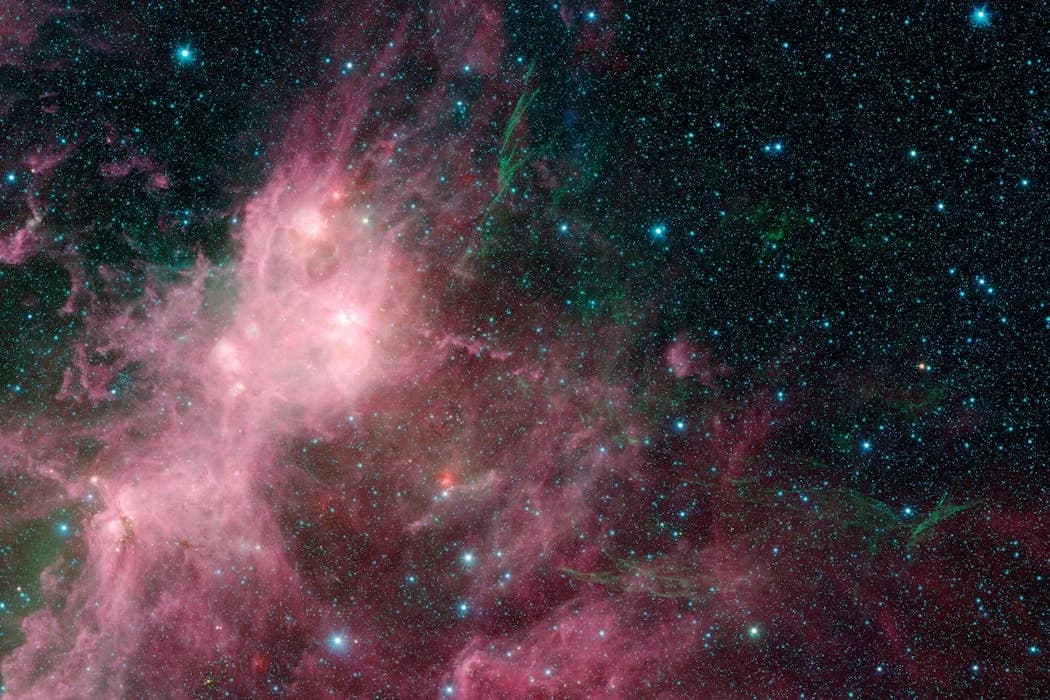
The universe is full of stars, galaxies and planets − it's expanding every day.NASA/JPL-Caltech/University of Wisconsin via AP
Question: What is the universe expanding into if it’s already infinite? — Mael, age 10, Missoula, Montana
It helps to start with a familiar image: when bread dough or muffin batter rises, it pushes outward into the baking pan and any chocolate chips end up farther apart. That image is useful, but it can mislead: unlike dough in a pan, the universe does not expand into a preexisting container. Instead, space itself stretches — the universe expands into itself.
What Does “Expansion” Actually Mean?
When astronomers say the universe is expanding they mean that the distances between distant objects are increasing. We measure this as the redshift of light from other galaxies: most galaxies appear to be moving away from us, and more distant galaxies move away faster. This observation — summarized by Hubble’s law — is the practical definition of cosmic expansion and does not require an external space for the universe to fill.
The Big Bang, Inflation, and How Expansion Began
The universe began in the event we call the Big Bang about 13.8 billion years ago. That term names a hot, dense early state of the universe, not an explosion into empty space. In the very earliest moments the universe underwent an extremely rapid growth called inflation (proposed by Alan Guth and others), which made tiny regions become much larger in a fraction of a second. After inflation the universe cooled, particles and light formed, and cosmic structures gradually developed into the galaxies and stars we see today.
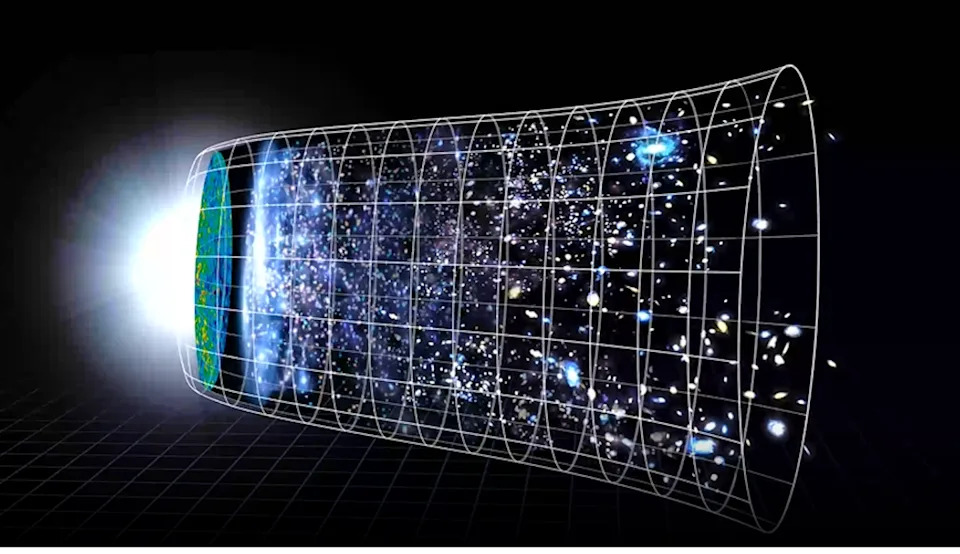
The expansion funnel visually shows how the universe’s rate of expansion has increased over time. At the left of the funnel is the Big Bang, and since then, the universe has expanded at a faster and faster rate.NASA
Who Predicted and Who Observed Expansion?
Mathematical solutions to Einstein’s general relativity showed that expanding (or contracting) universes were possible. Russian physicist Alexander Friedmann produced these solutions in 1922. Observationally, Edwin Hubble published evidence in 1929 that galaxies are receding from us and that the universe as a whole is expanding.
Why Is The Expansion Speeding Up?
Surprisingly, the expansion is not slowing down under gravity but accelerating. Scientists describe the unknown cause as dark energy because it doesn’t interact with light and has not been directly detected. In current cosmological models, dark energy makes up roughly 68% of the universe’s total energy density, while ordinary (baryonic) matter accounts for about 5%.
Is There Anything Outside Our Universe?
Observationally, we have no evidence for anything beyond our observable universe. Some theoretical ideas — generically called multiverse proposals — imagine many universes or larger structures that contain our universe. These remain speculative and are not yet supported by direct observations. The desire to go beyond our current models is partly driven by the difficulty of uniting quantum mechanics (which governs the very small) with general relativity (which governs gravity and the large scale). Theorists explore frameworks such as string theory, brane cosmology, and loop quantum gravity to try to bridge that gap.
How To Imagine This Strange Idea
Cosmic expansion has no center and no edge in the usual sense. A helpful picture is the surface of an inflating balloon: points on the surface move apart as the balloon expands, but the surface itself has no center on it and does not expand into a third dimension that is part of the surface. In the same way, our three-dimensional space can expand without needing an external place to expand into.
Nicole Granucci, Teaching Professor in Physics and Astronomy, Quinnipiac University, provided this explanation.
Help us improve.