
Researchers at the University of Warsaw and the University of Oxford propose a revised quantum field framework that expands the Hilbert space into a "twin space" to address long-standing mathematical problems with tachyons. This extension aims to restore Lorentz covariance, stabilize the vacuum and produce a lower-bounded energy spectrum while aligning with the two-state formalism of quantum mechanics. The paper does not claim experimental detection of tachyons but reopens conceptual questions about time symmetry, causality and quantum field theory.
New "Twin Space" Proposal Reframes Tachyons, Time Symmetry and Causality

A new tachyon theory argues faster-than-light particles may fit within relativity without the old paradoxes about time and causality. (CREDIT: Wikimedia / CC BY-SA 4.0)
Faster-than-light particles—tachyons—have long been a provocative idea in physics: they offer a way to probe the limits of special relativity but also appear to threaten the usual order of cause and effect. A new paper from researchers at the University of Warsaw and the University of Oxford argues that many of the historical paradoxes come not from the particles themselves but from an incomplete mathematical representation.

Physicist Andrzej Dragan
Background
The tachyon debate dates back to the 1960s when Gerald Feinberg introduced the concept of an "imaginary mass" that forces certain quanta to remain superluminal. That construction produced troubling consequences: frame-dependent reversals of cause and effect, unbounded energy spectra, unstable vacua, and formulations that did not transform consistently under Lorentz boosts. For decades these technical problems relegated tachyons to thought experiments and theoretical stress tests rather than viable components of mainstream relativistic quantum theory.
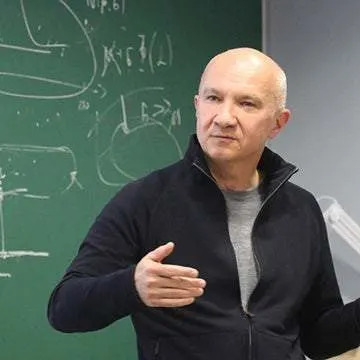
Physicist Artur Ekert
The Twin Space Proposal
Led by Andrzej Dragan and Artur Ekert, with Jerzy Paczos, Kacper Dębski, Szymon Cedrowski, Szymon Charzyński, and Krzysztof Turzyński, the team presents a revised quantum field-theory framework in Physical Review D. Their central claim is that conventional Fock-space representations are too small for tachyons. Because a Lorentz boost can map a positive-energy, forward-in-time tachyon into a negative-energy, backward-in-time excitation, the distinction between incoming and outgoing states becomes frame-dependent.
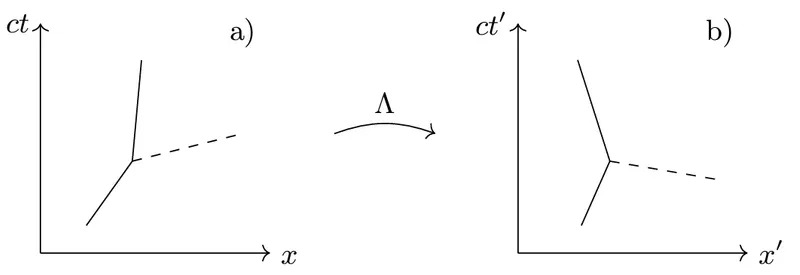
An emission of a positive-energy tachyon. (a) In one reference frame is Lorentz-transformed by a boost Λ into an emission of a negative-energy tachyon. (b) Backward in time, which can be reinterpreted as a regular absorption of a positive-energy antitachyon forward in time, in the boosted reference frame. (CREDIT: Physical Review D)
To handle this, they enlarge the Hilbert space into a so-called "twin space" that simultaneously accommodates input and output states. According to the authors, this extension restores Lorentz covariance, preserves canonical commutation relations, yields a Lorentz-invariant and stable vacuum, and produces an energy spectrum bounded from below—addressing several long-standing mathematical objections.

The blue glow of Cherenkov radiation in a nuclear reactor, one of the ways hypothetical tachyons can be detected. (CREDIT: Argonne National Laboratory)
"In this work, we show that these issues stem from the improper representation of the Lorentz group in a too-small Hilbert space."
Connections To Quantum Formalisms
The proposal has a clear affinity with the two-state (or two-vector) formalism of quantum mechanics developed by Yakir Aharonov, Peter Bergmann and Joel Lebowitz, which treats processes using both pre-selected (past) and post-selected (future) states. The authors argue that a similar two-directional viewpoint becomes necessary for a relativistically consistent description of tachyons.
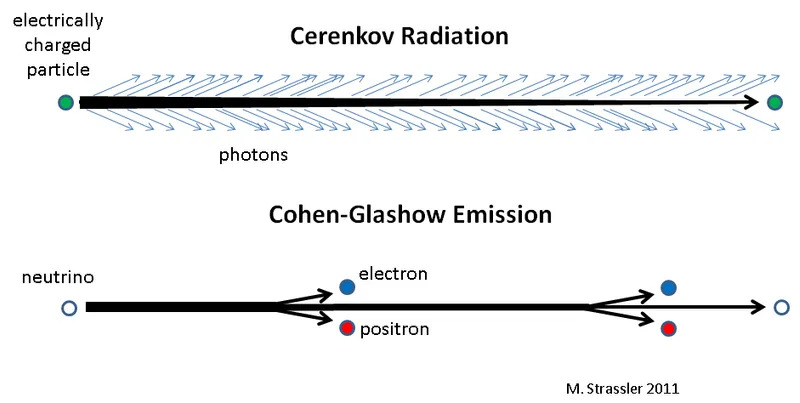
Cerenkov radiation involves the nearly continuous emission of photons by a charged particle moving faster than the speed of light in its vicinity. (CREDIT: Matt Strassler)
Implications And Limits
The paper does not claim that tachyons have been detected. Rather, it shows that if tachyonic excitations are to be described without breaking relativity or destabilizing quantum field theory, the underlying mathematical framework must be enlarged. The authors suggest that superluminal phenomena need not produce fatal logical contradictions; instead they may induce "disturbances of causality" comparable to the counterintuitive features already present in quantum mechanics.
Even without experimental evidence, tachyonic concepts already appear across theoretical physics: as modes in string theory, as tachyonic fields in cosmology, in discussions of the Casimir effect, and in models of spontaneous symmetry breaking. A cleaner mathematical treatment could sharpen our understanding of time symmetry, Lorentz invariance, vacuum stability, and symmetry-breaking mechanisms such as aspects of the Higgs transition.
Caveats And Next Steps
The authors are careful not to overstate their results: the work does not resolve interpretational debates around the two-state vector formalism, does not demonstrate retrocausality in everyday life, and leaves open major questions about whether these ideas can illuminate CP violation, baryon asymmetry, or other empirical puzzles. The immediate impact is conceptual: the paper provides a clearer set of mathematical rules for exploring whether tachyon-like behavior can be accommodated within relativistic quantum field theory.
Where To Read
The full study is available online in Physical Review D. For broader commentary, the original popular summary appeared in The Brighter Side of News.
Help us improve.





















