
Analysis of nearly 40 years of BiSON helioseismic data shows that the Sun's internal high-frequency oscillations have strengthened even as surface activity remains weak. Researchers conclude magnetic activity and structural changes are becoming confined to shallow layers about 1,000 km below the surface. Continued monitoring through Cycle 25 and into Cycle 26 (around 2030) will test whether this represents a sustained reorganization of the Sun's magnetic storage.
Sun's 'Heartbeat' Is Changing: Four Decades of Data Reveal a Shift Beneath the Surface
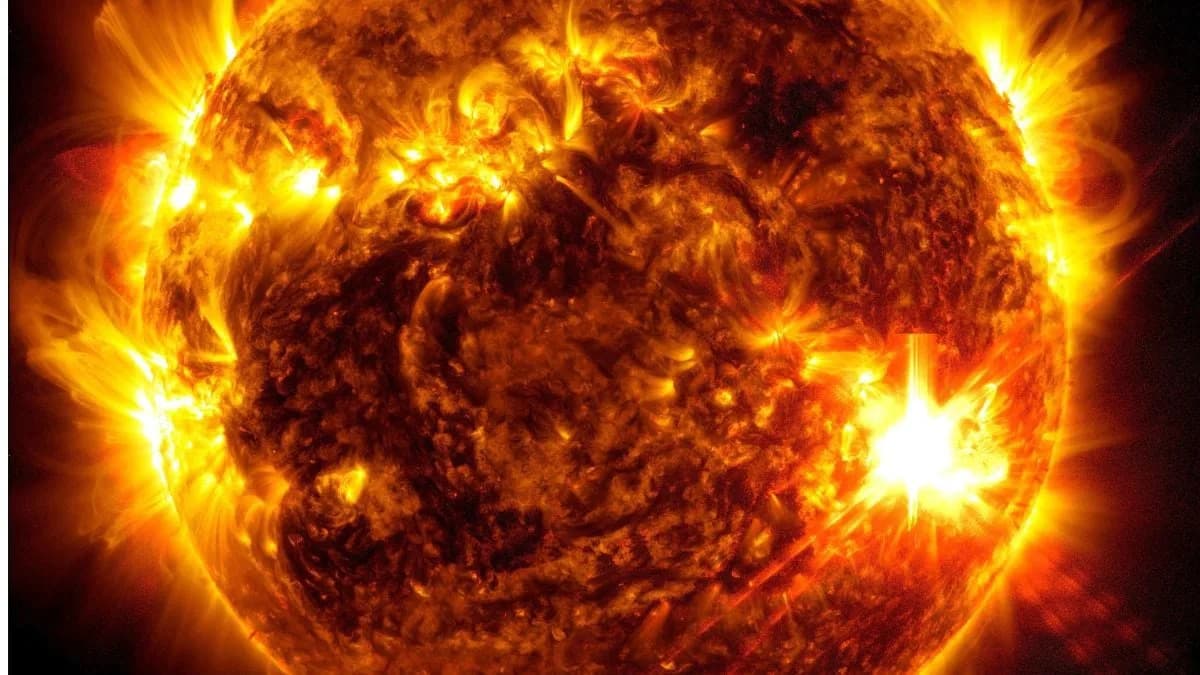
A solar flare imaged by NASA's Solar Dynamics Observatory in 2024. (NASA SDO)
Scientists probing beneath the Sun's visible surface report that its internal rhythms have changed significantly over the past 40 years. By analysing nearly four decades of helioseismic data, researchers have found a pattern that surface measurements alone did not reveal: magnetic activity and structural changes are becoming confined to shallower layers beneath the photosphere.
YouTube Thumbnail
What the Team Did
Led by Bill Chaplin of the University of Birmingham, the team examined Doppler velocity observations from the Birmingham Solar Oscillations Network (BiSON). The dataset spans back to 1987 and covers solar Cycles 22 through 25. BiSON is a global network of six spectrometers that has provided continuous helioseismic monitoring since the 1970s.
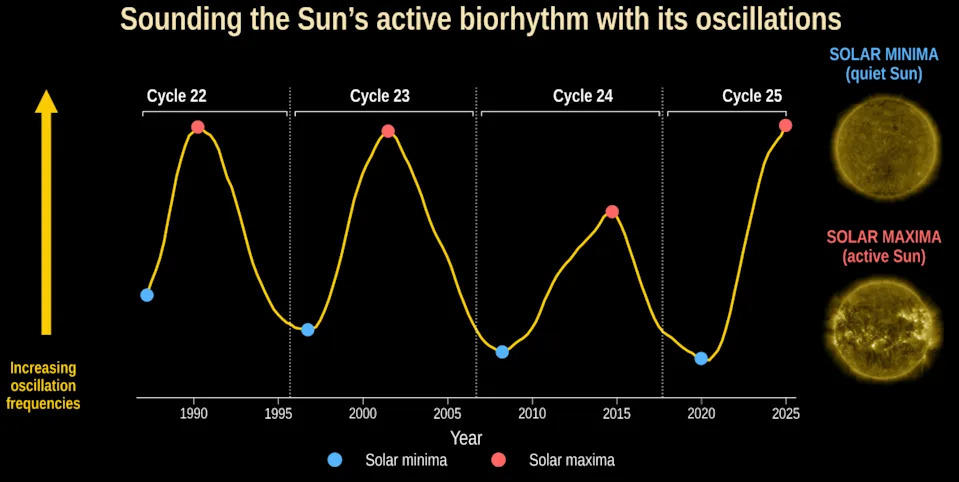
Oscillations caused by sound waves in the Sun's interior vary in frequency based on solar activity, across the 11-year solar cycle. (W.J. Chaplin/CC BY 4.0)
How They Measured the Sun's Interior
Using helioseismology, the researchers analysed p-mode oscillations—acoustic waves that make the Sun 'ring'—and divided the oscillation frequencies into low, mid and high bands to probe different depths. They compared these subsurface signals with common surface activity proxies, including sunspot counts and standard measures of radio emission, to relate interior behavior to what is observed in the outer atmosphere and corona.
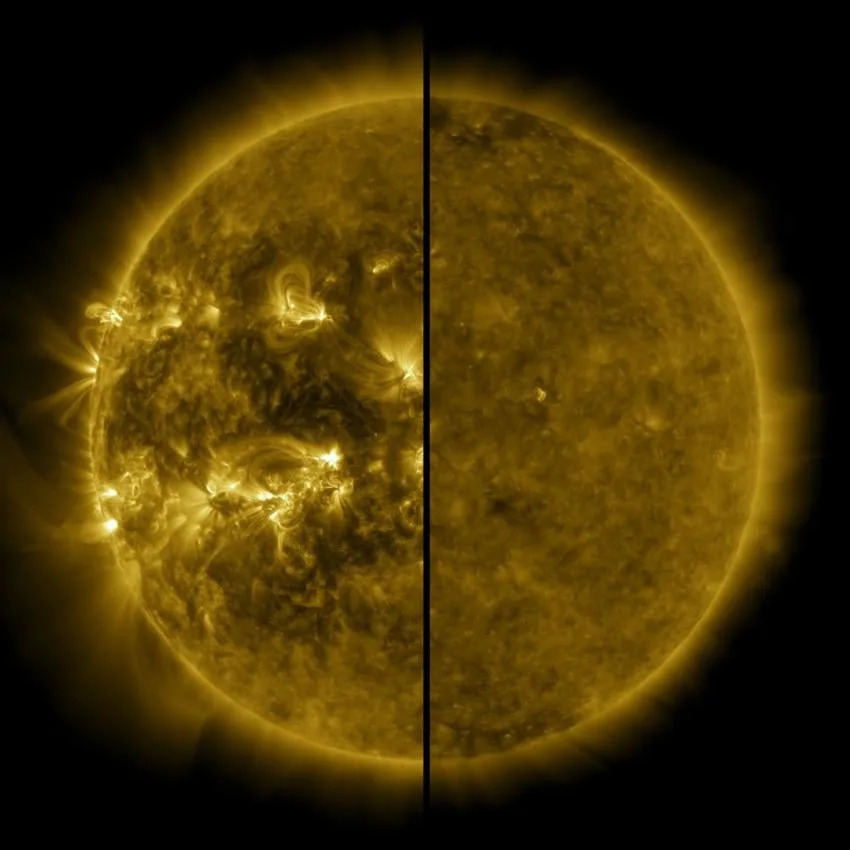
A comparison of the Sun's activity during solar maximum (left, imaged in 2014) and its much tamer solar minimum (right, imaged in 2019). (NASA/SDO/CC BY 4.0)
Key Findings
The study revealed an unexpected pattern: while surface activity has remained relatively weak in recent cycles (as seen during Cycle 24), the high-frequency internal oscillations have strengthened and now resemble those of earlier cycles. The authors interpret this as a systematic confinement of magnetic activity and structural changes to shallow layers roughly 1,000 kilometers (about 621 miles) beneath the visible surface.

Subscribe to ScienceAlert's free fact-checked newsletter
"We have uncovered evidence of systematic changes in the solar activity cycle," says Bill Chaplin. "Crucially, magnetic activity is becoming more tightly confined near the surface with each cycle."
Yale astronomer Sarbani Basu, a co-author, adds that the relationship between internal oscillations and surface activity has evolved over the past few cycles, suggesting a reorganization in how magnetic fields are stored beneath the Sun's surface.
Why This Matters
Understanding where and how magnetic fields are stored and reconfigured inside the Sun is essential for improving space weather forecasts. Strong flares and coronal mass ejections—linked to magnetic activity—can damage satellites, disrupt GPS and communications, and trigger geomagnetic storms that affect electrical infrastructure on Earth.
Next Steps
The team will continue monitoring BiSON data as Cycle 25 progresses and Cycle 26 approaches around 2030 to determine whether this pattern is a sustained shift or a temporary variation. The findings were published in the Monthly Notices of the Royal Astronomical Society.
Reference: Chaplin et al., Monthly Notices of the Royal Astronomical Society (study of BiSON helioseismic observations, covering Cycles 22–25).
Help us improve.





















