Italy's lower house has approved a bill that could start the process of reintroducing nuclear power after nearly 40 years. The legislation does not permit new plants but allows the government up to one year after final approval to issue decrees establishing a legal framework for future projects. The measure now moves to the Senate, and the government has highlighted interest in SMRs and AMRs, while opponents warn of high costs and political controversy.
Italy's Lower House Approves Bill That Could Reopen Door To Nuclear Power
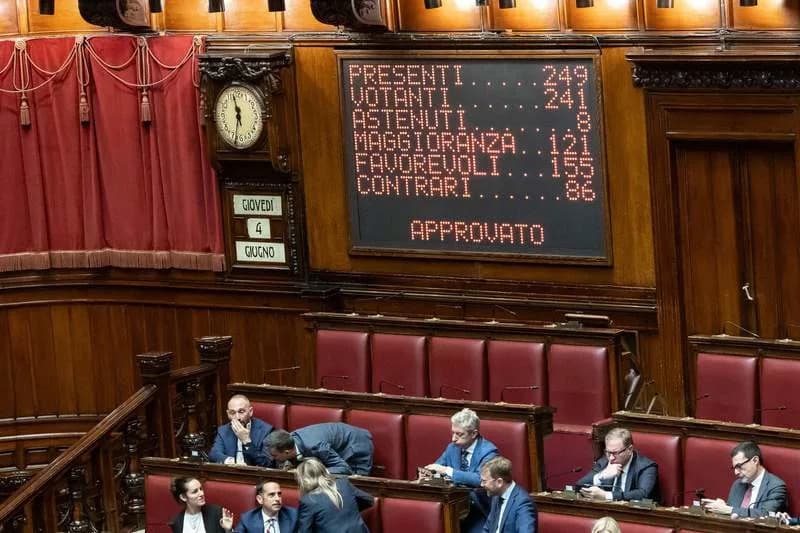
The result of the vote on the approval of the enabling law on sustainable nuclear energy in the Chamber of Deputies. (is associated with: «Italy's lower house backs legislation to revive nuclear power») Mauro Scrobogna/LaPresse via ZUMA Press/dpa
Italy's lower house of parliament has approved legislation that could pave the way for a return to nuclear energy nearly 40 years after the country began phasing out atomic power.
What the bill does — and doesn't do: The measure does not authorize the construction of new nuclear plants. Instead, it grants the government the authority to issue implementing decrees within one year after the law's final parliamentary approval. Those decrees would establish the legal and regulatory framework needed to develop plans and to assess potential projects at a later stage.
Next steps
After passing the Chamber of Deputies, the bill now moves to the Senate for further consideration. Only if the Senate approves the measure and subsequent implementing decrees are issued would concrete project planning and site assessments begin.
Historical context
Italy abandoned nuclear power following the 1986 Chernobyl disaster; the country's last reactors were shut down in 1990 after a national referendum. Later attempts to revive nuclear generation were shelved in the wake of Japan's 2011 Fukushima disaster.
Technologies Under Consideration
The government of Prime Minister Giorgia Meloni, in office for about three and a half years, has signaled interest in modern reactor technologies such as small modular reactors (SMRs) and advanced modular reactors (AMRs). Supporters argue these designs could offer greater flexibility, faster deployment and enhanced safety features compared with traditional large reactors.
Opposition And Concerns
Opposition parties and environmental groups have criticized the move, saying a nuclear restart could be costly, politically divisive and face public resistance. Key concerns include long-term radioactive waste management, financing and whether projected timelines are realistic.
Bottom line: The approved bill creates a legal path that could enable a future nuclear comeback, but it does not greenlight specific projects. The Senate's review and any implementing decrees will determine whether and how nuclear power might return to Italy's energy mix.
Help us improve.