
Virgin Galactic plans a 2027 research flight, OP‑01 (“Operation Period”), to study how menstruation and menstrual products behave in suborbital microgravity. The mission will focus on menstrual fluid dynamics and product performance during the brief minutes of weightlessness typical of Virgin Galactic flights. Two researchers from the Operation Period nonprofit, Manju Bangalore and Priya Abiram, will fly on the mission. Findings could inform long‑duration mission planning and medical product design on Earth.
Virgin Galactic’s OP‑01 “Operation Period”: A 2027 Flight to Study Menstruation in Microgravity

Billionaire entrepreneur Richard Branson wears his astronaut's wings at a news conference after flying July 11, 2021 with a crew in Virgin Galactic's passenger rocket plane VSS Unity to the edge of space.
Virgin Galactic has announced a 2027 research flight, OP‑01 — nicknamed “Operation Period” — that will for the first time aim to study how menstruation and related menstrual products behave in a suborbital microgravity environment. The mission will collect human‑tended data during the brief periods of weightlessness typical of Virgin Galactic’s flights.
What The Mission Will Study
According to a May 28 press release, OP‑01 will focus on menstrual fluid dynamics and the performance of menstrual products in suborbital space. Because Virgin Galactic’s missions provide only a few minutes of weightlessness within flights that last roughly an hour from takeoff to landing, the experiments are being designed to capture short‑duration effects and measurements that can be taken while participants are weightless.
Who Will Fly
The research flight will include two women affiliated with the Operation Period nonprofit: Manju Bangalore, a 28‑year‑old reproductive health scientist and founder of the nonprofit, and Priya Abiram, a 22‑year‑old aerospace engineer and the nonprofit’s director of research. Virgin Galactic said the pair are expected to become the youngest South Asian women to travel to space.
“At Virgin Galactic, we are committed to enabling human‑tended research that expands the scope of what can be studied in space,” said Amber Favaregh, director of system analysis and research at Virgin Galactic.
Program Context and Vehicle
Virgin Galactic, part of Richard Branson’s Virgin Group, operates suborbital spaceflights from Spaceport America in New Mexico. The company has flown 32 people across 12 missions to date and expects to resume commercial operations in 2026. OP‑01 is scheduled for 2027; a specific launch date has not been announced.
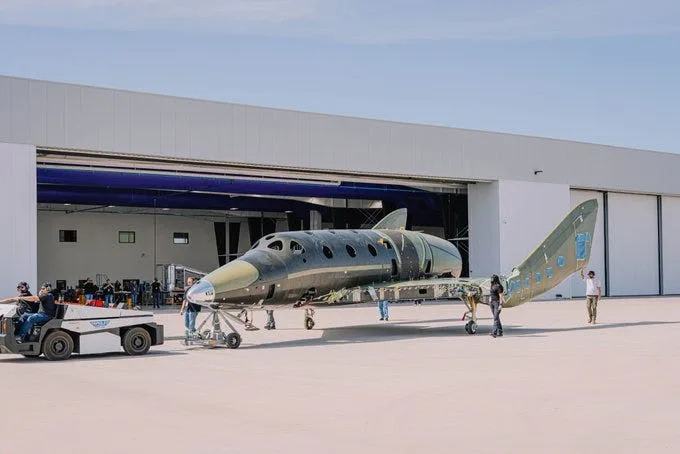
Virgin Galactic recently shared a 1st-look at its new spaceplane, which it calls Spaceship. The vehicle will soon be flying from New Mexico, taking paying customers on trips to the edge of space.
The company is preparing a new reusable spaceplane (referred to in filings as “SpaceShip”) designed to carry six passengers and support faster turnaround — up to eight missions per month. This prototype has completed assembly and ground testing in Arizona and will be transported to Spaceport America for flight testing later in the year. Meanwhile, the previously retired VSS Unity performed a glide flight on May 27 to help build operational readiness.
How Flights Work
Virgin Galactic uses an air‑launch approach. The carrier aircraft, VMS Eve — a four‑engine, twin‑fuselage mothership — carries the spaceplane to release altitude. The spaceplane then separates and climbs to roughly 54 miles (about 87 kilometers), a height within common U.S. military and NASA definitions of space, before gliding back to a runway landing.
Why This Matters
Although suborbital flights offer only brief microgravity exposure, OP‑01 could yield important data for planning longer missions and for medical and product design on Earth. Understanding how menstrual fluid behaves and how menstrual products perform in microgravity may improve mission logistics for female astronauts and inform healthcare innovations.
The mission is labeled OP‑01, suggesting Virgin Galactic and its partners may pursue additional research flights under the same initiative.
Eric Lagatta is the Space Connect reporter for the USA TODAY Network.
Help us improve.





















