ASKAP observations reveal that ASKAP J1745-5051, a symbiotic binary pairing an Earth-sized white dwarf with a low-mass red dwarf, produces long-period radio bursts and X-rays. Radio pulses are generated when the stars' magnetic fields clash during their eccentric 1.4-hour orbit, stripping charged particles that emit synchrotron radiation. X-rays come from hot gas accreting onto the white dwarf. The result shows at least some long-period radio transients originate from white-dwarf systems rather than magnetars.
Twenty-Year Radio Mystery Solved — A 'Vampire' White Dwarf Sparks Hour-Long Radio Bursts

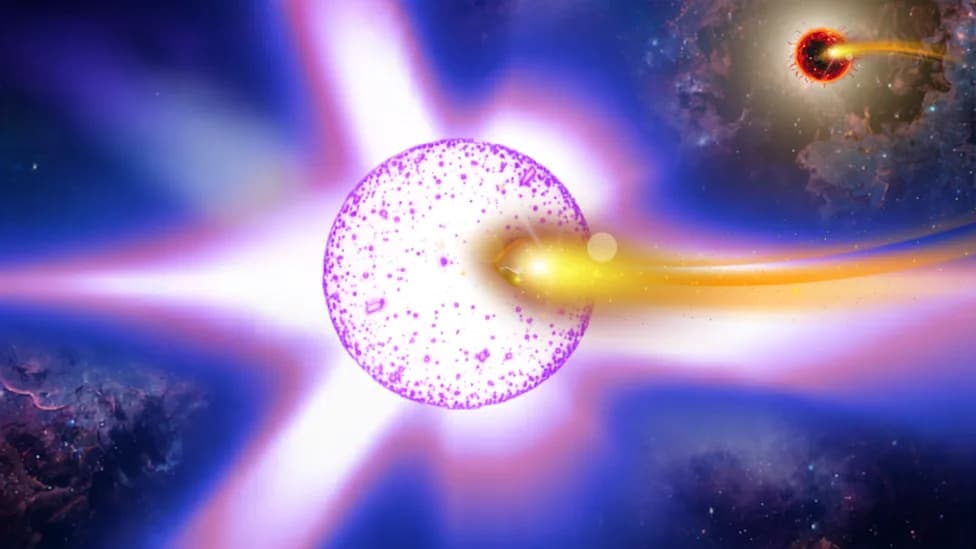
A schematic of the ASKAP J1745-5051 showing the compact white dwarf at the heart of a nest of magnetic-field lines, and a stream of matter flowing onto it from its companion red dwarf, which also has a magnetic field. | Credit: Carl Knox (OzGrav/Swinburne) and Dr Joshua Preston Pritchard (CSIRO)
Australian radio astronomers have identified the source of a class of mysterious long-period radio signals that puzzled researchers for more than 20 years. New observations with the Australian SKA Pathfinder (ASKAP) show that a symbiotic binary — a white dwarf siphoning material from a nearby red dwarf — produces the unusual, minute-to-hour-long radio bursts.
What Was Discovered
The object, catalogued as ASKAP J1745-5051, emits repeating radio bursts tied to its 1.4-hour orbit and also produces X-ray outbursts. The white dwarf in the system is roughly the diameter of Earth but has a mass comparable to the Sun; its companion is a low-mass red dwarf of about 0.1 solar masses.
How The Signals Are Produced
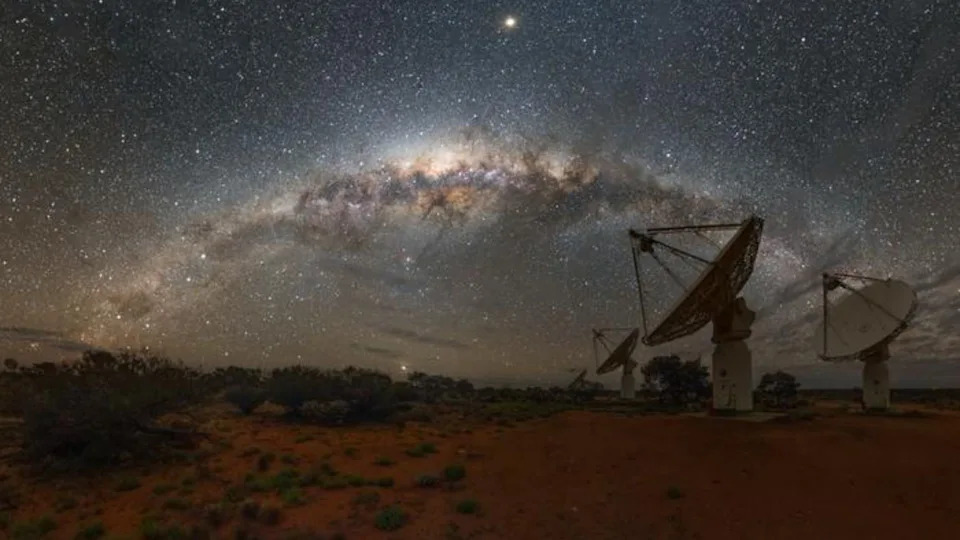
The ASKAP radio telescope at Inyarrimanha Ilgari Bundara, the CSIRO Murchison Radio-astronomy Observatory on Wajarri Yamaji Country in Western Australia. | Credit: Alex Cherney/CSIRO
The team, led by Kovi Rose of the University of Sydney, found that the X-rays arise from accretion: gas pulled from the red dwarf spirals toward the white dwarf, compresses and heats to hundreds of thousands or millions of degrees, and emits X-ray photons. The radio emission has a different origin. Both stars possess intrinsic magnetic fields and orbit each other in a strongly elliptical path. When the stars approach each other, their magnetic fields interact and strip charged particles from the stellar surfaces. Those particles then spiral along magnetic-field lines and emit synchrotron radiation — producing radio bursts that last while the fields remain in contact every 1.4 hours.
Why This Matters
Long-period radio transients are rare — only about a dozen are known — and their origins have been debated since their discovery in 2005. Magnetars (highly magnetic neutron stars) were proposed as candidates, but the ASKAP observations demonstrate that at least some of these transients are produced by interacting white-dwarf/red-dwarf binaries. ASKAP J1745-5051 also stands out because it produces both radio and X-ray emission; only one other long-period transient is known to produce X-rays, suggesting there may be multiple classes of sources within this group.
"Long-period radio transients have puzzled astronomers for years," said Rose, a postgraduate student. "Now we've been able to show that the source for one of these transients comes from a white dwarf actively pulling material from a companion star."
Implications and Next Steps
This discovery provides a template to help astronomers classify other long-period transients — distinguishing those powered by accreting white dwarfs from those that might be pulsars or magnetars. The findings were published on June 1 in Nature Astronomy.
Help us improve.