
In January 1971 Apollo 14 astronaut Stuart Roosa took more than 2,000 tree seeds into orbit to test whether spaceflight affected germination. Although some seed bags burst during postflight decontamination and early recovery attempts failed, other flown seeds planted about a year later in Mississippi and California produced viable seedlings. These "Moon Trees" were planted across roughly 40 states — including a loblolly pine at the White House — and showed no visible differences from control trees. NASA revisited the idea by sending more seeds on Artemis I in 2022.
Moon Trees: How Apollo 14 Carried Over 2,000 Seeds Into Orbit — And What Happened After
Apollo 14 astronaut Stuart Roosa brought seeds to space and planted them back on Earth.
On January 31, 1971, Apollo 14 launched and entered lunar orbit with a three-person crew that included astronaut Stuart Roosa. Roosa, a former U.S. Forest Service smokejumper, carried an unusual personal experiment: more than 2,000 tree seeds packed into sealed plastic bags and stored in a metal canister in his flight kit.
The goal was simple and compelling: test whether seeds exposed to spaceflight conditions — microgravity, radiation, and the stresses of launch and re-entry — would germinate or grow differently than identical seeds that remained on Earth.
Preparation and Seed Types
Working with Stan Krugman of the U.S. Department of Agriculture Forest Service, Roosa prepared seeds from five species: loblolly pine, sycamore, sweetgum, redwood, and Douglas fir. Each seed lot was classified, sorted, and sealed for the flight.
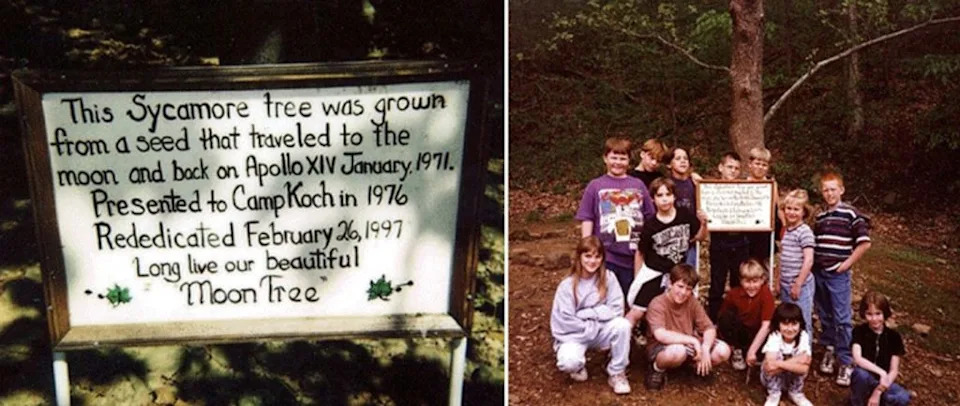
Children posing in front of the plaque and Sycamore tree at at Koch Girl Scout Camp in Cannelton, Indiana.NASA
Postflight Mishap and Recovery
Though the seeds successfully reached orbit and returned, the experiment nearly failed during postflight decontamination: some seed bags burst open, scattering seeds inside the decontamination chamber and briefly exposing them to vacuum conditions. Early germination attempts in Houston were unsuccessful because the compromised samples and facilities could not support recovery.
Successful Germination and The Moon Trees
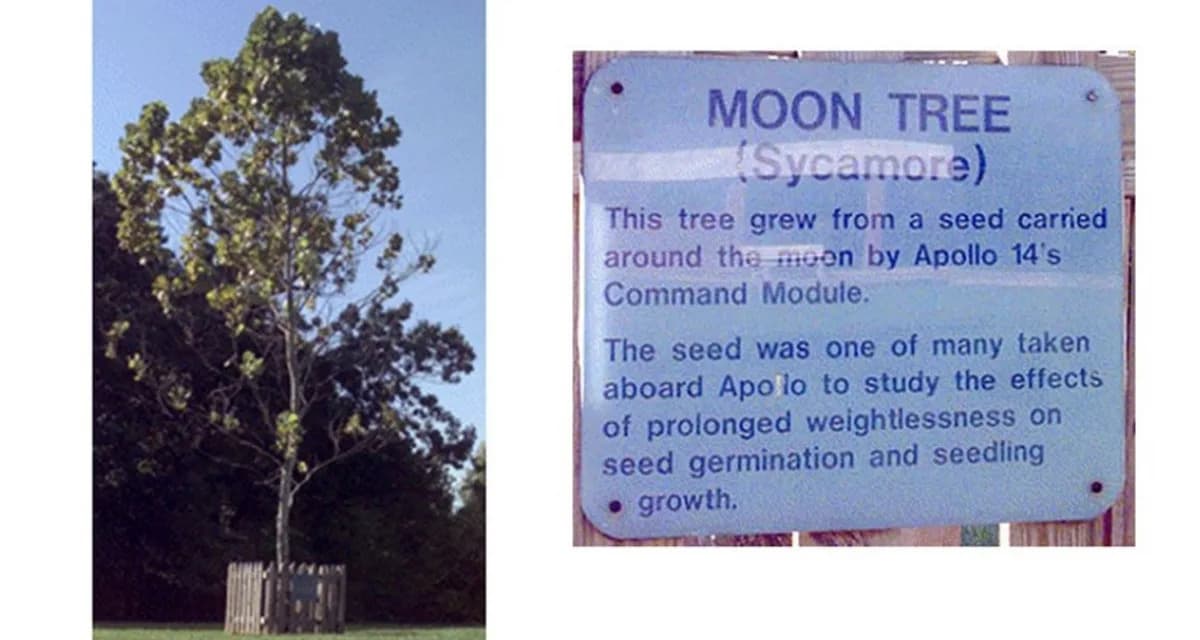
About a year later, other flight seeds were planted successfully — sycamore, loblolly pine, and sweetgum in Gulfport, Mississippi, and redwood and Douglas fir in Placerville, California. These flown seeds produced viable seedlings that were grown alongside control seedlings produced from Earth-bound seeds.
The resulting saplings, popularly known as "Moon Trees," were planted at public sites across roughly 40 U.S. states; a loblolly pine from the mission was even planted at the White House. Observers and researchers reported no notable differences in appearance or growth between the Moon Trees and their control counterparts.
Legacy
The Apollo 14 seed experiment became both a scientific curiosity and a public-engagement success, creating living monuments that commemorate early human spaceflight. In 2022, NASA’s Office of STEM Engagement partnered again with the U.S. Forest Service to send additional tree seeds into space aboard the Artemis I mission, extending the experiment’s legacy.
Tip: Several Moon Tree locations are listed in public registries and local inventories for anyone who wants to visit surviving specimens planted after Apollo 14.
Help us improve.





















