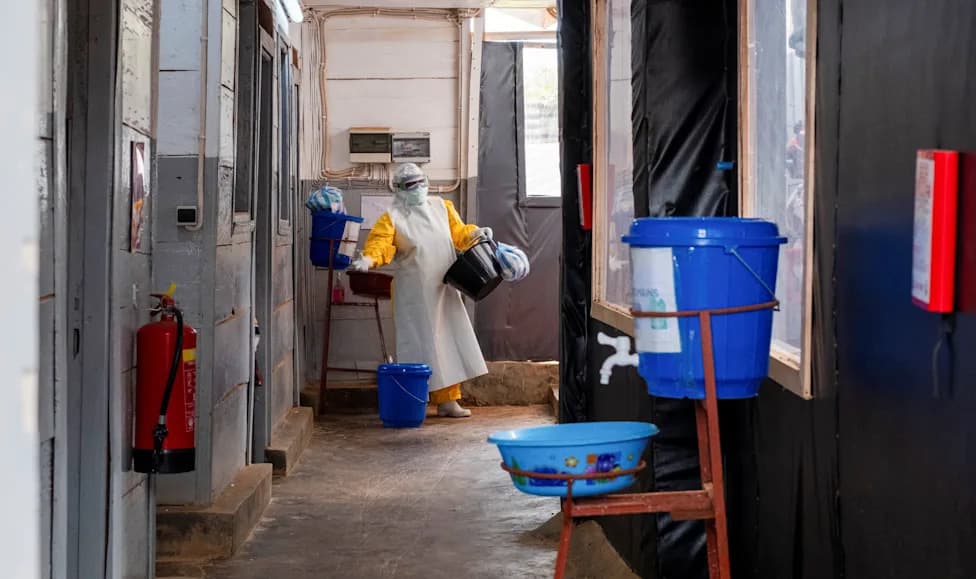
Uganda has temporarily closed its border with the Democratic Republic of Congo after several health workers were infected and suspected cases of the rare Bundibugyo Ebola strain increased. Congo has reported 121 confirmed cases and 17 confirmed deaths, with more than 1,000 suspected cases; Uganda has seven confirmed cases and one death. The WHO advises against border closures, calling the outbreak a Public Health Emergency Of International Concern and warning that closures can drive movement to unmonitored crossings.
Uganda Seals Border With Congo Amid Surge Of Rare Bundibugyo Ebola Cases
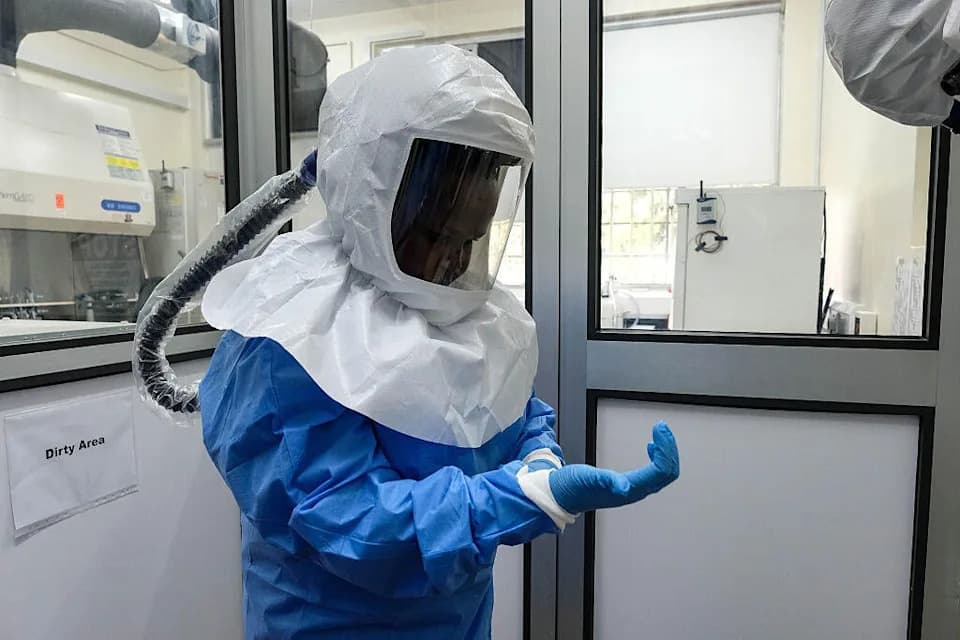
Sophia Mulei, a laboratory technologist, wearing protective equipment as she prepares to enter the Viral Hemorrhagic Fever Laboratory at Uganda Virus Research Institute on May 26, 2026, in Entebbe, Uganda. / Credit: Hajarah Nalwadda / Getty Images
Uganda on Wednesday ordered the temporary closure of its border with the Democratic Republic of Congo after a surge in suspected cases of the rare Bundibugyo strain of Ebola and confirmed infections in Uganda linked to exposure from Congolese patients.
The decision diverges from World Health Organization (WHO) guidance and reflects growing concern across East Africa about cross-border transmission. Bundibugyo is an uncommon Ebola variant for which there are currently no approved vaccines or targeted antiviral treatments.
Current Situation and Case Numbers
According to figures compiled by the U.S. Centers for Disease Control and Prevention (CDC) and the WHO, Congo has reported 121 confirmed Ebola cases and 17 confirmed deaths, with at least 1,077 additional suspected cases and 246 suspected deaths. Uganda has recorded seven confirmed cases, including one death.
Border Measures and Rationale
A Ugandan task force decided to restrict crossings after several Ugandan health workers were infected while treating Congolese patients who crossed into Uganda before the outbreak in eastern Congo was publicly declared on May 15. Dr. Diana Atwine of Uganda’s Ministry of Health said crossings will be allowed only for emergencies, outbreak response teams, cargo or security operations. Anyone entering from Congo under those exceptions will be placed in mandatory isolation for 21 days.
Public-Health Response
Public-health officials emphasize that rapid contact tracing and isolation remain essential to stopping Ebola’s spread. The virus typically presents as a severe hemorrhagic fever and spreads through close contact with bodily fluids of sick or deceased patients; health workers and family caregivers face the highest risk.
On Wednesday, Congolese authorities reported that the first person to recover from the Bundibugyo virus in this outbreak was discharged from a treatment center in Rwampara, one of the epicenter towns in eastern Congo.
WHO Position And Operational Challenges
The WHO has cautioned against border closures, warning that restricting formal crossings can divert movement to informal, unmonitored routes and potentially increase disease spread. The agency has declared this outbreak a Public Health Emergency Of International Concern and warned that neighboring countries remain at heightened risk.
Efforts to contain the outbreak are being hampered by delayed lab confirmation (initial tests sought a more common Ebola type), insecurity from armed groups in eastern Congo, large numbers of displaced people, and limited infrastructure that complicates surveillance and care. WHO Director-General Tedros Adhanom Ghebreyesus called for a ceasefire in affected areas to allow safe humanitarian and public-health access.
International Measures
U.S. authorities are expanding enhanced airport screenings for recent travelers from Congo, Uganda and South Sudan. Entry for recent travelers from those countries is currently limited to a small number of designated U.S. airports where additional screening is in place; a new U.S. facility in Kenya is also being arranged to support Americans exposed to or infected with Ebola. Some patients and contacts have been transported to facilities in Europe for monitoring and care.
Key takeaway: Rapid contact tracing, safe isolation, and secure humanitarian access are critical to containing this outbreak. Border closures may slow formal travel but risk pushing movement into informal crossings that are harder to monitor.
Help us improve.