During a brief refuelling stop in Yerevan, Secretary of State Marco Rubio and Armenian Foreign Minister Ararat Mirzoyan initialled a new step in the U.S.-backed TRIPP corridor plan to link Azerbaijan with its Nakhchivan exclave via Armenia. The non-public document lays out a joint-venture structure and commissions an engineering survey; earlier proposals included a proposed 74% U.S. stake in a TRIPP Development Company. Rubio also signed agreements on strategic partnership and critical minerals as Armenia balances relations with Russia, Iran and the West.
US and Armenia Advance TRIPP Corridor After Rubio’s Stopover in Yerevan
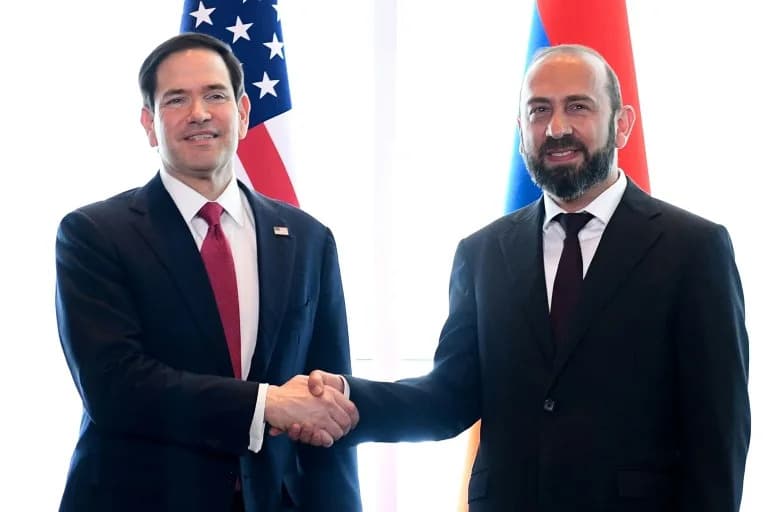
US Secretary of State Marco Rubio (L) met Armenian Foreign Minister Ararat Mirzoyan (R) (KAREN MINASYAN)(KAREN MINASYAN/AFP/AFP)
The United States and Armenia took a concrete step toward the proposed TRIPP corridor during a brief refuelling stop in Yerevan by Secretary of State Marco Rubio. The move advances plans for a road-and-rail link through Armenian territory that would connect mainland Azerbaijan with its Nakhchivan exclave.
Rubio, returning from a four-day trip to India, met Armenian Foreign Minister Ararat Mirzoyan at Yerevan airport and initialled a new document tied to the Trump Route for International Peace and Prosperity (TRIPP). The document, not released publicly, details a joint-venture structure and commissions an engineering survey, the State Department said.
What the Agreement Covers
The TRIPP initiative, promoted under the administration of former President Donald Trump, envisions a combined road-and-rail corridor running through Armenia to link Azerbaijan and its separated Nakhchivan exclave. An earlier State Department framework proposed that Armenia grant the United States a 74 percent stake in a "TRIPP Development Company," with explicit assurances that U.S. firms would benefit from the project.
"This agreement marks the biggest step to date on making this historic route a reality, on advancing peace, and on increasing prosperity in Armenia and frankly in the region," Rubio said at the signing ceremony.
Geopolitical Balancing
Armenia, historically aligned with Russia, has moved to recalibrate its foreign policy after Moscow did not prevent Azerbaijan's rapid 2023 offensive that retook Nagorno-Karabakh. Prime Minister Nikol Pashinyan's government has frozen Armenia's membership in the Russia-led Collective Security Treaty Organization (CSTO) and has signalled interest in pursuing closer ties with the European Union.
At the same time, Yerevan has sought to reassure neighbouring Iran—long a cordial partner—that any TRIPP corridor would remain under Armenian sovereignty, not under U.S. control. That diplomatic balancing is central to Armenia's approach as it deepens ties with Western partners.
Economic and Strategic Cooperation
Rubio also signed agreements to renew a broad U.S.-Armenia strategic partnership and to cooperate on critical minerals, a priority for Washington as it seeks supply-chain alternatives to Chinese-dominated markets. "We are laying the groundwork for economic engagement that allows Armenians to make money and find prosperity—and Americans to do the same together," Rubio said, adding that U.S. cooperation would respect Armenian sovereignty.
Mirzoyan said he expects the agreements to be implemented on the ground and described them as "truly beneficial for the Republic of Armenia." High-level U.S. visits to Armenia remain uncommon; Vice President J.D. Vance visited the region in February as part of a peace push, though his trip was overshadowed by controversy after he deleted a social media post referring to World War I-era killings of Armenians as "genocide."
The TRIPP step initialled in Yerevan is procedural but significant: it establishes a joint-venture framework and funds an engineering survey—advance work required before construction or formal investment decisions. Observers say the project could reshape regional transport and economic ties if it moves forward, but it will also require careful diplomacy to manage competing interests from Russia, Iran, Turkey and Azerbaijan.
Help us improve.