
SpaceX's V3 Starship completed a largely successful test flight, splashing down in the Indian Ocean after lifting off just after 5:30 p.m. local time. The vehicle reoriented and reignited engines despite one engine failing, and it deployed 22 mock satellites, including two that attempted to image the heat shield. The Super Heavy booster failed its boost‑back burn and fell uncontrolled into the Gulf of Mexico. The flight advances SpaceX's work on a NASA lunar lander even as the company prepares a likely IPO.
Starship V3 Test: Controlled Splashdown, Booster Falls — SpaceX Advances Toward Lunar Goals
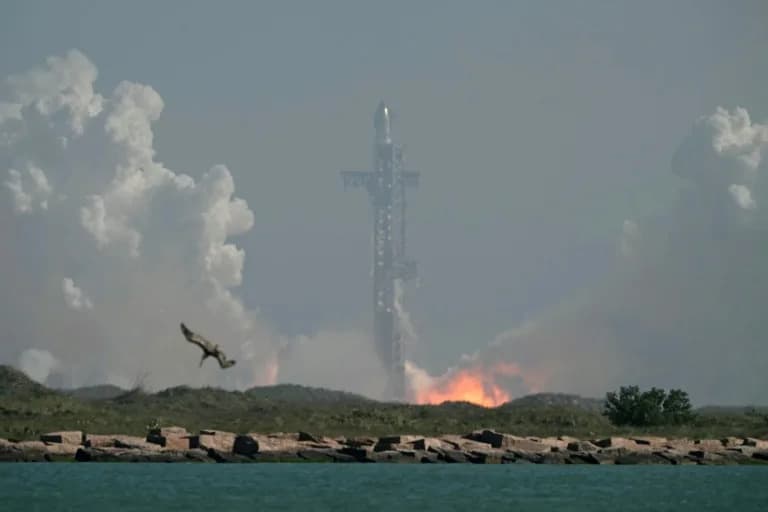
The launch of the mammoth rocket comes as Elon Musk's space company prepares a buzzy initial public offering (RONALDO SCHEMIDT)(RONALDO SCHEMIDT/AFP/AFP)
SpaceX's third‑generation Starship completed a largely successful test flight on Friday, splashing down in the Indian Ocean after lifting off just after 5:30 p.m. local time (2230 GMT). The mission validated key design changes while exposing areas that still need refinement as the company pushes toward both a likely IPO and NASA lunar contracts.
Flight Overview
The vehicle lifted off on schedule and carried out most planned objectives. SpaceX did not intend to recover the Super Heavy booster or the upper stage; the upper stage's final splashdown was fiery but controlled. The company confirmed the outcome on X with the post "Splashdown confirmed!"
What Worked
Reorientation and Engine Restart: The third‑generation Starship flipped upright and successfully reignited its engines to control descent despite one engine being out of service.
Payload Deployment: The spacecraft released 22 mock satellites. Two of those payloads attempted to photograph the vehicle's heat shield for post‑flight analysis, providing useful data for future thermal protection assessments.
What Didn’t Go Exactly to Plan
Orbital Precision: An engine malfunction during an early burn meant the upper stage did not achieve a perfectly precise orbit. Company spokesperson Dan Huot said, "I wouldn't call it nominal orbital insertion," but added it remained "within bounds" of previously modeled trajectories.
Booster Boost‑Back Failure: After separation, the Super Heavy booster failed to complete its boost‑back burn and fell uncontrolled into the Gulf of Mexico. Although SpaceX had not planned to recover the booster, the team had aimed for a precision return.
Context And Reaction
The launch followed an aborted attempt the day before when the countdown was halted repeatedly. SpaceX engineers diagnosed a hydraulic pin on the launch tower that failed to retract; the company reported the issue was fixed overnight.
Elon Musk praised his team on X, calling the flight "epic" and writing, "You scored a goal for humanity." An official who appeared during the pre‑launch program also congratulated the team after the flight, calling it a strong step forward for the vehicle.
Why This Matters
This was Starship's 12th flight overall and its first in seven months. The stacked rocket stands just over 407 feet (124 meters) tall in the latest configuration. SpaceX is under contract with NASA to deliver a modified Starship to serve as a lunar lander for the Artemis program. NASA and industry partners are targeting an in‑orbit rendezvous test in the mid‑2020s, with a crewed lunar landing planned in the latter part of the decade.
Clayton Swope of the Center for Strategic and International Studies said the upgraded vehicle "did most of what SpaceX hoped it would do," but cautioned that "there is a long way to go and many more test flights before Starship is ready" for the next major lunar mission.
Looking Ahead
SpaceX's recent filing to go public has placed additional public and regulatory scrutiny on test outcomes. Engineers will analyze flight data — especially from the heat‑shield imagery and the engine and guidance performance — to refine the design ahead of future test flights that will be critical for both commercial ambitions and NASA’s Artemis timeline.
Help us improve.





















