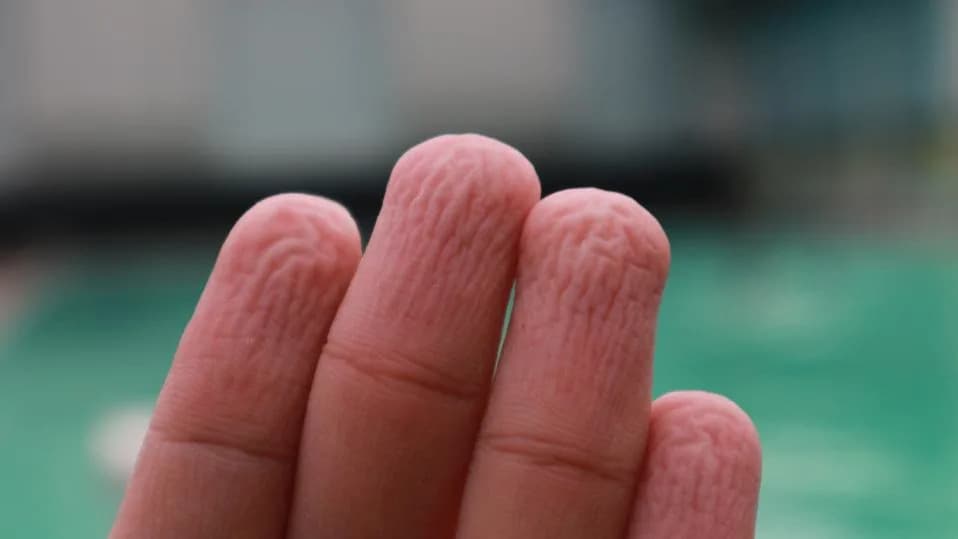
Pruney fingers are an active reflex, not passive swelling. Water entering sweat ducts triggers a sympathetic nervous response that constricts blood vessels, collapsing glabrous skin into the familiar wrinkles. Studies show wrinkling improves handling of wet objects (about 12% faster in one test) and is used clinically to assess peripheral sympathetic nerve function. Repeatable wrinkle patterns may even have forensic or biometric potential.
Why Our Fingers Prune in Water: The Nervous Reflex That Improves Grip (And Why It Matters)
Science dismissed the wrinkly finger as osmosis for a century. The real answer runs through your autonomic nervous system, and much further back.getty
Pruned or "pruney" fingers are not just passive swellings. Decades of folklore said skin simply absorbed water and puffed up, but modern research shows finger wrinkling is an active, neurally controlled reflex with clinical uses and plausible evolutionary benefits.
How Wrinkling Works
When glabrous skin (palms, fingertips and the soles of the feet) is submerged, small amounts of water penetrate sweat ducts and stimulate sensory nerve endings. That signal travels to the autonomic nervous system — specifically the sympathetic branch — which responds by constricting blood vessels beneath the skin. Vasoconstriction reduces subcutaneous volume and the overlying skin collapses inward along lines set by the vascular architecture, producing the familiar channels and ridges we call wrinkles.
Key Observations That Changed the Explanation
Two findings undermined the old passive-osmosis idea. First, 2016 biomechanical modelling showed that passive swelling would require the skin to expand by roughly 20% to create the observed patterns — an expansion that does not occur. Second, clinicians noted as early as the 1930s that patients with severed peripheral nerves do not develop wrinkles when immersed. The absence of wrinkling after nerve damage implicates neural control rather than passive absorption.
Evidence From Experiments
Empirical tests support a functional explanation. A 2013 experiment in Biology Letters found that volunteers with wrinkled fingers moved wet marbles about 12% faster than those with unwrinkled fingers; no advantage appeared for handling dry objects. A follow-up study measuring grip forces found that wrinkled fingers needed no more force than dry fingers to hold wet items, while wet-but-smooth fingers required greater grip effort. These results suggest the wrinkles improve traction and drainage on wet surfaces.
Not every test is unanimous: some studies failed to show benefits for very small, lightweight objects, probably because such items require minimal friction and so reveal little difference. Still, the converging lines of morphological, neurological and behavioral evidence make the adaptive hypothesis compelling, even if it cannot be proven beyond any phylogenetic doubt.
Clinical And Practical Uses
Because wrinkling depends on intact sympathetic innervation, clinicians use a simple diagnostic test: immerse a hand in warm water for about 30 minutes and assess the degree of wrinkling. Poor or absent wrinkling can indicate peripheral sympathetic nerve damage, making the pruney-finger response a noninvasive neurological sign.
Recent 2025 work in the Journal of the Mechanical Behavior of Biomedical Materials added an intriguing note: the wrinkle topography is repeatable because the constricting blood vessels are anatomically fixed. That repeatability raises the possibility of forensic or biometric applications — individual-specific wrinkle patterns that emerge only under wet conditions.
Evolutionary Interpretation
The anatomical specificity (limited to glabrous skin), the environmental trigger (wet surfaces), and measurable performance gains in wet tasks together suggest a plausible adaptive story: wrinkles may have helped hominins manipulate wet food, forage in streambeds, or handle rain-slick surfaces, where a secure grip had real fitness value. While demonstrating a modern function doesn't by itself prove historical selection, the alignment of mechanism, location and benefit is a strong convergent case.
Caveats And Open Questions
Important caveats remain. Improved handling has not been demonstrated across every task or object type, and small/light items may show no measurable advantage. Also, adaptive hypotheses about evolutionary history are inherently provisional. Still, the phenomenon offers a tidy example of how nervous-system control, morphology and behavior can intersect in a functionally meaningful trait.
Takeaway: Finger wrinkling is an active sympathetic reflex that improves handling of wet objects, serves as a simple clinical test for nerve function, and may reflect an adaptive response shaped by our ancestors' wet environments.
Help us improve.