The anglerfish’s iconic glowing lure—long assumed to be only a hunting aid—may also have evolved to help find mates, a new study finds. Researchers examined 118 museum specimens and a large DNA dataset and estimate bioluminescent lures appeared about 34 million years ago. That innovation coincided with rapid diversification of deep‑sea anglerfish, suggesting the light promoted mate recognition, reproductive isolation and speciation.
How Anglerfish Lights Shaped Their Strange Sex Lives — And Sparked a Deep‑Sea Evolutionary Boom
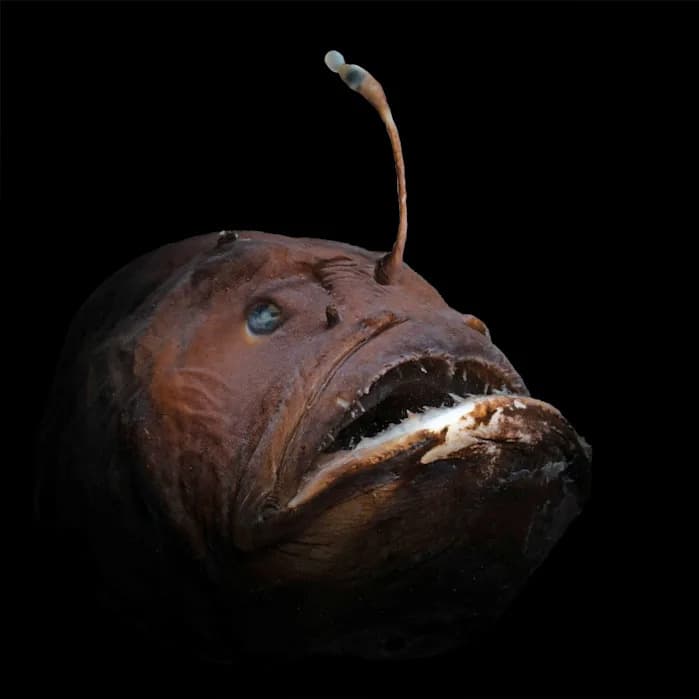
Many anglerfish, like the Diceratias pileatus, have bioluminescent lures that have evolved over time.Alex Maile, University of Washington, Burke Museum of Natural History and Culture
More than 3,000 feet beneath the North Atlantic off Greenland, an odd predator waits in total darkness, dangling a bright blue orb from the tip of its head. That eerie glow draws other animals close until they stray into the anglerfish’s toothy jaws.
Since 1878 scientists have assumed the anglerfish’s bioluminescent lure evolved primarily to catch prey. A new paper in Ichthyology and Herpetology suggests the light did more than lure food: it likely played a key role in mating, communication and the diversification of deep‑sea anglerfishes.
Extreme Reproduction: Males That Never Let Go
Deep‑sea anglerfish are famous for a dramatic reproductive strategy. Tiny males bite onto much larger females and remain attached for life. “They bite on and they’re completely set for life,” says Alex Maile, an ichthyologist at the University of Kansas and lead author of the study.
After attachment, males lose many independent functions—eyesight and immune responses decline—as they fuse anatomically into the female. Their bodies elongate, testes enlarge, and they essentially become permanent sperm‑producing appendages; researchers have recovered females with up to six males attached.
Why the Light Matters
Observing courtship or mate attraction in situ is extraordinarily difficult. “The odds of watching an anglerfish trying to attract a mate in its natural setting are at least bigger than a trillion to one,” Maile says. Studying them requires expensive deep‑sea rovers or trawling; co‑author Matt Davis estimates costs can reach roughly $100,000 a day for ship time and equipment.
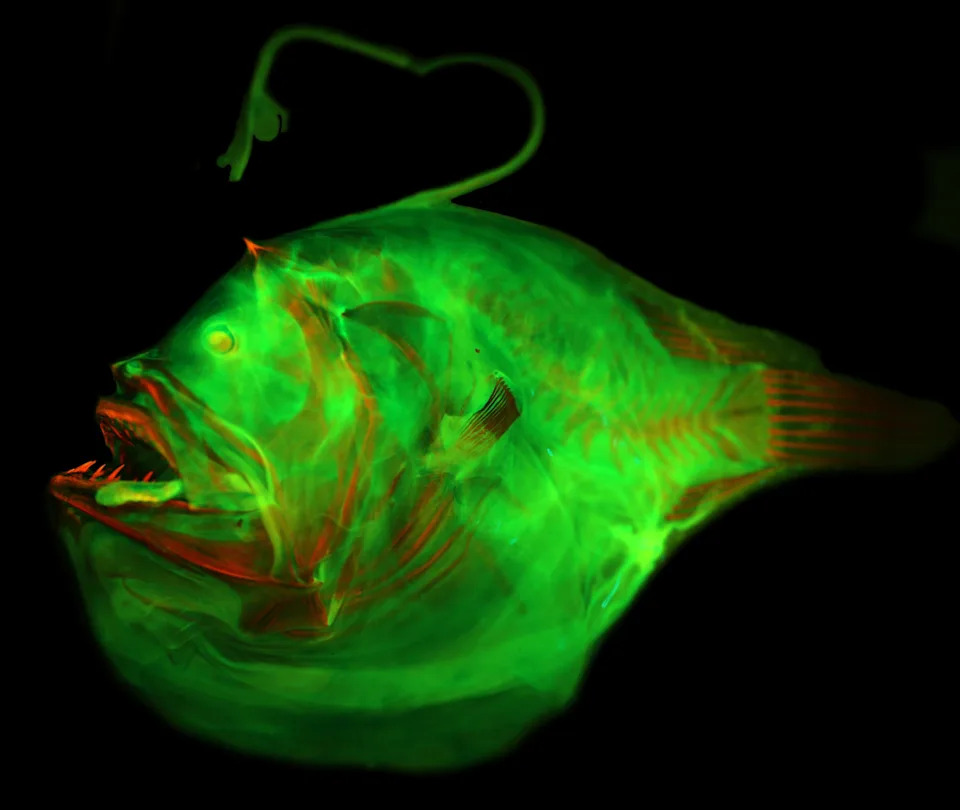
Anglerfish, like this Bufoceratias wedli species from the Field Museum of Natural History, have orbs that are thought to attract both prey and mates.Matthew Davis, Field Museum of Natural History
To probe the lure’s evolutionary history, Maile and Davis examined 118 museum specimens and analyzed a broad DNA dataset spanning shallow and deep anglerfish lineages. Their results indicate the appearance of bioluminescent lures—about 34 million years ago—coincided with a major diversification of anglerfishes in deep water, suggesting the light became important for sexual communication and species formation.
From Mechanical Wiggling to Glowing Orbs
Anglerfish originated roughly 72 million years ago in shallow water and later colonized the deep ocean. Early species used simple mechanical lures that moved or mimicked prey. Some evolved chemical lures that released attractant compounds. The most recent innovation was a bioluminescent orb: a glowing bulb that collects bioluminescent bacteria, can be shuttered by a skin flap, and produces visual signals in the dark.
“This kind of work shows there’s far more complexity in the lure’s evolution than would be necessary just to catch prey,” says Tracey Sutton, a marine biologist at Nova Southeastern University who was not involved with the study.
Evolutionary Consequences
The study’s analyses suggest that when anglerfish evolved glowing lures and occupied deep‑sea habitats, they underwent rapid speciation. The lures likely acted like lighthouses—enabling mate recognition and communication, creating reproductive isolation between populations, and ultimately fueling the formation of new species. Deep‑sea, bioluminescent clades appear more diverse and to have evolved faster than shallow‑water relatives with mechanical or chemical lures.
What We Still Don’t Know
Despite these advances, many questions remain. How exactly do mating signals vary between species? Which visual or chemical cues do males use to locate females? Better in situ observations and targeted genetic sampling will be needed to answer these questions, but the new study provides a major step forward by linking lure evolution to reproductive behavior and biodiversity in the deep sea.
Why it matters: The research reframes the anglerfish lure not only as an effective hunting tool but also as a key communication signal that reshaped the evolutionary trajectory of one of the ocean’s most bizarre predators.
Help us improve.