
The COSMOS‑Web survey, the largest JWST program so far, has produced the most detailed map of the cosmic web to date, tracing galaxy filaments back to when the universe was about 1 billion years old. JWST’s improved sensitivity and infrared coverage reveal faint galaxies and resolve structures that appeared smoothed in previous Hubble data. By placing galaxies into more precise slices of cosmic time, COSMOS‑Web sharpens our view of how clusters and filaments formed and evolved. The results were published May 6 in The Astrophysical Journal.
JWST’s COSMOS‑Web Reveals the Cosmic Web in Unprecedented Detail
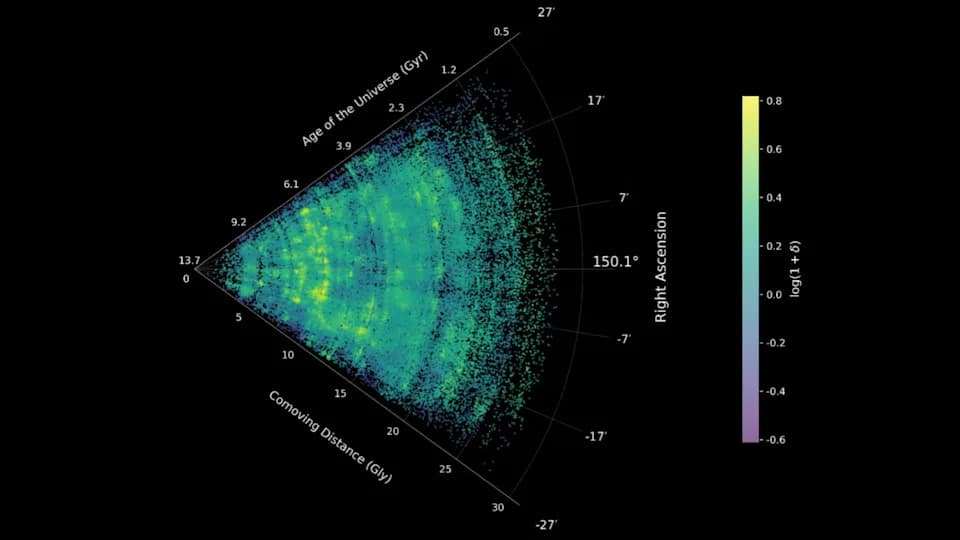
A slice through the COSMOS-Web cosmic-web map, showing galaxies across nearly 14 billion years of cosmic history. The vertex on the left marks the present day; moving outward, each galaxy is placed at its distance in cosmic time, reaching back to when the universe was less than a billion years old. Bright yellow regions show the dense clusters and filaments of the cosmic web, while dark regions mark the near-empty voids in between. | Credit: UCR/Hossein Hatamni
Using the James Webb Space Telescope (JWST), astronomers have produced the most detailed map yet of the universe’s largest structure: the cosmic web. The COSMOS‑Web survey — the largest JWST observing program to date — traces a vast network of galaxies back to when the universe was roughly 1 billion years old.
What Is the Cosmic Web?
The "cosmic web" describes the universe’s large-scale architecture: an intricate lattice of filaments and sheets made of dark matter and gas, along which galaxies and clusters formed and evolved. These filaments are separated by enormous, nearly empty voids, producing a pattern that shapes the distribution and growth of galaxies over cosmic time.
Why COSMOS‑Web Matters
COSMOS‑Web leverages JWST’s sensitivity and infrared capabilities to detect many more faint, distant galaxies in the same patch of sky and to estimate their distances far more precisely. That combination lets astronomers place galaxies into narrower slices of cosmic time, sharpening the three-dimensional map and revealing structures that earlier surveys smoothed over.
"JWST has completely changed our view of the universe, and COSMOS‑Web was designed from the start to give us the wide, deep view we need to see the cosmic web," said project lead Hossein Hatamnia of the University of California, Riverside (UCR). "For the first time, we can study the evolution of galaxies in cluster and filamentary structures across cosmic time, from when the universe was about a billion years old to the nearby universe."
UCR scientist Bahram Mobasher, a member of the COSMOS‑Web team, added that features that appeared as single, smooth structures in Hubble data now resolve into multiple, distinct components with JWST’s greater depth and resolution. "What used to look like a single structure now resolves into many, and details that were smoothed away before are now clearly visible," he said.
Putting Distances in Context
By "nearby universe," the team refers to distances on the order of ~1 billion light‑years. For context, the Solar System’s distant Oort Cloud may extend out to roughly a light‑year or more at its outermost reaches; COSMOS‑Web, by contrast, maps galaxies as they appeared roughly 13 billion years ago (when the universe was about 1 billion years old), giving astronomers an exceptionally deep view into cosmic history.
The COSMOS‑Web findings were published on May 6 in The Astrophysical Journal, and they underscore JWST’s ability to refine and redefine our picture of structure formation in the universe since the telescope began returning science data in 2022.
What Comes Next
With COSMOS‑Web and other JWST surveys, researchers will continue to study how environment — whether a galaxy sits in a dense cluster or along a tenuous filament — affects galaxy growth, star formation, and the assembly of massive structures over billions of years.
Help us improve.





















