The Supreme Court unanimously ruled that a man injured in a 2017 truck crash may sue C.H. Robinson, the freight broker that arranged the load, finding a federal safety exception allows his negligent-hiring claim to proceed. The decision follows a CBS News investigation revealing at least 10,000 "chameleon carriers" since 2021 that often evade oversight and are linked to disproportionately severe crashes. CBS found these reincarnated carriers are about four times more likely to be involved in serious crashes, with at least 141 deaths and roughly 1,800 injuries over five years.
Supreme Court Allows Man To Sue Freight Broker After Devastating Truck Crash
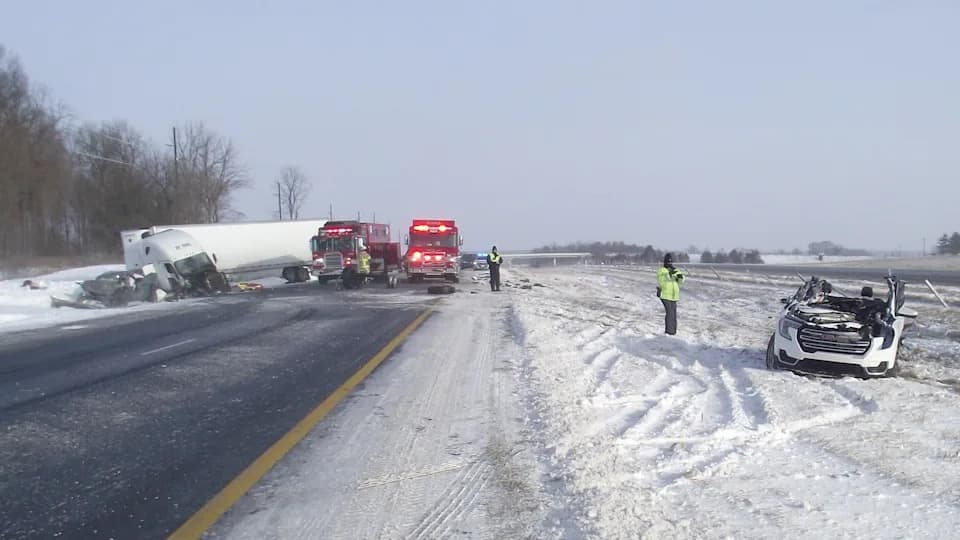
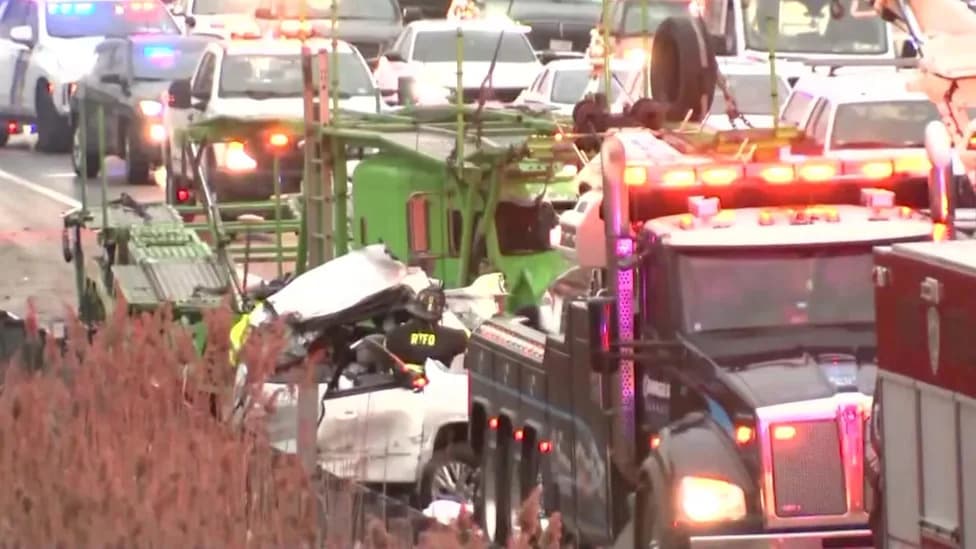
The aftermath of a deadly 2022 Christmas Eve crash on I-75 in Ohio where a semi-truck (left) crossed the median and slammed into an SUV and a pickup. / Credit: Ohio State Highway Patrol
The Supreme Court on Thursday unanimously ruled that a man injured when a tractor-trailer struck his parked car may proceed with a lawsuit against the freight broker that arranged the load — a decision hailed by highway-safety advocates pressing for greater accountability in the freight industry.
In 2017, Shawn Montgomery lost part of his leg after a speeding truck collided with his parked vehicle in Illinois. Montgomery sued C.H. Robinson, the nation’s largest freight broker, alleging the company negligently hired or retained a carrier with a troubling safety record.
The trucking industry and other interests had urged the Court to block such state-law claims, arguing that exposing brokers to negligence suits would create unfair and burdensome legal exposure and that federal regulators — not private companies — are primarily responsible for carrier safety oversight.
Court Finds Safety Exception Applies
Justice Amy Coney Barrett wrote for the unanimous Court that the federal transportation-law exemptions relied on by C.H. Robinson do not bar state-law claims that concern motor-vehicle safety. "Requiring C.H. Robinson to exercise ordinary care in selecting a carrier therefore concerns motor vehicles — most obviously, the trucks that will transport the goods. So Montgomery's negligent-hiring claim falls within the (law)'s safety exception," she wrote, allowing the lawsuit to proceed.
Investigation Highlights Industry Risks
A recent CBS News investigation detailed how a surge in demand for overland shipping — driven in part by increased online shopping — has strained the U.S. trucking system and helped create opportunities for risky operators to evade oversight by reincarnating under new names. CBS's analysis of Department of Transportation records identified at least 10,000 reconstituted "chameleon carriers" approved since 2021. These carriers frequently reuse officers, facilities, or equipment from companies that regulators previously flagged for safety problems.
"These reconstituted carriers are far more likely to be involved in severe crashes," the CBS analysis concluded.
The investigation found that such carriers are about four times more likely to be involved in severe crashes than non-reconstituted firms. Over the last five years, crashes involving these operators were linked to at least 141 deaths and roughly 1,800 injuries. CBS also found more than 30,000 carriers listing fake or undeliverable registration addresses, examples including entries such as "NOMORE, GONE, GA." During the same period, the number of trucking firms grew roughly 31% since 2015 while the Federal Motor Carrier Safety Administration's (FMCSA) workforce decreased by about 10%.
Allegations And Company Response
The CBS report highlighted deadly incidents tied to reincarnated carriers, including a 2022 Christmas Eve crash in Ohio that killed four members of one family. That truck was operated by BLF Truck Transportation, a company that had previously used three other names each flagged for safety concerns.
In a deposition obtained by CBS, BLF operator Alexander Delgado testified that a C.H. Robinson representative told him to "open up another" carrier after his prior company faced a shutdown for safety violations. C.H. Robinson has disputed the account, saying BLF "deceived C.H. Robinson by double brokering a load, which is a violation of federal law and our carrier agreements," and questioned Delgado's credibility.
Michael Leizerman, the attorney representing Montgomery and other crash victims, said the ruling could pressure major brokers to screen carriers more carefully. "They don't end up behind the wheel of an 80,000-pound vehicle unless someone hires them to do so," he said. "And many times that's the large brokers like C.H. Robinson."
C.H. Robinson's chief legal officer, Dorothy Capers, said the company was disappointed in the decision and reiterated the firm's commitment to safety. She said C.H. Robinson will continue to support stronger federal enforcement and work with regulators, carriers, and customers to strengthen the national safety system.
The Supreme Court decision clears the way for Montgomery's negligence claim to move forward in state court and could open the door to similar suits against brokers that select or oversee carriers with problematic safety histories.
Help us improve.