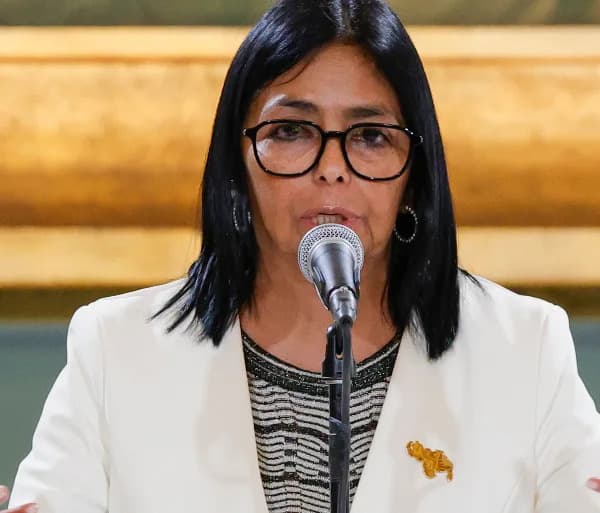
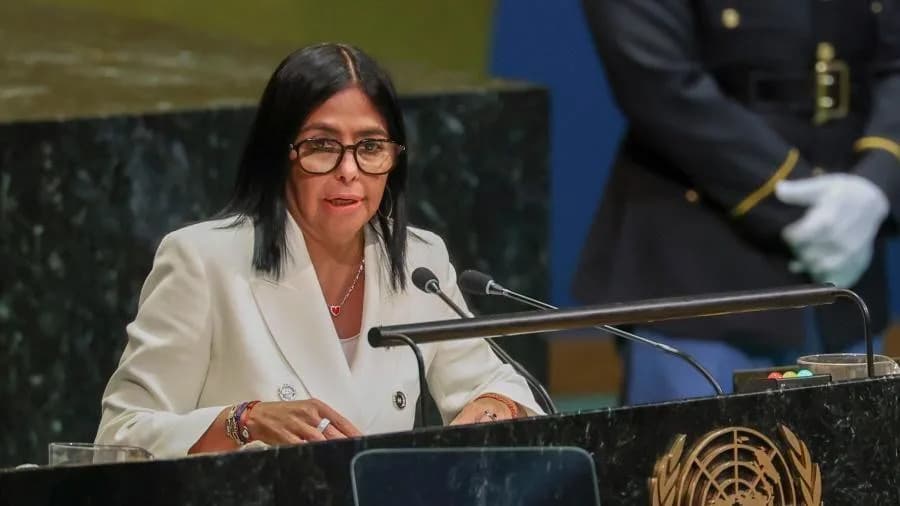
President Donald Trump twice suggested this week that Venezuela could become the United States' 51st state, posting a map of the country filled with the U.S. flag. Acting President Delcy Rodríguez issued a measured denial, reflecting a cautious approach as her government navigates U.S. pressure after a January military operation and Nicolás Maduro's capture. Analysts say Rodríguez’s muted response signals a pragmatic, survival-driven pivot by Chavismo amid eased U.S. sanctions and Washington's recognition of her as Venezuela's head of state. Public reaction in Caracas is mixed, with some decrying submission and others accepting tactical restraint.
Trump Suggests Venezuela Could Be the 51st State; Caracas Responds With Measured Silence
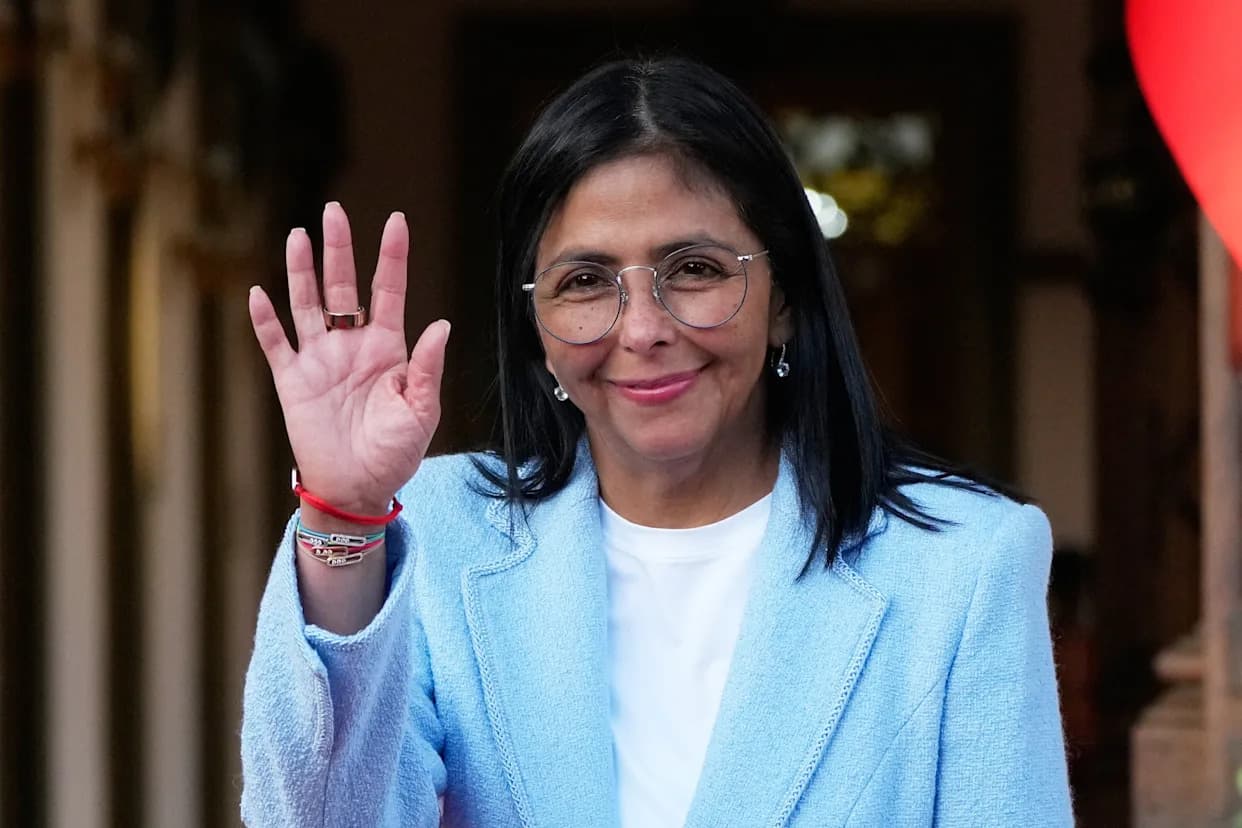
FILE - Venezuela's acting President Delcy Rodriguez waves after bidding farewell to U.S. Energy Secretary Chris Wright following their meeting at Miraflores Palace in Caracas, Venezuela, Feb. 11, 2026. (AP Photo/Ariana Cubillos, File)(ASSOCIATED PRESS)
Twice this week, U.S. President Donald Trump publicly floated the idea of making Venezuela the United States' 51st state, including a Truth Social post that showed a map of Venezuela overlaid with the American flag. The remarks prompted only a muted response from Caracas, where acting President Delcy Rodríguez issued a brief, measured denial.
Past challenges to Venezuela's sovereignty typically drew swift denunciations from senior officials and large pro-government demonstrations. After the Jan. 3 capture of Nicolás Maduro, crowds in Caracas burned U.S. flags and chanted "Gringo go home." This time, however, the response from the ruling movement, Chavismo, has been far more restrained.
Pragmatism Over Provocation
Rodríguez told reporters Monday that Venezuela had no plans to become a U.S. state, emphasizing, "We will continue to defend our integrity, our sovereignty, our independence, our history." She added that Venezuela is "not a colony, but a free country." Still, her tone was notably measured compared with the heated rhetoric of previous years.
"This is probably the most public and sharp manifestation of the government’s transactional, self-survival approach above everything else right now," said Christopher Sabatini, senior fellow for Latin America at Chatham House in London. "It’s better that they hold their tongue, not offend the U.S. right now. Why overreact to a ridiculous claim by Donald Trump?"
Analysts say the muted reaction reflects the tightrope Rodríguez must walk after the January U.S. military operation in Caracas. The Trump administration has rolled out a phased plan aimed at stabilizing the crisis-wracked country and has pressured Rodríguez’s faction to soften long-standing anti-U.S. rhetoric.
Shifts In Leadership And Policy
Following Maduro's ouster, the U.S. surprised many Venezuelans by choosing to work with Rodríguez rather than the traditional political opposition. Rodríguez has cooperated with Washington’s phased plan, promoted Venezuela—an oil-rich nation—to international investors, and opened parts of the energy sector to private investment and international arbitration. She has also replaced senior officials, including Maduro’s longtime defense minister and the attorney general.
The Trump administration has praised Rodríguez’s actions, lifted personal sanctions against her, eased some measures on the country, and now recognizes her as Venezuela’s sole head of state. Some sanctions remain in place.
Maduro’s Arrest And Public Reaction
After their Jan. 3 capture, Nicolás Maduro and his wife, Cilia Flores, were transported to New York to face drug-trafficking charges. Both have pleaded not guilty and remain jailed in a Brooklyn detention center.
In Caracas, reactions to the government’s restrained response ranged from accusations of capitulation to pragmatic acceptance. "She knows that it’s wise not to engage in direct confrontation because she knows she’s bound to lose," said college student Adonai Osoria. "Now, are there some who disagree, who don’t like it? Well, yes, of course. But I consider her reaction right now to be a common, understandable reaction."
Pro-government grassroots groups known as colectivos remain influential at demonstrations. Local leader Jorge Navas called Trump’s comments "irresponsible acts of provocation" but praised Rodríguez’s diplomatic restraint. "We are bending, strategically, but we will not break," Navas said. "We continue to resist, that is, realistically, given the country’s economic situation."
Reporting contributed by Garcia Cano in Mexico City.
Follow AP’s coverage of Latin America and the Caribbean at https://apnews.com/hub/latin-america
Help us improve.