Astronomers have identified 20 very metal-poor stars orbiting unusually close to the Milky Way's disk that may be remnants of an ancient dwarf galaxy nicknamed Loki. Chemical abundances from CFHT spectroscopy combined with Gaia kinematics and simulations suggest this galaxy merged with the Milky Way more than 10 billion years ago. The inferred mass of Loki is ~1.4 billion solar masses, but the sample is small and further high-resolution observations are needed to confirm the finding.
Astronomers Find Fossil Stars From an Ancient Galaxy — 'Loki' May Have Been Swallowed by the Milky Way
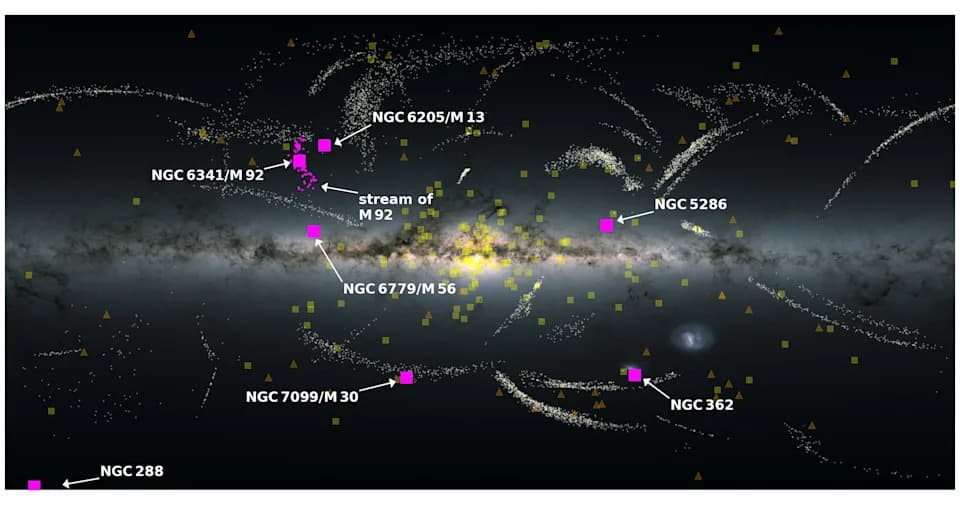
The Milky Way is suspected to have merged with up to a dozen or more dwarf galaxies over its 12-billion-year history. This Gaia telescope map shows the locations of star clusters from suspected mergers in purple. | Credit: ESA/Gaia/DPAC
Astronomers have identified a group of unusual stars in the inner Milky Way that may be the leftover "bones" of a dwarf galaxy the Milky Way devoured early in its history. The candidate progenitor, nicknamed Loki, could have merged with our Galaxy more than 10 billion years ago.
What the Team Did
The research team selected 20 very metal-poor stars from an existing catalog and observed each target with a high-resolution spectrograph at the Canada–France–Hawaii Telescope (CFHT). Spectra reveal the stars' chemical abundance patterns, while precise positions and motions from the Gaia spacecraft allowed the team to compute distances and orbital paths.
Why These Stars Stand Out
These stars orbit unusually close to the Milky Way's disk — within roughly 6,500 light-years of the Sun — yet they are old and extremely metal-poor. That combination is unexpected because disk stars are typically younger and metal-rich. The chemical similarities across the sample and their clustered abundances hint that they may share a common origin rather than being random halo interlopers.
Prograde and Retrograde Orbits — A Puzzle Solved by Simulations
The sample includes stars moving both with and against the Milky Way's rotation (prograde and retrograde). At first glance, that might suggest multiple progenitors, but cosmological simulations show an explanation: if the merger occurred very early — when the Milky Way was still light and had not yet developed a settled rotating disk — an infalling dwarf could scatter its stars into a wide variety of orbits. The authors place such an accretion roughly 3 billion years after the Big Bang, which corresponds to an event more than 10 billion years ago.
Estimated Properties of 'Loki'
Matching the observed orbital and chemical patterns with simulations, the team estimates the infalling galaxy had a total mass on the order of ~1.4 billion solar masses. The nickname "Loki" — after the Norse trickster god — reflects how these stars complicated straightforward interpretation.
Limits and Next Steps
The authors caution that the current sample is small. High-resolution spectroscopy is time-intensive (about four hours per star on CFHT), so confirming Loki's status requires observing many more stars with consistent instrumentation and methods. Future wide-field spectroscopic surveys and next-generation instruments will allow astronomers to collect both high-quality chemistry and precise kinematics for hundreds of inner-Galaxy metal-poor stars.
Lead author Federico Sestito (University of Hertfordshire) told Live Science that investigating these stars could be "very important" for reconstructing the Milky Way's early assembly and that Loki could be among "the very first small galaxies formed in the young universe."
Independent experts regard the findings as promising but provisional: larger samples and consistent follow-up observations will be needed to confirm whether these stars truly are the fossil remains of a single ancient dwarf galaxy or a rare Milky Way subpopulation.
Reference: Study published March 23 in Monthly Notices of the Royal Astronomical Society. Observations used the Canada–France–Hawaii Telescope and Gaia astrometry.
Help us improve.