
The CIGaRS framework combines AI-driven, image-based inference with large-scale simulations to improve Type Ia supernova distance estimates by modeling progenitor age, metallicity, host galaxies, dust and selection effects simultaneously. Designed to handle tens of thousands of events, it is tailored for the Vera C. Rubin Observatory's LSST data stream. The approach aims to reduce systematic biases in measurements of cosmic expansion and refine constraints on dark energy.
AI, 'Cannibal' Stars and the Rubin Observatory: A New Way to Measure Dark Energy
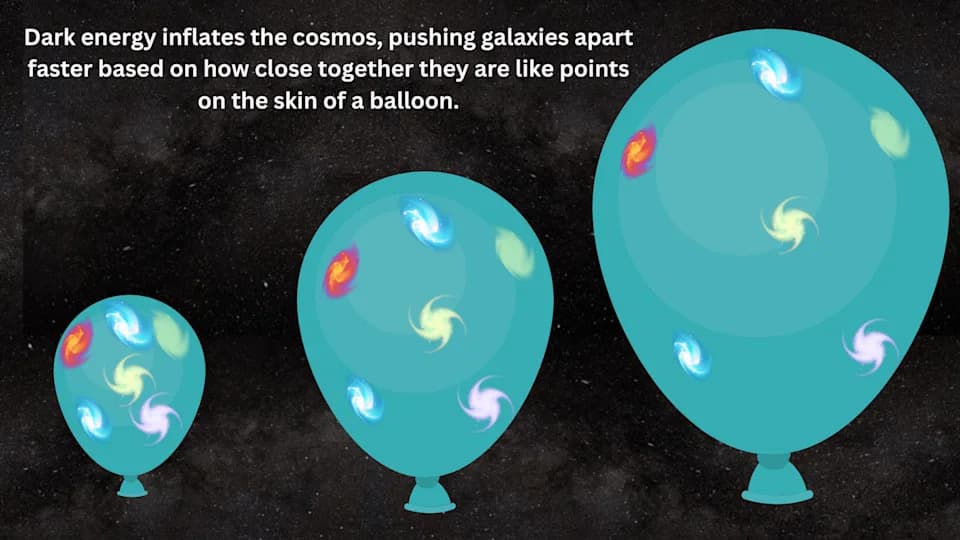
The expansion of the universe due to dark energy with galaxies expanding like points on the skin of an inflating balloon. | Credit: Robert Lea (created with Canva)
Scientists are combining artificial intelligence, large-scale simulations and upcoming observations from the Vera C. Rubin Observatory to sharpen one of cosmology's key tools: Type Ia supernovae, the so-called "standard candles" used to measure cosmic distances and map the universe's accelerating expansion.
Type Ia supernovae occur when a white dwarf in a binary system accretes matter from a companion star or merges with another white dwarf, triggering a runaway thermonuclear explosion. Because many Type Ia explosions have similar intrinsic brightness, astronomers have used them to infer distances across cosmic scales — a method that led to the discovery of dark energy in 1998.
Why Standard Candles Are Not Perfectly Standard
Over the past two decades researchers have found subtle but important variations in Type Ia brightness that correlate with their host-galaxy properties. Explosions in massive, older galaxies differ slightly from those in younger, lower-mass systems. Those environmental trends, plus dust extinction and selection effects, limit the precision of distance estimates and can bias cosmological inferences if not modeled properly.
The CIGaRS Approach
The new Combined Inference and Galaxy-Related Standardization (CIGaRS) framework addresses these limitations by merging image-based inference, population modeling and end-to-end simulations. Rather than relying primarily on spectroscopic measurements, CIGaRS uses imaging plus simulation-driven, statistical inference to estimate progenitor properties (such as age and metallicity, the abundance of elements heavier than helium), host-galaxy characteristics, dust effects, supernova rates over time and cosmological parameters simultaneously.
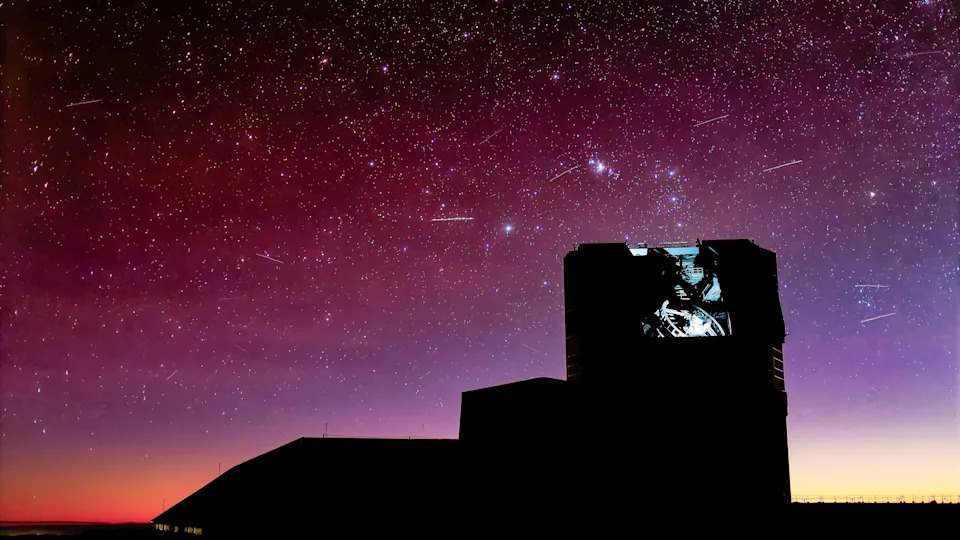
The Rubin Observatory looks out on the cosmos and a wealth of Type 1a supernovas. | Credit: NSF–DOE Vera C. Rubin Observatory/NOIRLab/SLAC/AURA/W. O'Mullane
"A powerful way of modeling the universe is to simulate it in the computer," said Raúl Jiménez of the University of Barcelona. "This provides a way to vary all possible parameters at the same time to predict what universe we live in. ... The impact of these systematics in our inference is arguably the most important missing ingredient in current approaches to model the universe."
By tying the astrophysics of progenitors and hosts into a single self-consistent statistical model, the team can control selection biases and quantify previously hidden systematic uncertainties. Their simulations are designed to run at the scale of tens of thousands of supernovae — a crucial capability for the Rubin Observatory's Legacy Survey of Space and Time (LSST), which will deliver an unprecedented transient dataset.
Implications for Dark Energy
Improved distance estimates from image-based, simulation-led inference will tighten constraints on how the expansion of the universe has changed over time, and therefore on dark energy — the unknown agent responsible for the accelerating expansion that now makes up roughly 68% of the universe's energy budget and began to dominate cosmic dynamics about 4 billion years ago.
"Unlike other frameworks, which require analytic simplifications, our no-compromise end-to-end simulation-based inference approach is uniquely capable of extracting the full cosmological and astrophysical information from the Rubin Observatory's hard-earned data," said team leader Konstantin Karchev of the University of Barcelona.
The team's work was published in Nature Astronomy on May 6.
What’s next: Applying CIGaRS to Rubin/LSST imaging will test the framework on realistic survey data, quantify residual systematics, and help ensure that Type Ia supernovae deliver unbiased, high-precision distances for cosmology in the coming decade.
Help us improve.





















