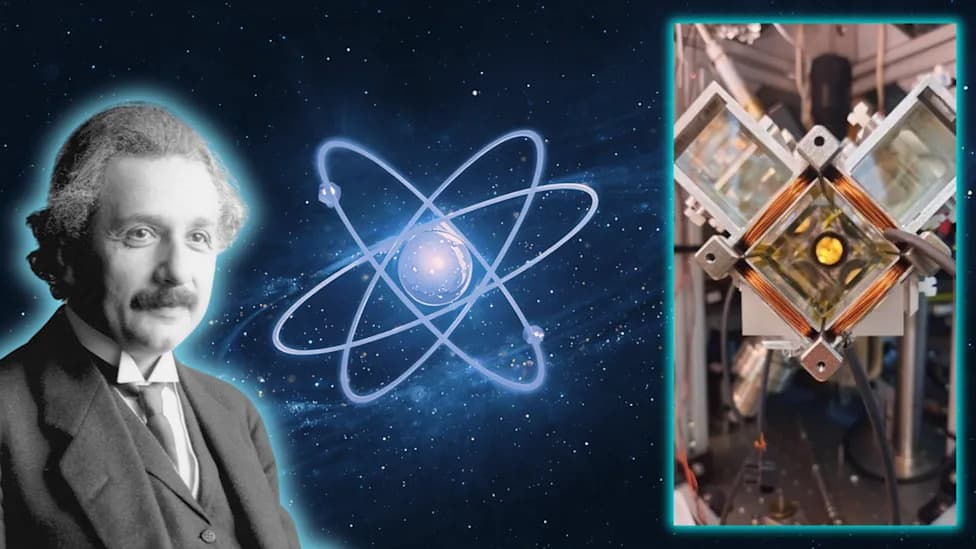
Researchers at Adolfo Ibáñez University and Columbia University reformulated parts of Einstein’s field equations into a Maxwell-like form and used plasma physics techniques to show that, under an ideal Ohm-type condition, some gravitational structures become "frozen into" spacetime evolution. They identify a conserved gravitational magnetic flux and a new topological invariant, gravitational helicity, which quantifies twist and linkage of field lines. Although the results are theoretical and depend on idealized assumptions, the framework could provide a useful, topological lens for interpreting numerical relativity and extreme astrophysical events.
Physicists Recast Einstein’s Equations to Reveal Preserved Topological Structures in Spacetime
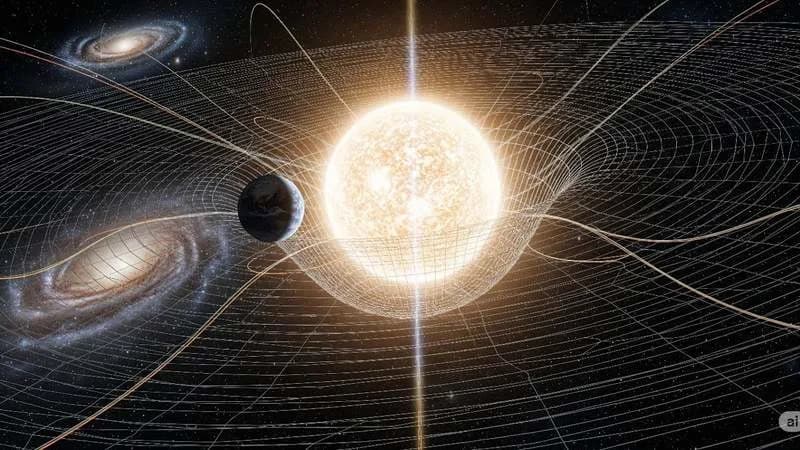
New physics research suggests spacetime may preserve some gravitational structures as it evolves. (CREDIT: Wikimedia / CC BY-SA 4.0)
Spacetime is often described as the four-dimensional arena in which the universe unfolds: a fabric of space and time that bends, stretches and shifts as matter and energy move. More than a century after Einstein formulated general relativity, however, physicists still face challenges describing how that arena evolves in regimes where gravity is intensely nonlinear and unpredictable.
A new theoretical study from researchers at Adolfo Ibáñez University (Chile) and Columbia University, published in Physical Review Letters, offers a fresh perspective. By rewriting Einstein’s field equations in a Maxwell-like form and borrowing analytical tools from electrodynamics and plasma physics, the authors show that certain geometric structures of spacetime can behave like features embedded in an electrically conducting fluid. Under an idealized condition analogous to Ohm’s law, some of these structures remain "frozen into" the dynamics rather than rearranging arbitrarily.
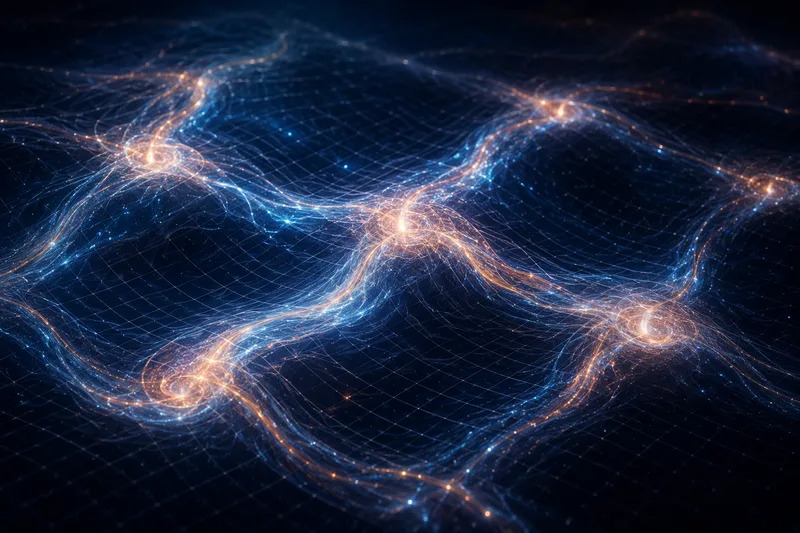
Instead of treating spacetime only as geometry, researchers found that some of its structures may behave more like features in an electrically conducting fluid. In this view, these structures stay connected as spacetime changes. (CREDIT: AI-generated image / The Brighter Side of News)
From Electrodynamics to Gravity
The team recast parts of the Einstein equations into a form that resembles nonlinear electrodynamics and magnetohydrodynamics (MHD) — the physics of electrically conducting fluids such as plasmas. This framing enabled the authors to ask a targeted question: if magnetic field lines in an ideal MHD plasma remain connected under an Ohm-type condition, can analogous gravitational field lines or surfaces remain connected as spacetime evolves?
“We have carried out several studies together focusing on relativistic plasma dynamics,” said co-author Felipe A. Asenjo. “Using a general mathematical framework, we analyzed the preservation of topological structure — including aspects related to the curved spacetime metric itself.”
Key Theoretical Findings
Within their idealized framework the authors identify several notable conserved or preserved quantities:
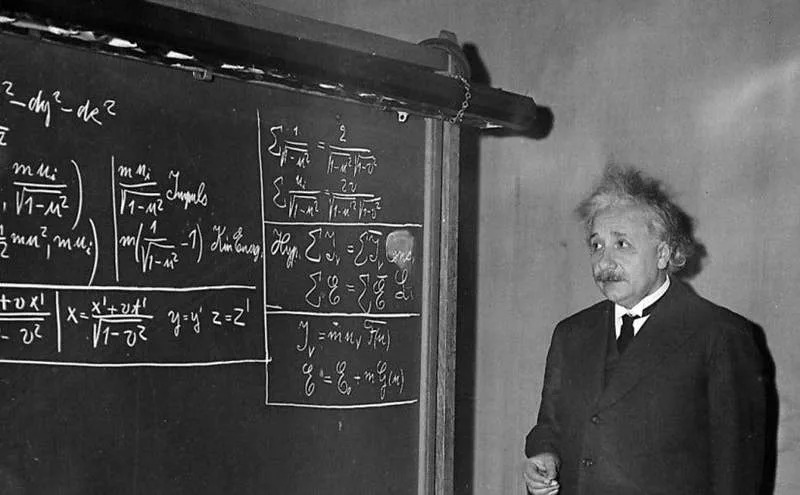
The team rewrote Einstein’s standard equations of general relativity into a form that resembles equations used in nonlinear electrodynamics and magnetohydrodynamics. (CREDIT: Wikimedia / CC BY-SA 4.0)
- Frozen-In Gravitational Structures: Certain two-dimensional gravitational surfaces and associated field lines can remain connected and co-move with the spacetime flow under an ideal Ohm-type condition.
- Gravitational Magnetic Flux: A conserved flux quantity analogous to magnetic flux in MHD — the amount of a "gravitational magnetic" field threading a comoving surface — remains constant in the ideal limit.
- Gravitational Helicity: A topological invariant that measures twist, writhe and linkage of gravitational field lines is shown to be conserved under the same ideal conditions, providing a geometric interpretation of an otherwise abstract invariant.
“We can use the same procedure used to demonstrate that magnetic field lines remain connected in a plasma when Ohm’s law holds, to look for the analog behavior for gravitational field structures,” Asenjo explained. “We show that analogous gravitational field structures also remain frozen into the dynamics when an ideal Ohm-type condition is fulfilled.”
Scope, Caveats and Relevance
The authors emphasize important limitations. The results rely on an ideal Ohm-type condition built into the formalism; the tetrad-projected Einstein tensor does not obey a strict frozen-in law in full generality. In more realistic or dissipative settings, the preserved topological features may break down, and the authors do not claim that all gravitational evolution in nature will preserve these structures.
Nevertheless, the framework is conceptually useful. It provides a complementary language to numerical relativity, emphasizing conserved connections, flux and helicity rather than geometry alone. That perspective could help theorists identify robust features in highly dynamical processes — such as black hole mergers, neutron-star collisions, core-collapse supernovae and other phenomena driven by nonlinear curvature dynamics — and it may point to regimes where topological constraints fail, potentially revealing new physics.
Outlook
This work extends a lineage of approaches that visualize gravity with electric- and magnetic-like fields (for example, tendex and vortex line tools) and places new emphasis on topological invariants. As a theoretical framework, it invites follow-up studies to explore when and how these conserved quantities survive beyond idealized assumptions and whether they can aid interpretation of complex simulations or suggest observational signatures in gravitational-wave data.
Publication: The findings are available in Physical Review Letters. The authors acknowledge inspiration from discussions within the gravitational-physics community, including ideas shared during a talk by Kip Thorne.
Help us improve.