
The James Webb Space Telescope found hundreds of compact, red-shifted objects called "little red dots" (LRDs) in the early universe. A source identified in archival Chandra X-ray data, 3DHST-AEGIS-12014 (the X-ray dot), emits X-rays likely through channels carved in a dense gas cocoon, linking it to LRDs. This supports the idea that many LRDs are young, rapidly accreting supermassive black holes shrouded in gas, a phase that could explain fast early black-hole growth. Follow-up observations and wide-area surveys like the Nancy Grace Roman Space Telescope will search for rare analogues and test this picture.
X-Ray–Bright Black Hole May Explain James Webb's Mysterious 'Little Red Dots'
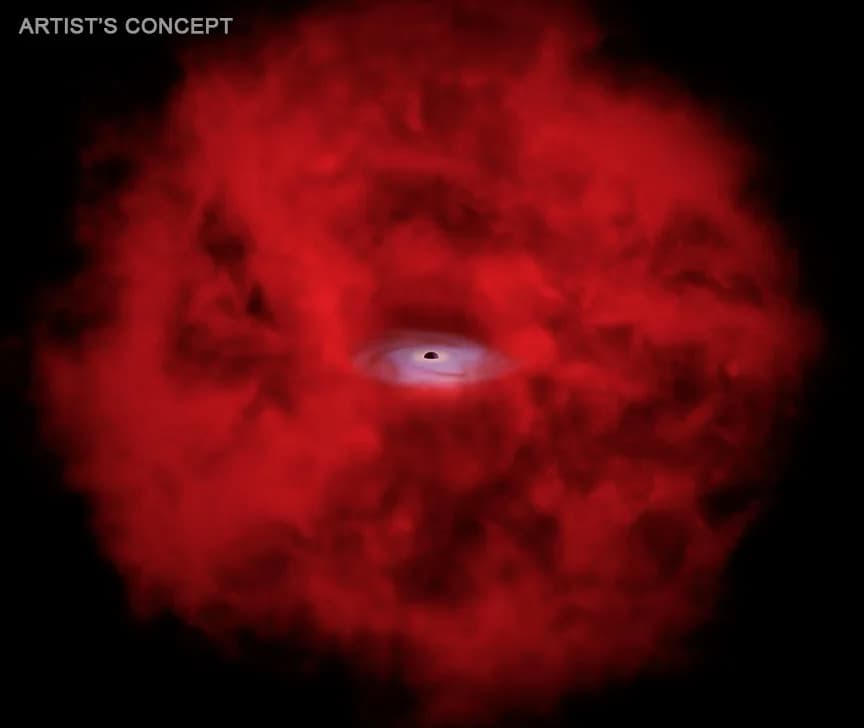
An illustration depicting a close-up view of the "X-ray dot." | Credit: NASA/CXC/SAO/M. Weiss; adapted by K. Arcand & J. Major
A black hole that emits X-rays could be the missing piece in understanding so-called “little red dots” (LRDs) — a puzzling class of compact, red-shifted sources seen by the James Webb Space Telescope (JWST) in the very early universe roughly 12 billion light-years away.
Archival X-Rays Meet Webb’s Deep Imaging
In a paper published March 16 in The Astrophysical Journal Letters, researchers spotlight an object cataloged as 3DHST-AEGIS-12014, nicknamed the X-ray dot (XRD). The XRD was present in archival data from NASA’s Chandra X-ray Observatory collected more than a decade ago but only became compelling after JWST imaged the same field. That combination of legacy X-ray data and new infrared imaging offers fresh context for the nature of LRDs.
“It is always wonderful to see archival data aid in solving mysteries that were completely unknown when the data were first taken,” said Anthony Taylor, an astrophysicist at the University of Texas at Austin, highlighting the value of long-term legacy observations.
Why the X-Rays Matter
Most LRDs identified by JWST have not shown detectable X-ray emission, which is puzzling because actively accreting supermassive black holes (SMBHs) typically produce X-rays in their hot, turbulent coronas. The XRD differs: it is a bright X-ray source that otherwise resembles LRDs in Webb images.
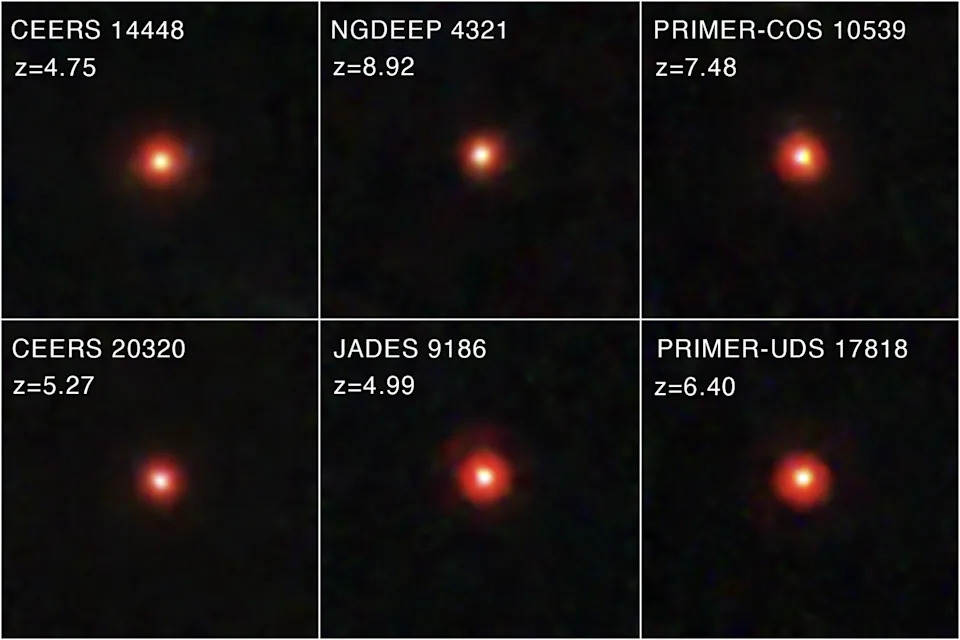
Little red dots, as they appeared more than 12 billion years ago, were discovered through early-universe surveys. | Credit: NASA, ESA, CSA, STScI, Dale Kocevski (Colby College)
One leading explanation, supported by this study, is that many LRDs are young, rapidly growing black holes wrapped in dense cocoons of gas and dust that absorb X-rays. In the case of the XRD, researchers propose that the central black hole has begun to clear channels through its surrounding shroud, creating sightlines that allow X-rays to escape while the object retains its overall red appearance — imagine a cosmic jack-o'-lantern leaking inner light through a dark shell.
Implications for Early Black Hole Growth
If LRDs generally represent a brief, heavily shrouded phase of rapid gas accretion onto nascent SMBHs, that phase could help explain how some black holes in the early universe grew to millions or billions of solar masses in only a few hundred million years. The XRD therefore provides a tangible clue linking the compact red sources Webb sees to an important stage of black hole evolution.
Next Steps
Follow-up observations of the XRD are a priority. Additional X-ray, infrared and spectroscopic data will test whether it truly is an LRD in transition or a more typical SMBH obscured by unusual dust. Wider surveys by upcoming missions such as the Nancy Grace Roman Space Telescope will search for rare modern analogues of LRDs; Roman’s wide-area coverage complements Webb’s depth by making it possible to find infrequent, but informative, examples.
Regardless of the final interpretation, the XRD highlights the scientific power of combining archival and current observatories to unravel the early universe’s most enigmatic objects.
Help us improve.





















