
A new James Webb Space Telescope image showcases the bright core of the spiral galaxy Messier 77, about 45 million light-years away in the Cetus constellation. The galaxy's active nucleus is fueled by a supermassive black hole roughly 8 million times the Sun's mass, heating nearby gas to emit intense radiation. Webb's mid-infrared camera (MIRI) penetrates dust to reveal fine structures around the nucleus; the telescope has been observing the cosmos since its 2021 launch.
Webb Reveals Luminous Heart of Spiral Galaxy Messier 77
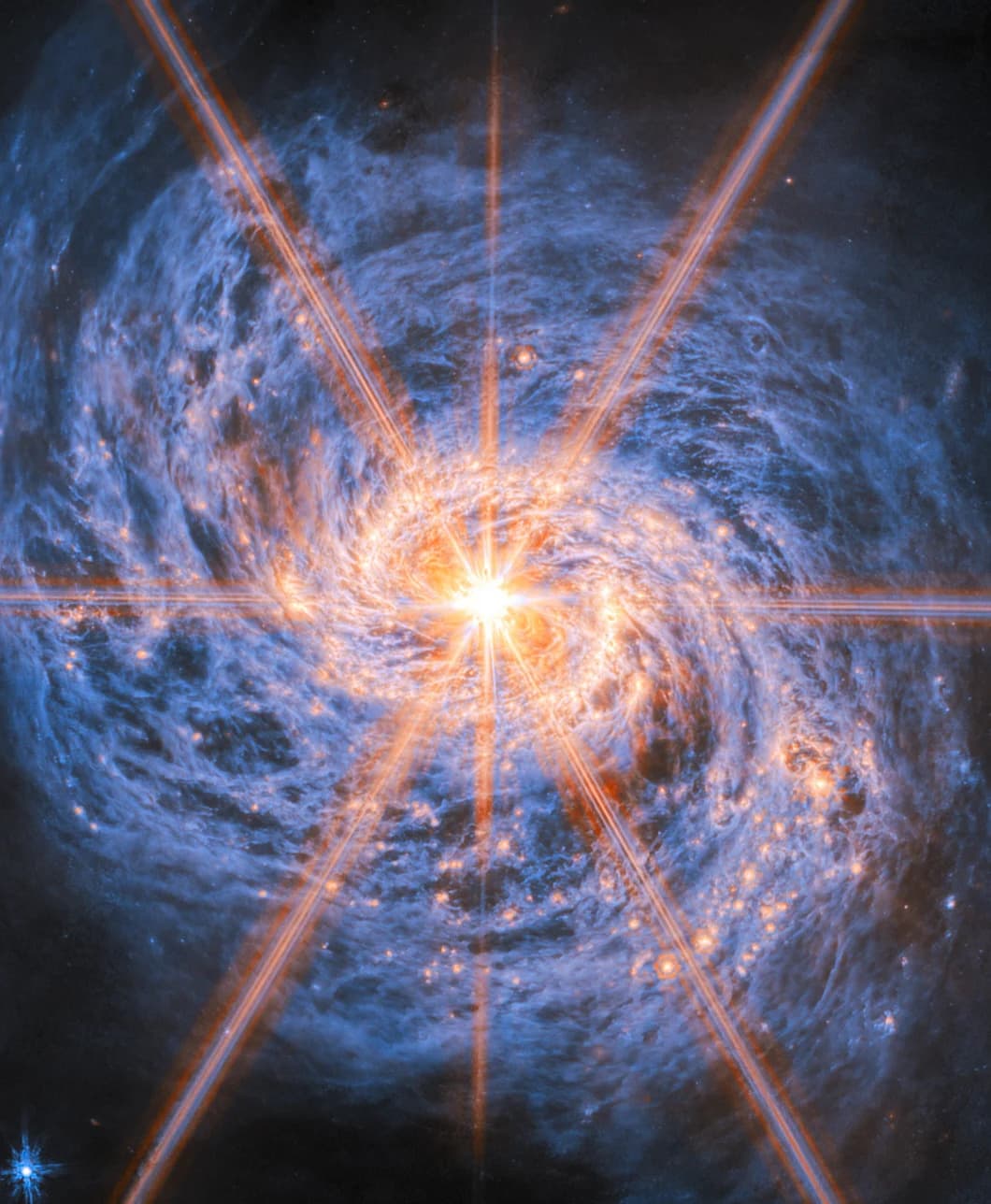
This image provided by NASA/ESA/Webb from the NASA/ESA/CSA James Webb Space Telescope shows Messier 77 (M77), a barred spiral galaxy famous and appreciated among astronomers for its combination of relative proximity and spectacular features to study. (NASA via AP)(ASSOCIATED PRESS)
A striking new image from NASA's James Webb Space Telescope reveals the luminous, turbulent core of the spiral galaxy Messier 77, located about 45 million light-years away in the Cetus (whale) constellation.
One light-year is roughly 6 trillion miles.
The galaxy's active nucleus is powered by a supermassive black hole roughly 8 million times the mass of the Sun. Gas and dust drawn into tight orbits around the black hole become extremely hot and emit intense radiation. Webb's Mid-Infrared Instrument (MIRI) captured these features, using infrared light to peer through the dust that obscures the region in visible wavelengths.
Messier 77 (also cataloged as NGC 1068) is a well-studied Seyfert galaxy, a class of active galaxies with bright, compact nuclei. Webb's sensitivity and resolution reveal fine structures in the dust and gas surrounding the nucleus and help astronomers study how material behaves as it spirals toward the black hole.
The James Webb Space Telescope, the world's largest and most powerful space observatory, has been imaging the universe since its launch in 2021. NASA released the image this week, highlighting Webb's ability to illuminate hidden regions of galaxy centers.
Credits: NASA/ESA/CSA/European Southern Observatory, image released by NASA. The Associated Press Health and Science Department provides additional reporting.
Help us improve.





















