
The lower jaw of a middle-aged man unearthed at St. Nicholas East Kirk in Aberdeen contained a 20-karat gold ligature that bridged a missing lower incisor, making it the earliest known dental bridge of its kind in Scotland. The mandible shows heavy plaque, three cavities and periodontal disease. Researchers suggest the gold wire may have secured the lost tooth or a prosthetic and was possibly fashioned and fitted by a jeweller. The find, reported April 24 in the British Dental Journal, sheds light on medieval dental care and cosmetic concerns before dentistry became a profession.
500-Year-Old Gold Dental Bridge Unearthed in Aberdeen — Scotland's Earliest Known Example May Have Held a False Tooth
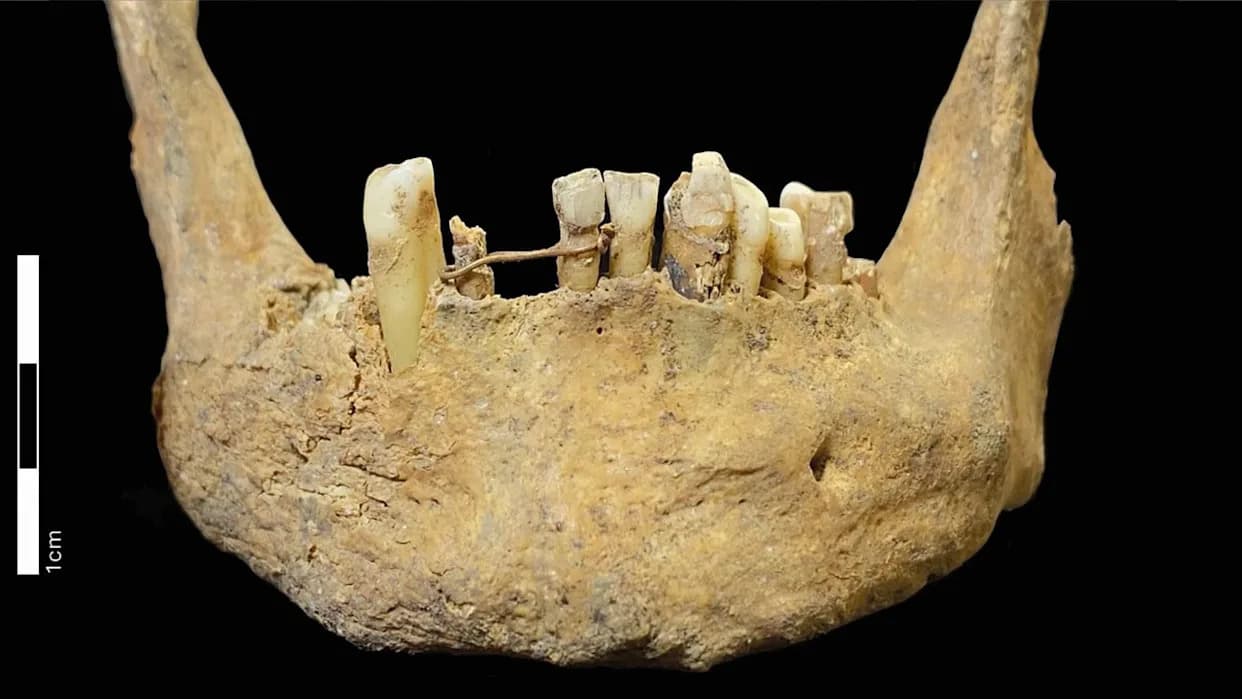
A lower jaw recovered during excavations at St. Nicholas East Kirk in Aberdeen contains what researchers say is the earliest documented dental bridge of its kind found in Scotland. A 20-karat gold wire, known as a ligature, was wrapped around two teeth roughly 500 years ago to span the gap left by a missing lower incisor.
The study, published April 24 in the British Dental Journal, describes the mandible as one of many remains recovered from the medieval church site. St. Nicholas East Kirk, likely founded in the 11th century and used until the Protestant Reformation, yielded more than 900 burials and thousands of isolated bones during the excavation. Although the wired jaw was not part of an intact burial, the bone morphology and tooth-wear patterns indicate it belonged to a middle-aged man who died between about 1460 and 1670.
The mandible retains nine teeth and shows that the lower right central incisor had been lost during life. All preserved teeth carried hardened dental plaque; three teeth showed caries (cavities); and there were signs of periodontal disease consistent with gum recession — evidence of generally poor oral health common in the late medieval period. What distinguishes this specimen is the thin 20-karat gold wire looped around the roots of two teeth to bridge the missing incisor.
The gold ligature encircled the lower right lateral incisor and the lower left central incisor. According to co-author Rebecca Crozier, a bioarchaeologist at the University of Aberdeen, one end of the wire was looped around a root while the other was secured by a twisted knot. "The wire had been rubbing against the root of one of the anchoring teeth for some time," she said. The ligature may have been holding the actual lost tooth in place or securing a prosthetic (false) tooth.
"The application of the ligature would likely have caused some discomfort during the procedure," Crozier told Live Science, "but the man would most likely have grown used to the presence of the wire over time and probably stopped noticing it."
The authors note that dentistry was not an organized profession until the 19th century, but semi-skilled dental work was performed earlier by barbers, healers and jewellers. Wire splints and ligatures to stabilize loose or missing teeth are described in medieval European medical texts, and later examples, such as 17th-century gold ligatures found in France, corroborate the practice.
Beyond restoring some chewing function, the ligature likely had a cosmetic purpose. In the medieval period, outward appearance and perceived health were often linked to moral character, so people who could afford it sought treatments to preserve or restore their smiles. The study suggests a jeweller may have crafted and fitted the gold wire for this Scotsman.
Significance: This find illuminates how people in late medieval Scotland managed dental problems and pursued cosmetic solutions long before dentistry became a formal profession. The gold ligature provides rare physical evidence of skilled, material-based dental intervention and of the social value of appearance in past communities.
Help us improve.





















