The Hubble Space Telescope has produced a six-band composite image of NGC 3137, a galaxy about 50 million light-years away. The image reveals bright blue clusters of young stars forming within luminous red nebulae. NGC 3137 is forming stars at roughly 0.5 solar masses per year and is visible from Earth in the constellation Antlia, catalogued by Nicolas‑Louis de Lacaille in the 1750s. Notably, the galaxy lies well beyond the Local Group.
Hubble Reveals Roaming Galaxy NGC 3137 in Vivid Detail
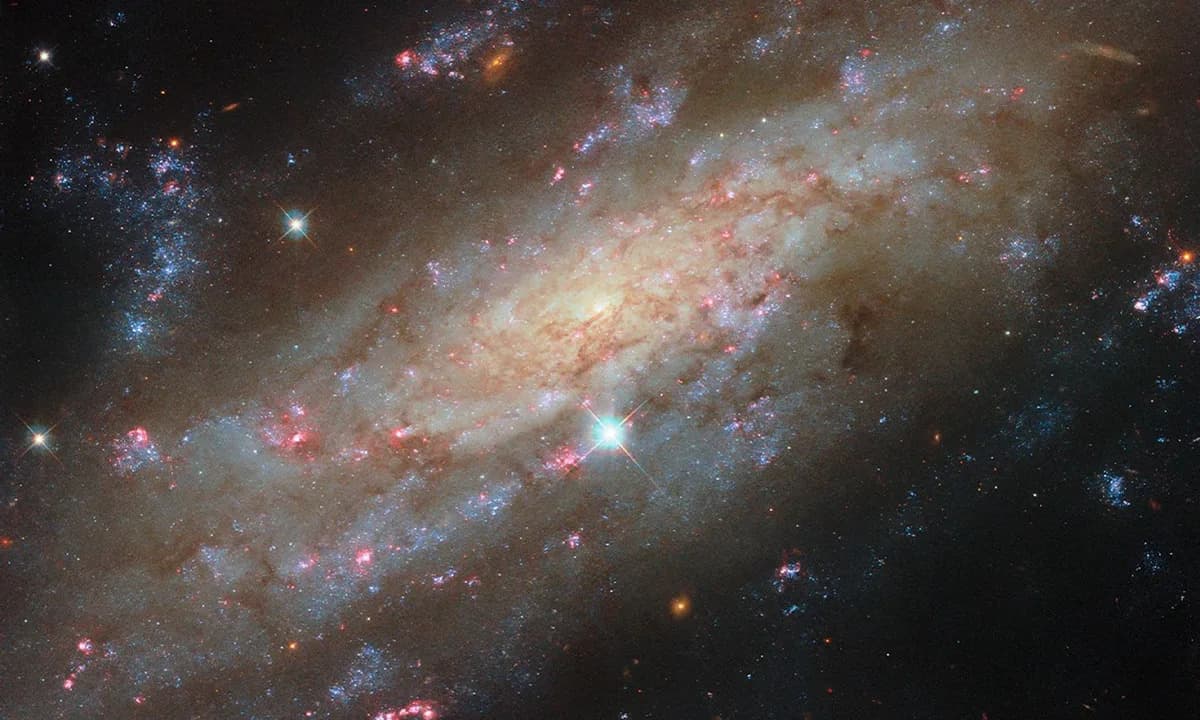
The Hubble Space Telescope has captured a striking, high-resolution image of the galaxy NGC 3137, located roughly 50 million light-years from Earth. The picture—assembled from six separate observations in different color bands—reveals bright blue clusters of young stars embedded in glowing red clouds of gas and dust.
What the Image Shows
The composite highlights pockets of active star formation. The bright blue knots are newly formed, massive stars, while the surrounding red regions are emission nebulae where gas is heated and ionized by intense ultraviolet radiation. Astronomers estimate that NGC 3137 is forming stars at about 0.5 solar masses per year, a rate that helps researchers study how stellar nurseries evolve over time.
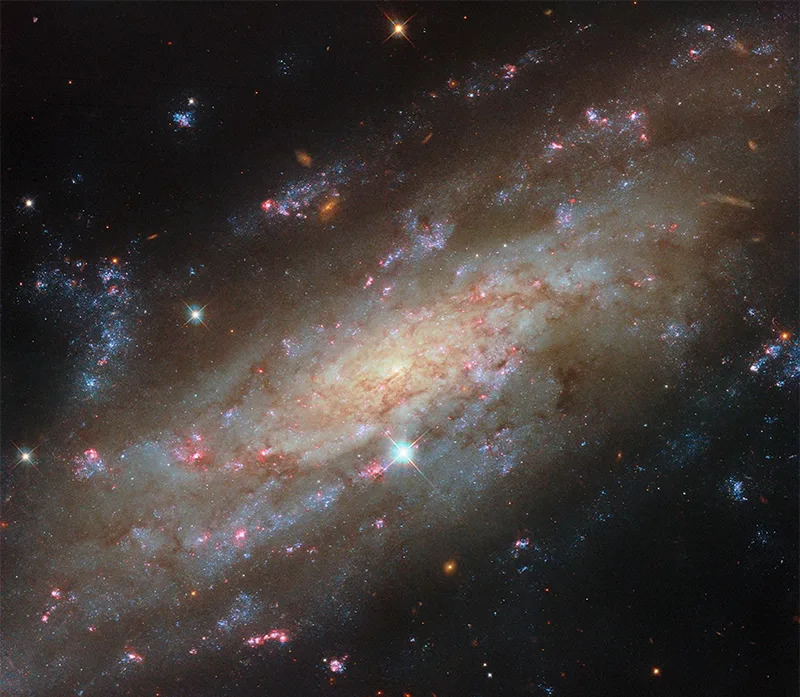
Image by ESA / Hubble & NASA, D. Thilker and the PHANGS-HST Team
Where It Sits in the Sky
From Earth, NGC 3137 appears in the constellation Antlia. That constellation was catalogued in the early 1750s by French astronomer Nicolas‑Louis de Lacaille, who named it after the recent invention la machine pneumatique (the air pump).
Clarifying Its Membership
Contrary to a previous description, NGC 3137 is not a member of the Local Group. At about 50 million light-years away, it lies well beyond the Local Group’s boundaries and instead belongs to a more distant galaxy environment.
Image Credit: ESA / Hubble & NASA; D. Thilker and the PHANGS‑HST Team.
This Hubble snapshot gives astronomers a detailed view of star formation in a galaxy outside our immediate neighborhood, offering clues about how gas, dust and young stars interact across different galactic environments.
Help us improve.