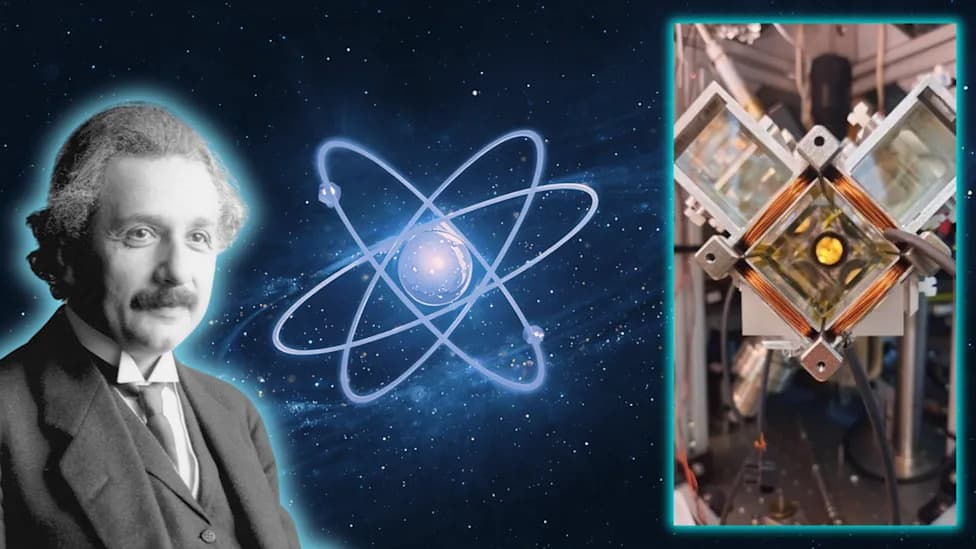
Researchers analyzing gravity-linked collapse models of the quantum wave function argue that, if gravity triggers collapse, fluctuations in the gravitational field would impose a fundamental limit on clock precision. The effect is vanishingly small—well below the reach of today’s atomic clocks—but establishes a concrete experimental target for testing quantum-gravity ideas. The study, published in Physical Review Research, highlights how ultra-precise or specially prepared clocks (for example, squeezed states) could one day probe these subtle phenomena.
Could Gravity Make Time Itself 'Fuzzy'? New Study Suggests a Fundamental Limit to Clock Precision
Time Can’t Always Be Measured AccuratelyWong Yu Liang - Getty Images
Researchers exploring radical solutions to quantum measurement have found that, if gravity triggers the collapse of the quantum wave function, time may have a built-in fuzziness that sets a fundamental limit on how precisely clocks can measure it.
Quantum mechanics allows particles to exist in superpositions—multiple possible states at once—encoded by a wave function. When a measurement occurs, the wave function appears to collapse to a single outcome, but the mechanism behind that collapse remains unsettled. Several theoretical proposals treat collapse as a genuine physical process: the Ghirardi–Rimini–Weber (GRW) model, the continuous spontaneous localization (CSL) model, and the Diósi–Penrose (DP) idea. The DP approach, developed in the late 1980s by Roger Penrose and Lajos Diósi, suggests that gravity itself may force a quantum system to choose a definite state.
In a new analysis published in Physical Review Research, Nicola Bortolotti (Enrico Fermi Museum and Research Centre) and collaborators examined the predictions of gravity-linked collapse models for the measurement of time. They conclude that fluctuations in the gravitational field—if they underlie collapse—would introduce an intrinsic uncertainty in the flow of time, implying a theoretical lower bound on clock precision.
“What we did was to take seriously the idea that collapse models may be linked to gravity,” said lead author Nicola Bortolotti. “And then we asked a very concrete question: What does this imply for time itself?”
The practical consequences are negligible for everyday life. Even the most advanced atomic clocks, which report stability and precision at roughly the 19th decimal place in relative frequency, are many orders of magnitude away from the predicted fuzziness. In other words, current clocks will not notice this effect. But the result is significant: it provides a concrete experimental target and shows how precision timekeeping can test deep ideas about quantum mechanics and gravity.
“Our work shows that even radical ideas about quantum mechanics can be tested against precise physical measurements, and that, reassuringly, timekeeping remains one of the most stable pillars of modern physics,” said co-author Catalina Curceanu.
The study also connects to other emerging ideas about time in quantum theory. For example, a recent paper discussed a “quantum twin paradox” in which the passage of time could be placed into a superposition—simultaneously faster and slower. Experimental searches for these subtle phenomena may rely on ultra-precise atomic clocks prepared in nonclassical states (such as squeezed states) to amplify or reveal tiny quantum-time effects.
For now, the conclusion is conceptual rather than practical: if gravity induces wave-function collapse, then time cannot be measured arbitrarily precisely. That theoretical limit both refines our picture of quantum gravity proposals and points to future experiments that could either constrain or support those ideas.
Why it matters: The work links foundational quantum theory to measurable precision experiments. Even when effects are far beyond current sensitivity, outlining testable consequences helps convert speculative ideas about quantum gravity into empirical science.
Help us improve.