Vasuki indicus is a newly described giant snake from Gujarat, India, known from 27 well-preserved vertebrae. Vertebral dimensions suggest a very thick, cylindrical body, and length estimates range from 35.8 to 49.9 feet (≈10.9–15.2 m), with the top estimate exceeding Titanoboa. The fossil dates to the Middle Eocene (~47 million years ago) and is assigned to the extinct Madtsoiidae family, which once had a broad global distribution.
New Giant Snake From India, Vasuki indicus, Could Rival Titanoboa
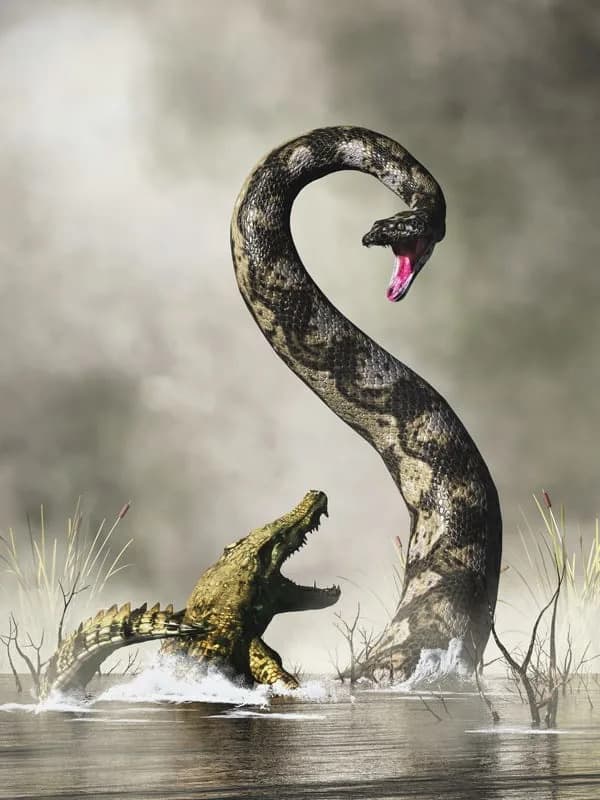
titanoboa© Daniel Eskridge/Shutterstock.com
Researchers have described a newly identified giant snake from what is now western India based on an exceptionally preserved portion of its vertebral column. The species has been named Vasuki indicus, and the fossil material—recovered in Gujarat—sheds fresh light on the diversity of prehistoric snakes.
Discovery and Fossil Material
The specimen consists of 27 largely intact vertebrae recovered from a grey shale unit in the Panandhro Lignite Mine, Kutch district, Gujarat State. Individual vertebrae measure between 1.48 and 2.47 inches long (approximately 3.76–6.27 cm) and 2.46 to 4.39 inches wide (about 6.25–11.15 cm), proportions that indicate a very robust, cylindrical body rather than a laterally compressed form.
Size Estimates and Comparison With Titanoboa
Using standard quantitative methods that relate vertebral dimensions to total body length, the authors estimate Vasuki indicus measured roughly 35.8–49.9 feet (about 10.9–15.2 meters) when alive. The upper bound of this range would place it longer than Titanoboa, the previously recognized largest snake. However, because Vasuki’s vertebrae are slightly smaller than Titanoboa’s and length reconstructions have inherent uncertainty, Titanoboa may still have been the heavier or longer animal in practice.
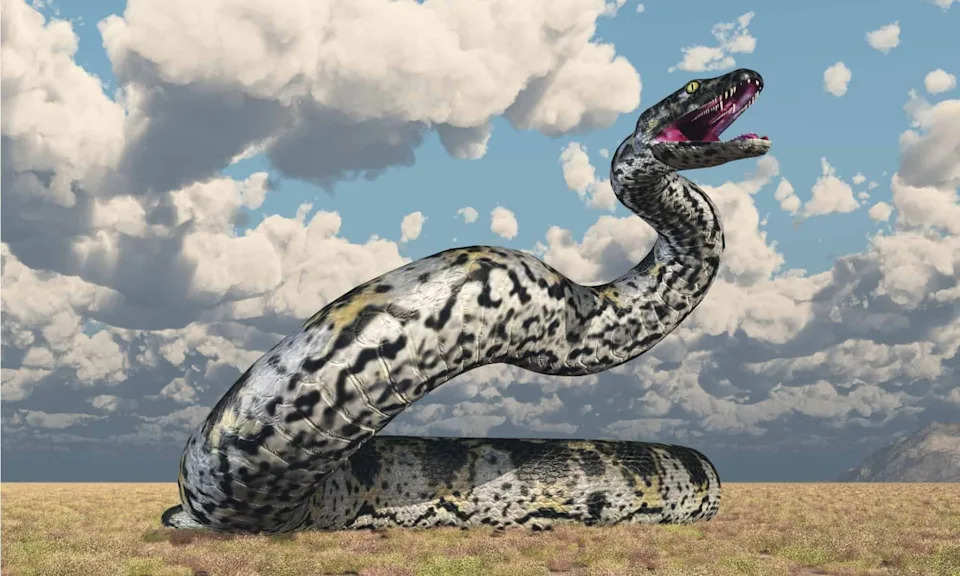
Prehistoric giant snake Titanoboa was huge!©Michael Rosskothen/Shutterstock.com
Age and Paleoclimate
The fossil is dated to the warm Middle Eocene, roughly 47 million years ago. Regional mean temperatures at that time are estimated at about 82°F (≈27.8°C), consistent with the subtropical to tropical environments that supported very large reptiles. The Panandhro shale preserves a fauna from this interval and provides the geological context for the find.
Classification and Significance
The authors place Vasuki indicus within the extinct snake family Madtsoiidae, a lineage that persisted from the Late Cretaceous into the Late Pleistocene and once ranged across India, Africa, Madagascar, South America and parts of Europe. The study suggests Vasuki represents a relic lineage that likely originated on the Indian subcontinent and later dispersed into southern Eurasia and Africa during the Eocene. Madtsoiids included some of the largest known terrestrial snakes, and Vasuki adds an important data point to our understanding of snake evolution and paleobiogeography.
Why it matters: This discovery highlights the exceptional size that snakes could attain in warm Eocene ecosystems and underscores India’s role as a potential center for early lineages that later spread across continents. Further finds and analyses will be needed to refine size estimates and clarify how Vasuki fits into the broader family tree of giant prehistoric snakes.
Help us improve.