
New observations of interstellar comet 3I/ATLAS show its water is extraordinarily enriched in deuterium, with a D/H ratio at least 30 times higher than any measured Solar System comet and roughly 40 times the value in Earth’s oceans. ALMA and MDM observations on Nov. 4, 2025 detected HDO and methanol, and a coma model plus Bayesian retrieval were used to infer water production. The result, published in Nature Astronomy, strongly suggests the comet formed in much colder conditions than those that produced Solar System comets, though the authors note important caveats and measurement uncertainties.
Interstellar Comet 3I/ATLAS: Water Reveals a Far Colder Birthplace Than Our Solar System
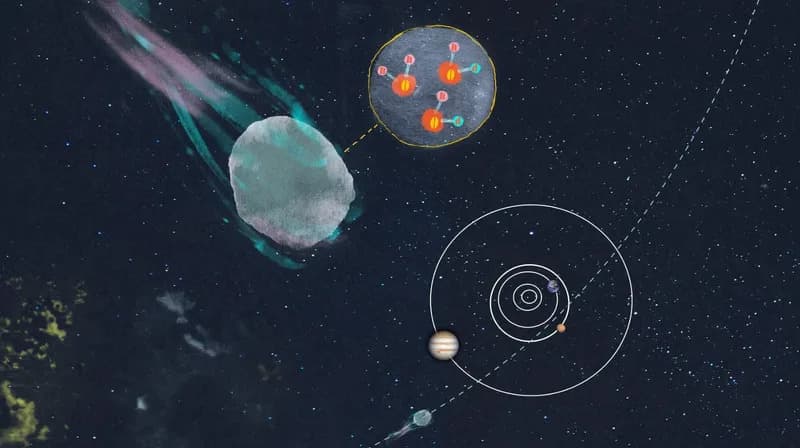
Astronomers studying the interstellar comet found that its water is packed with an unusually heavy form of hydrogen called deuterium. (CREDIT: Hans Anderson, Michigan News)
Long before 3I/ATLAS swept through the inner Solar System, the water it carries had preserved a chemical record of the environment where it formed. New observations now show that the comet’s water is extraordinarily enriched in deuterium — a heavy isotope of hydrogen — at levels far beyond those measured in comets from our own system, pointing to a birthplace that was much colder than the region that produced Earth and the other bodies orbiting the Sun.
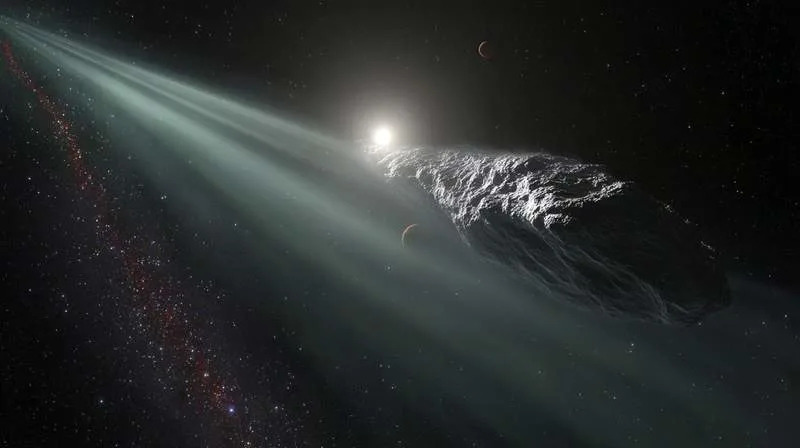
Interstellar comet 3I/ATLAS carries deuterium-rich water, pointing to a far colder birthplace than our solar system. (CREDIT: Wikimedia / CC BY-SA 4.0)
Key Findings
A team led by Luis Salazar Manzano (University of Michigan) reports in Nature Astronomy that the deuterium-to-hydrogen (D/H) ratio in 3I/ATLAS is at least 30 times higher than in any Solar System comet measured to date and roughly 40 times higher than the value in Earth’s oceans. This is the first isotopic analysis of an interstellar object and offers a rare chemical glimpse into conditions around another star.
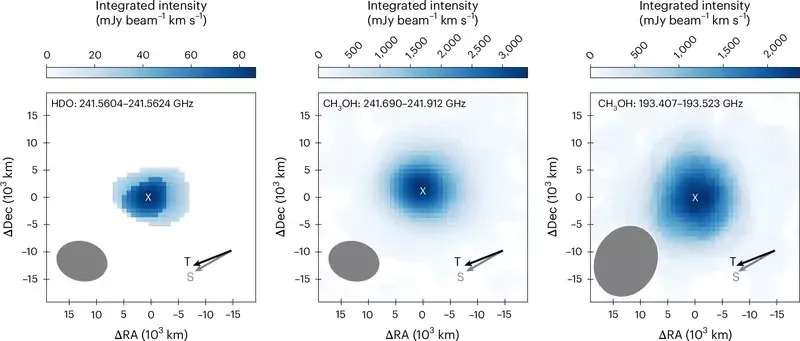
Integrated intensity (moment-0) maps of the detected species. (CREDIT: Nature Astronomy)
How the Measurement Was Made
Astronomers discovered 3I/ATLAS early and organized prompt follow-up observations while it still displayed an active coma. Initial outgassing was spotted with the MDM Observatory in Arizona, and the team secured sensitive spectral observations with the Atacama Large Millimeter/submillimeter Array (ALMA) in Chile. The ALMA spectra (taken on Nov. 4, 2025, six days after perihelion) detected HDO — a deuterium-bearing form of water — and methanol; ordinary H2O did not exceed the direct detection threshold in those data.
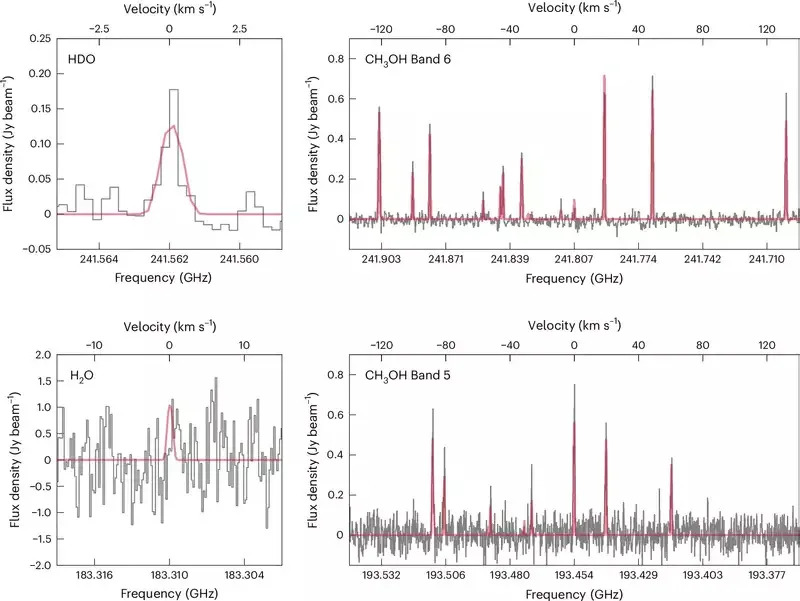
3I/ATLAS ALMA spectra and best-fit models for HDO, H2O and CH3OH in Band 5 and Band 6. (CREDIT: Nature Astronomy)
To infer the overall water production despite the weak direct H2O signal, the researchers used a coma model combined with a Bayesian retrieval technique, analyzing methanol emission lines to estimate H2O output and comparing that to the measured HDO. Even conservative analyses that relied only on water-related constraints returned an unusually high D/H ratio.

Teresa Paneque Carreño
Implications: A Much Colder Origin
Very cold environments favor chemical reactions that enrich water with deuterium, so the observed extreme enrichment strongly suggests 3I/ATLAS formed under far colder conditions than those that created Solar System comets. The team outlines two plausible formation scenarios: (1) a very cold prestellar phase before the parent star formed, or (2) formation in the outer reaches of a protoplanetary disk (for example, beyond the carbon-dioxide snowline), where temperatures and chemistry would favor deuterium enrichment and make later ejection into interstellar space more likely.

Luis Salazar Manzano
Context and Additional Clues
Previous studies already noted unusual chemistry in 3I/ATLAS — enhanced carbon dioxide and methanol, carbon-chain depletion, and changing nickel-to-iron ratios — and estimated a kinematic age between 3 billion and 11 billion years, potentially making it the oldest interstellar object yet identified. The new isotopic result strengthens the idea that the comet’s chemical history differs fundamentally from that of Solar System comets.
Limitations and Caveats
The authors are careful about uncertainties. Their water-production estimate assumes that H2O dominates collision processes in the coma; nearby carbon dioxide may have influenced local conditions during the observations. Because of these uncertainties, one water-production estimate is reported as an upper limit and the team includes a more conservative case as well. The researchers also argue that small galactic-scale variations in hydrogen isotopes or alteration of a thin surface layer during the object’s interstellar journey are unlikely to explain the extreme D/H ratio observed.
Why This Matters
Interstellar comets are rare direct samples of material formed around other stars. Unlike remote images of disks, an object like 3I/ATLAS provides a tangible chemical record that helps astronomers compare planet-forming environments across the galaxy. The finding implies that water chemistry — and thus the conditions for building water-rich worlds — may vary far more between planetary systems than previously assumed.
“This is proof that whatever the conditions were that led to the creation of our solar system are not ubiquitous throughout space,” said Teresa Paneque-Carreño, co-leader of the study and assistant professor of astronomy at the University of Michigan.
The study appears in Nature Astronomy. Astronomers have not yet been able to trace 3I/ATLAS back to a parent star because backward orbit reconstructions remain unreliable given incomplete stellar motion data.
Help us improve.





















