
Massive stars sometimes produce luminous, nonfatal eruptions called "supernova impostors," driven by episodic eruptive mass loss that is hard to measure. A new study by Cheng, Conroy, and Goldberg used MESA models and synthetic stellar populations to calibrate the previously unconstrained eruptive-efficiency parameter by comparing models to red supergiant luminosity distributions in the SMC, LMC, and M31. They found the efficiency increases with metallicity and, when applied, implies stars above ~20 solar masses may avoid the red supergiant phase. Further tests in more diverse galaxies are needed to confirm and refine this trend.
Why Some Stars Become 'Supernova Impostors' — A New Study Links Eruptive Outbursts to Metallicity
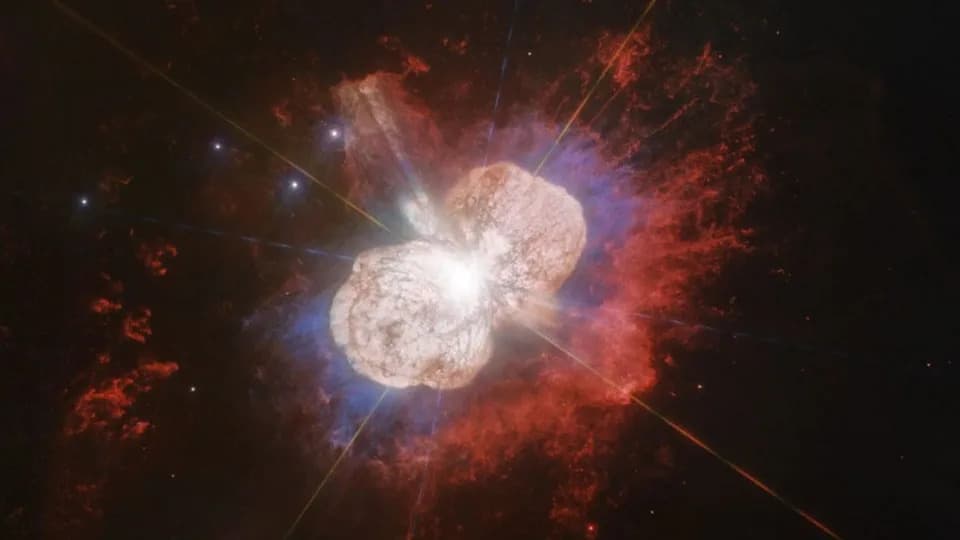
Historical records do show that about 170 years ago, the star Eta Carinae underwent an unusual outburst that made it one of the brightest stars in the southern sky. But it wasn't a supernova, it was a "supernova impostor.". | Credit: NASA, ESA, Hubble; Processing & License: Judy Schmidt
Stare up at a brilliant transient in the night sky and you might assume you've witnessed a star’s final, cataclysmic death — a supernova. In some cases, however, the star survives. These dramatic, nonterminal eruptions are nicknamed "supernova impostors." They briefly rival true supernovae in brightness but leave the progenitor star intact.
What Are Supernova Impostors?
Supernova impostors occur in very massive stars that undergo episodic, violent expulsions of their outer layers. Astronomers call this behavior eruptive mass loss. Unlike steady stellar winds, eruptive mass loss happens in fits and starts, producing luminous outbursts that can be hard to interpret from a single observation.
The Modeling Challenge
Longstanding stellar evolution models struggle to reproduce the late lives of the most massive stars. One key difficulty is how to represent eruptive mass loss. Modelers typically invoke super-Eddington conditions — when radiation pressure is strong enough to push material off the star — and encode the process with an efficiency parameter. That parameter acts like a free dial setting how powerful an eruption is, but until now it lacked solid observational calibration.
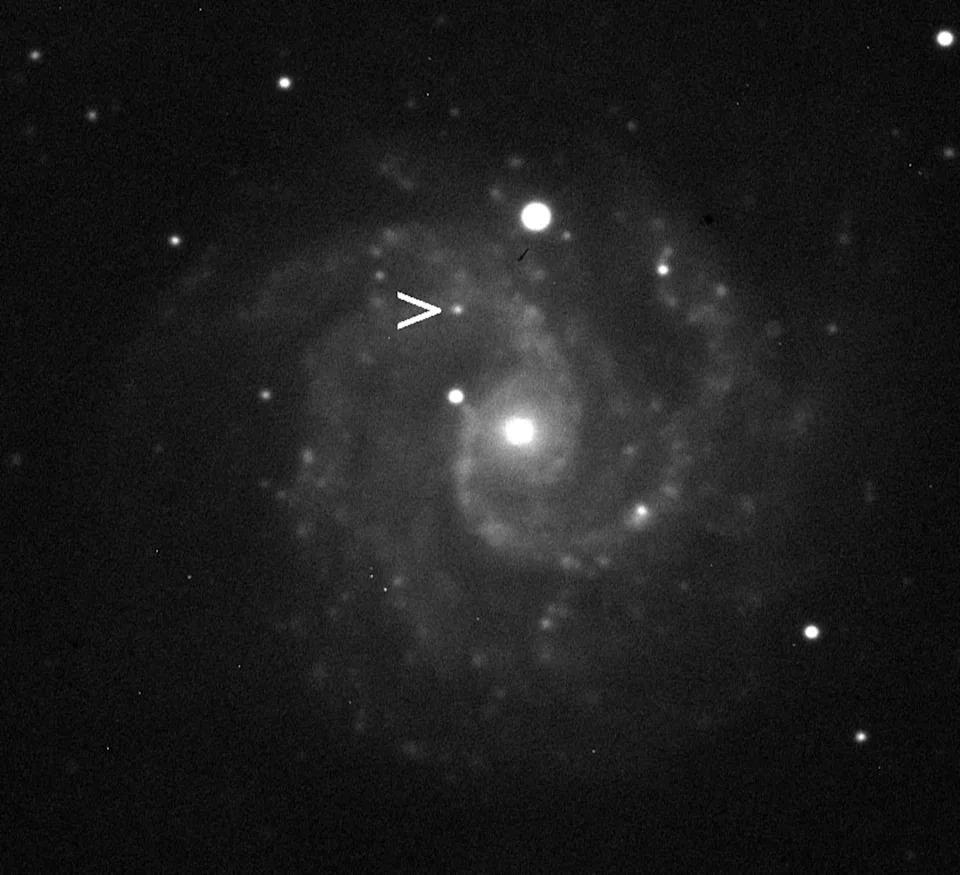
NGC 3184, also known as The Little Pinwheel Galaxy, with an arrow pointing to a supernova impostor observed in 2010 known as SN 2010dn. | Credit: Kevin Heider/Wikimedia Commons/CC BY-SA 3.0
A Population-Based Solution
Rather than attempting to measure every eruption from individual stars, Shelley J. Cheng (Center for Astrophysics | Harvard & Smithsonian), Charlie Conroy, and Jared A. Goldberg adopted a population approach in a new study posted to arXiv. They used the MESA stellar-evolution code to generate models with different values of the eruptive-efficiency parameter, then created synthetic stellar populations that mimic real star-forming regions.
To compare models with reality, the team used wide-field time-domain survey data (for example, Pan-STARRS1) and luminosity distributions of red supergiants observed in nearby galaxies: the Small Magellanic Cloud (SMC), the Large Magellanic Cloud (LMC), and M31 (Andromeda). This lets them match model predictions to observed brightness distributions across different metallicity environments.
Key Findings
Their comparisons showed the efficiency parameter is not arbitrary: it correlates positively with metallicity. In plain terms, stars with higher metal content tend to experience stronger eruptive mass loss. When this calibrated prescription is included in evolutionary models, stars born with masses above roughly ~20 solar masses can lose so much material in repeated outbursts that they do not become red supergiants, instead evolving along a different pathway.
Implications and Next Steps
This work provides an important observational anchor for a previously unconstrained model parameter, improving predictions for the fates of the most massive stars and for the types of transients they produce. The authors emphasize the need to test the metallicity–mass-loss relationship in more distant and diverse galaxies, and to probe whether metallicity primarily affects eruption triggers or the mass-loss efficiency once eruptions begin.
The study highlights how combining modern surveys, population modeling, and flexible stellar codes like MESA can turn an unconstrained modeling knob into a physically informative parameter — bringing us closer to understanding how the most massive stars live, erupt, and die.
Help us improve.





















