
NASA’s Dragonfly will send an SUV‑sized, eight‑rotor rotorcraft to fly across Titan’s dense, cold atmosphere to study preserved organic chemistry. Equipped with a 40‑cup sample carousel, tiny ovens, a laser and a compact mass spectrometer, Dragonfly will hop across equatorial dunes to search for prebiotic molecules. The mission is budgeted at $3.35 billion, could launch as early as 2028, and will require nearly seven years of cruise time before a three‑year surface campaign.
Where NASA’s Dragonfly Is Headed — “We Don’t Need Roads” as It Prepares to Fly Across Titan
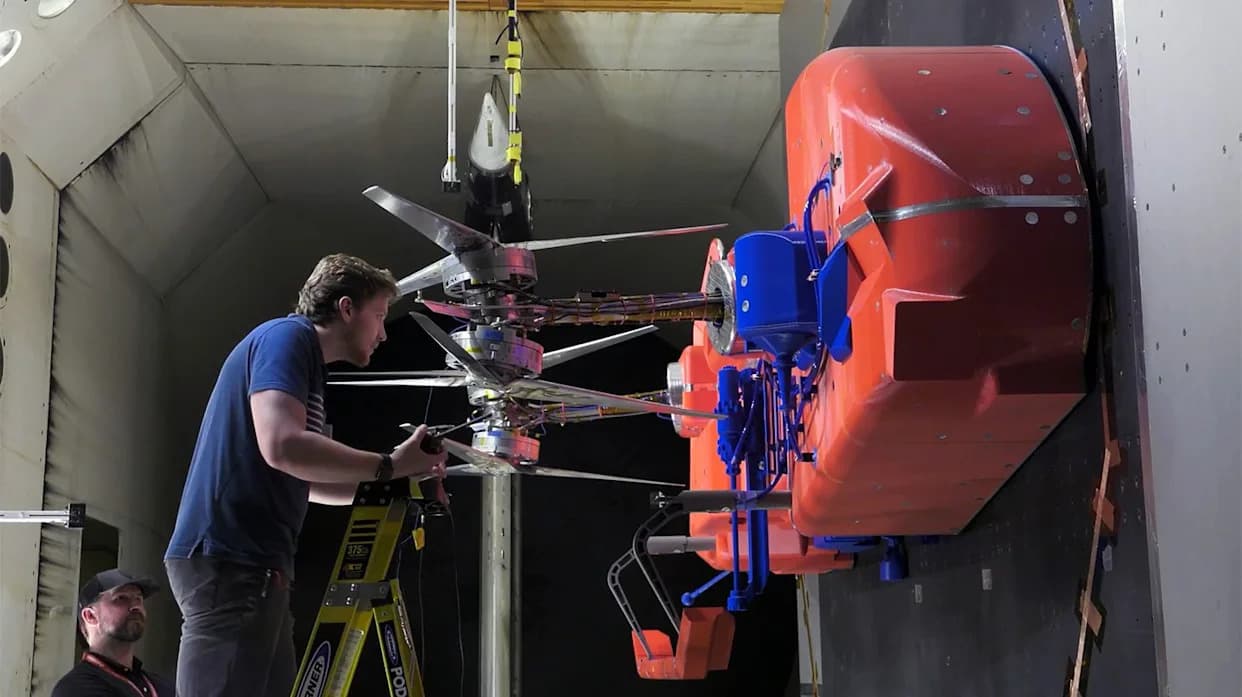
Johns Hopkins Applied Physics Laboratory engineers Max Wolbeck and Daniel Peterson install rotors on a model of half the Dragonfly aircraft for testing. - NASA
NASA is trading wheels for rotors with Dragonfly, an SUV‑sized, eight‑rotor rotorcraft designed to explore Titan, Saturn’s largest moon. Engineers have begun assembling the honeycomb panels for the vehicle’s fuselage, completed drop tests of its parachute system, and demonstrated that its compact onboard chemistry lab can detect trace amounts of target molecules in sample material.
Why A Flying Explorer?
Titan sits roughly 886 million miles from Earth and is unique among moons for having a thick, hazy atmosphere—about 1.5 times the pressure at Earth’s sea level and roughly three times as dense. Combined with gravity that’s only about one‑seventh of Earth’s, those conditions make powered flight particularly efficient. "That combination makes an octocopter an excellent choice because it can fly with relative ease," said Charles Malespin, who leads the team that developed Dragonfly’s sample‑analysis hardware. "Dragonfly could cover vast stretches of terrain and explore a much larger area than a traditional wheeled vehicle."
Science Goals And Instruments
Scientists view Titan as a natural laboratory for prebiotic chemistry. Its methane‑rich atmosphere constantly produces complex organic molecules that settle onto the icy surface, forming dunes and deposits of carbon‑rich material. Because Titan has remained cold and relatively unchanged by biology or aggressive geology, it preserves chemical pathways that on early Earth may have led toward life.
"There may have been a melt pool that lasted as long as about 1,000 years," said Melissa Trainer, planetary scientist and lead of the mission’s DraMS mass spectrometer. "A 1,000‑year chemistry experiment could produce unexpected results—who knows what we might find."
At a briefing at NASA’s Goddard Space Flight Center, mission officials described how the $3.35 billion effort will drill into Titan’s hard, icy surface, analyze samples in a compact onboard lab, and then lift off again to investigate new sites. The sampling system includes a carousel holding 40 sample cups, small ovens to heat and release volatiles, and a laser to probe organic material.
NASA Dragonfly team members begin integrating the sample carousel into the DraMS mass spectrometer instrument.
Design Advantages Over Mars Helicopters
Dragonfly’s mission profile differs fundamentally from small Martian helicopters because Titan’s dense air and lower gravity allow a larger, instrument‑laden platform. Whereas Mars rotorcraft had to be extremely lightweight and use very long blades to fly in an atmosphere about 100 times thinner than Earth’s, Dragonfly can carry more science payloads and robust sample systems. "You could practically fly with cardboard wings—the atmosphere is that thick," Malespin said, illustrating how Titan’s conditions open new design possibilities.
Where It Will Go—and What It Won’t Do
Over an expected three‑year surface campaign, Dragonfly will hop between dune fields and ancient impact sites to probe how simple organics might assemble into more complex molecules such as amino acids, nucleobases and fatty acids. One mission limitation is that Dragonfly is not designed to sample Titan’s methane‑ethane seas near the north pole; instead, it will focus on equatorial dune regions where organic sand grains are readily accessible. "We want to visit the sand," said deputy project scientist Shannon MacKenzie. "Those organic sand grains may represent the end product of extensive chemistry that wouldn’t be captured by scooping lake liquids."
The mission could launch as early as 2028 and will require nearly seven years of cruise time to reach Titan.
What To Watch Next
Watch for further milestones as the Dragonfly team completes assembly of the rotorcraft’s structure, finalizes parachute and landing tests, and integrates its suite of instruments for flight and in‑situ chemistry. If all goes according to plan, Dragonfly will open a new era of mobile aerial exploration on another world.
Help us improve.





















