
In 2023 astronomers uncovered 5–10 light‑year‑long filaments near Sagittarius A*, the Milky Way’s central black hole. Unlike previously known vertical, relativistic filaments, these new features lie horizontally, emit thermal radiation, and appear on one side of Sgr A*. The discovery — enabled by MeerKAT radio images and specialized processing — may trace past outflow activity from the black hole and could help constrain Sgr A*’s spin and orientation. Ongoing multiwavelength observations and modeling aim to reveal their origin.
Astronomers Discover Mile-Long Filaments Near Milky Way’s Heart — A New Clue About Sagittarius A*

milky way
In 2023, astronomers announced the discovery of long, narrow filaments near the center of the Milky Way that resemble the streaked lines seen in science-fiction hyperspace effects — but these are real astrophysical structures. Each filament is roughly 5–10 light‑years long and appears clustered close to Sagittarius A* (Sgr A*), the supermassive black hole at our galaxy’s center. Researchers are still studying how these features formed and what they reveal about the galactic nucleus.
What Makes These Filaments Unusual?
Unlike previously known Galactic Center filaments — which are largely vertical, magnetic, and relativistic — the newly reported filaments lie roughly horizontal, appear on one side of Sgr A*, and show thermal emission. The older population, first reported in the early 1980s by Farhad Yusef‑Zadeh, can reach lengths near ~150 light‑years and are interpreted as synchrotron structures produced by relativistic electrons spiraling in magnetic fields. By contrast, the new horizontal filaments seem to emit thermal radiation and may be connected to outflow activity from Sgr A* that interacted with nearby molecular clouds.
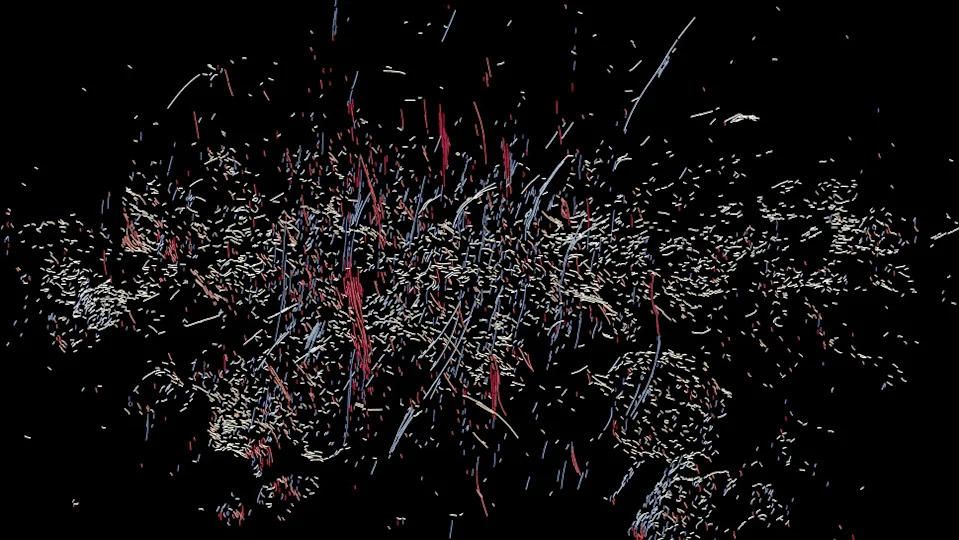
Image by Farhad Yusef-Zadeh
“I’m used to them being vertical. I never considered there might be others along the plane,” says Farhad Yusef‑Zadeh in a paper released with Northwestern University, noting that studying these filaments could help constrain how Sgr A* spins and how it is oriented relative to the rest of the galaxy.
How Were They Found?
The discovery was enabled by advances in radio astronomy, particularly the MeerKAT telescope operated by the South African Radio Astronomy Observatory (SARAO). By applying specialized image‑processing techniques that subtract large‑scale background emission and suppress noise, observers were able to reveal faint, linear features that had been hidden in previous data. The team describes the new MeerKAT images as a “game changer” for studying faint structures in the Galactic Center.
Physical Differences and Implications

hyperspace
The two filament populations differ in orientation, emission mechanism, and likely origin. Vertical filaments are predominantly magnetic and relativistic (synchrotron), with particles traveling near light speed. The horizontal filaments appear thermal and may represent material accelerated in a molecular cloud by a past outflow from Sgr A* or by interactions with local magnetic or shock structures. If confirmed, these horizontal features could provide a new diagnostic of past activity from the central black hole and help refine models of the Galactic Center environment.
What Comes Next?
Researchers continue to follow up with multiwavelength observations, deeper radio imaging, and theoretical modeling. Each new filament adds a piece to the puzzle of how Sgr A* influences its surroundings and how the inner Milky Way evolved. As Yusef‑Zadeh puts it, “Our work is never complete” — the filaments raise many questions and motivate more observations to test competing explanations.
Bottom Line: These horizontal, mile‑scale filaments are a newly emphasized feature of the Galactic Center. Whether they mark signatures of ancient black‑hole outflows, localized shocks, or other processes, they open a fresh window onto the dynamics of Sgr A* and its neighborhood.
Help us improve.





















