
The Artemis II crew — Reid Wiseman, Victor Glover, Christina Koch and Jeremy Hansen — splashed down on April 10 after a 10-day lunar flyby that set a new human-distance record beyond Apollo 13. At the U.N., the astronauts said the mission was intended to "connect with humanity" and inspire global unity while preparing for Artemis III and IV. Crew members described a mix of humility and pride when viewing Earth from space; NASA leadership noted the role of the 2020 Artemis Accords in shaping international cooperation.
Artemis II Crew: "We Wanted To Connect With Humanity" — Reflections After Historic Lunar Flyby

Artemis II Commander Reid Wiseman, Artemis II mission specialist Christina Koch, Artemis II pilot Victor Glover and Artemis II mission specialist Jeremy Hansen look at the Nasdaq MarketSite in Times Square in New York City.(Getty Images)
The Artemis II crew — Reid Wiseman, Victor Glover, Christina Koch and Jeremy Hansen — returned to Earth on April 10 after a 10-day lunar flyby that set a new human-distance record beyond the Apollo 13 mark from 1970. The team splashed down off the coast of San Diego and have since been sharing their impressions of the mission and its broader meaning.
At a stop at United Nations headquarters in New York, Ambassador Mike Waltz presented the astronauts with novelty hats he called "MUNGA" (short for "Make the U.N. Great Again"). The visit gave the crew an opportunity to describe what they hoped the mission would mean for people around the world.
Mission Purpose and Message
"As a crew, we wanted to go for all and by all," Reid Wiseman told attendees. "We wanted to set the stage for Artemis III and get our space agency and the world ready for the missions to come. But in the end, we really wanted to connect with humanity — to have people pause and see that this world can still do something exceptionally well when they put their minds to it."
What They Saw From Space
Victor Glover described a range of emotions during the flight. "You asked how it felt, and it wasn't one feeling for the entire mission," he said. "What we saw out the window was changing, and I felt grateful for what we were seeing and for what we were returning to. I felt blessed to have this experience."
Christina Koch said the darkness of space made Earth feel "even more special than it's ever been," noting that national borders and divisions look less absolute from a global vantage point. "You realize there's nothing guaranteed about this, and that the global scale is our world — what we do with it is our choice," she said.
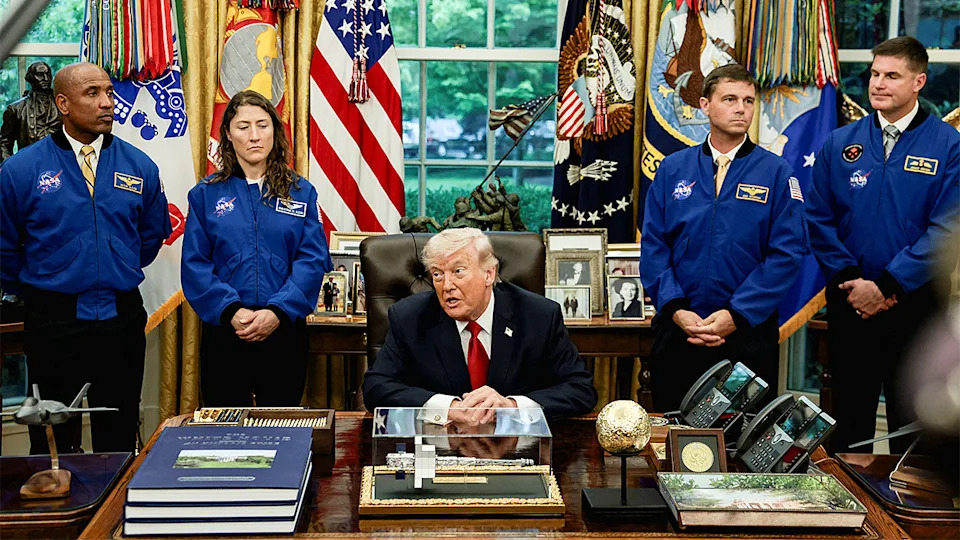
Artemis II astronauts Reid Wiseman, Victor Glover, Christina Koch and Jeremy Hansen flank President Donald Trump in the Oval Office at the White House.
Jeremy Hansen reflected on the contrast between feeling small as an individual and proud of what humanity can achieve together. He described being struck by the stars and by how many people tuned in to watch and resonate with the mission after the crew returned.
Context And Follow-Up
The Artemis program is preparing for Artemis III, currently expected to launch next year, with Artemis IV targeted for the following year. During the U.N. visit, NASA Administrator Bill Nelson (as of mid-2024) noted that the Artemis Accords — introduced in 2020 — helped frame international cooperation and principles for responsible exploration of space.
The crew also visited the White House, where they met with former President Donald Trump; Trump had spoken to the astronauts while they were orbiting the Moon. The visits reflect both the scientific milestones of Artemis II and the mission's broader public and diplomatic outreach.
Looking Ahead
Artemis II emphasized both technical achievement and a human connection: the astronauts said they hoped the mission would inspire people worldwide and demonstrate what coordinated effort can achieve. As Artemis III approaches, the program aims to build on those accomplishments and continue expanding human exploration beyond low Earth orbit.
Help us improve.





















