US policy failures after the 2003 invasion allowed Iran to cultivate deep political and military influence inside Iraq, a legacy that now complicates President Trump’s confrontation with Tehran. Iran-aligned militias have launched scores of attacks across the Gulf, some reportedly originating from Iraqi territory, while Baghdad grapples with political paralysis and a collapsing economy. The IMF forecasts a near 7% contraction as oil exports fall and legislative delays block access to financing. The war’s outcome — more than individual Baghdad appointments — will likely determine Iraq’s future trajectory.
How the US Failure in Iraq Is Complicating Trump’s Confrontation With Iran
The long-running collapse of US policy in Iraq — tracing back to the 2003 invasion — has resurfaced to complicate President Donald Trump’s confrontation with Iran and to threaten the security of Washington’s Gulf partners.
From Invasion to Influence
Much like today’s confrontation with Tehran, the 2003 invasion to topple Saddam Hussein proceeded despite misgivings from Arab allies. Few foresaw that the mismanagement of the post-Saddam order would create openings for Iran to penetrate a former adversary and steadily build influence from within.
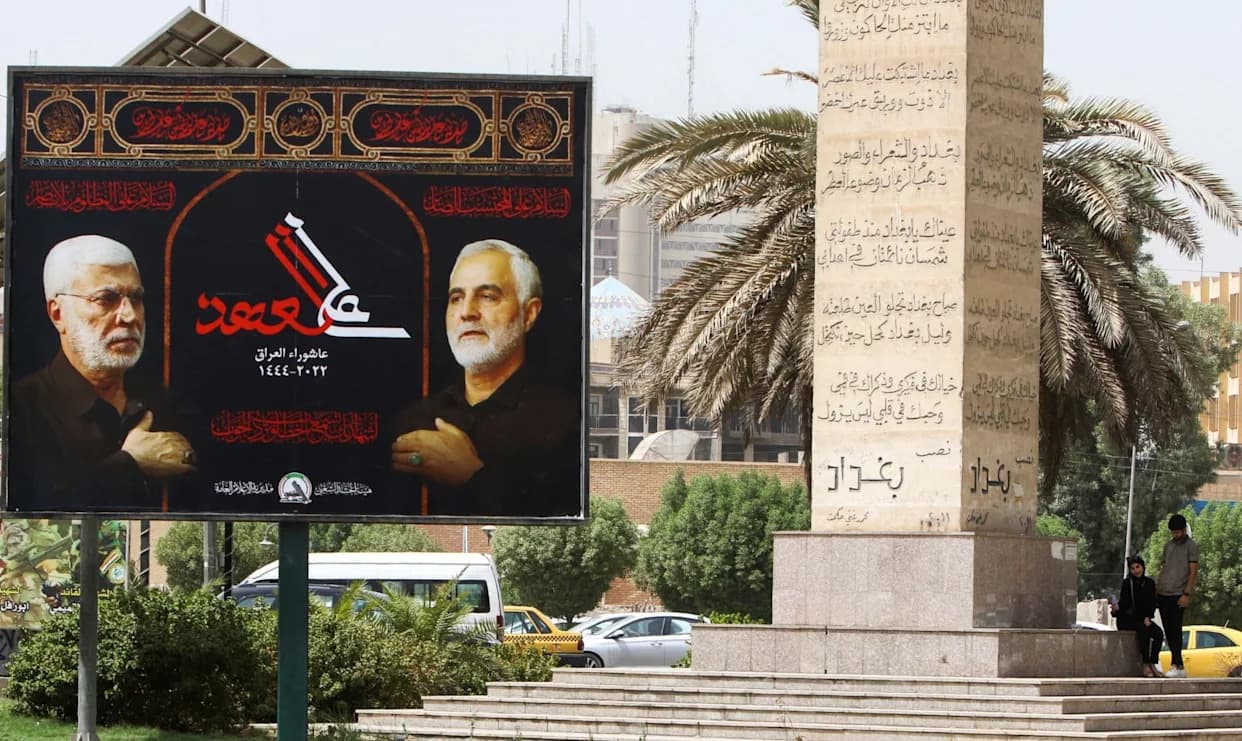
What began as attacks targeting US forces evolved into entrenched political and military power: Iranian influence over Shia parties and the projection of force through well-armed militias.
Militias, Cross-Border Attacks and Regional Risk
Since the start of US and Israeli strikes on Iran in February, Iran-aligned militias in Iraq have rallied to Tehran’s defense and launched attacks across the Gulf, including strikes that hit Kuwait and Saudi Arabia. There is no definitive public tally, but reporting in The Wall Street Journal estimated that roughly half of the nearly 1,000 drone attacks on Saudi Arabia originated from Iraqi territory.
These assaults — and Baghdad’s apparent inability to prevent them — underscore the conflict’s complexity and the difficulty Washington faces in charting a way out. They also raise urgent questions about how Gulf monarchies will engage with Iraq once active fighting subsides and attention turns to shaping a post-war order.
Economic Strain and Political Paralysis
Iraq today is deeply fragmented: democratic institutions are dysfunctional, central authority is weak, corruption is widespread, and the economy remains overwhelmingly dependent on hydrocarbons. Roughly 90% of central-government revenue comes from oil exports, most of which transit the Strait of Hormuz.
Iraq also depends on Iran for energy: a significant portion of the gas needed to power its electricity grid is imported from Tehran, while Iraq routinely flares much of its associated gas because it has insufficient processing capacity to capture and commercialize the fuel.
The standoff between Iran and the United States — the two dominant external influences on Baghdad — has already inflicted serious economic damage. Oil exports have plunged, prompting the IMF to forecast an economic contraction of nearly 7% this year. Jihad Azour, director of the IMF’s Middle East and Central Asia department, warned that legislative paralysis, including delays in forming a government, has left authorities unable to borrow from markets or request official support from multilateral institutions. That forces Baghdad into stark choices: cut spending or draw down foreign reserves.
Roots Of The Crisis
Many of Iraq’s present problems can be traced to US decisions after the 2003 invasion. The dismantling of the Iraqi army left tens of thousands of trained but disenfranchised men without jobs, a sectarian political architecture institutionalized communal division, and weakened state institutions created space for the rise of ISIS and the empowerment of Shia militias.
“None of this was inevitable,” the author notes. Confronted with theories that this damage was intentional, Paul Krugman reportedly replied: “Trust me. I know these guys. They’re not that smart.”
Regional Responses And Political Fallout
For much of the past decade, Gulf states led by Saudi Arabia have sought to stabilize Iraq through diplomacy and economic incentives, trying to draw the country back into the Arab fold. Those efforts have produced limited success: Iran’s influence remains embedded in Iraqi politics and security networks.
In response to recent militia attacks, the US has reportedly withheld physical shipments of dollars generated from Iraq’s oil sales. President Trump has also moved to block the political comeback of former prime minister Nouri al-Maliki, a pro-Iran figure who was vying to form a new government. Instead, Iraqi politicians have nominated businessman Ali Al-Zaidi as prime minister-designate — a choice that underscores elite fragmentation and raises doubts about Baghdad’s immediate capacity to build a stable coalition.
What Comes Next?
Whether Al-Zaidi can assemble a working cabinet is uncertain. What is clearer is that the trajectory of Iran’s influence in Iraq will be shaped less by which politicians occupy Baghdad’s Green Zone than by the outcome of the broader regional conflict.
The bigger question for regional actors is whether they will again be left to pick up the pieces — and whether Gulf states can dislodge an influence that has been years in the making.
Victoria J. Taylor, of the Atlantic Council and a former US diplomat who worked on Iraq under the Biden and Trump administrations, warns that Iran-backed Iraqi militias are escalating attacks at home and abroad, forcing Baghdad to choose between confronting them at the risk of internal conflict or ceding further control of the state.
Help us improve.