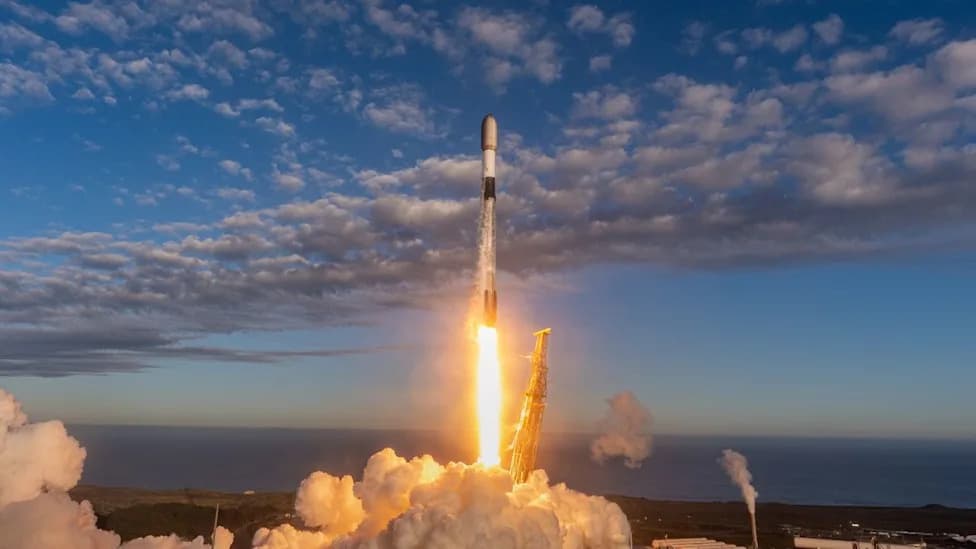
SpaceX's Falcon Heavy returned to flight on April 29, launching the 6.6-ton ViaSat-3 F3 satellite from Kennedy Space Center at 10:13 a.m. EDT. The spacecraft is headed to geostationary orbit about 22,236 miles above Earth and is expected to separate roughly five hours after liftoff. Two side boosters landed back in Florida about eight minutes after launch; the central core was expended into the Atlantic. ViaSat-3 F3 will complete the ViaSat-3 mini-constellation and provide high-throughput broadband across the Asia-Pacific region.
Falcon Heavy Returns: SpaceX Launches ViaSat-3 F3 To Geostationary Orbit
Credit: Spacex
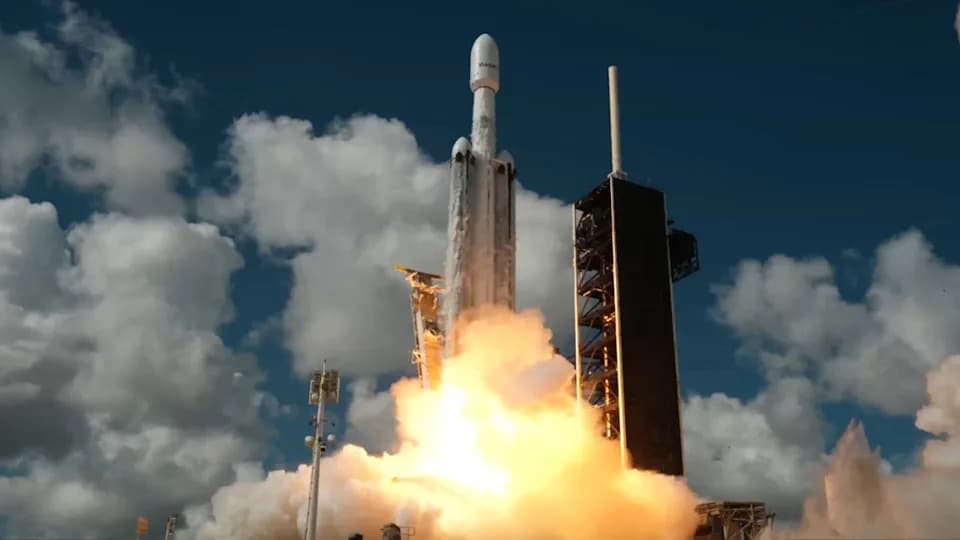
SpaceX's powerful Falcon Heavy returned to flight on April 29, lifting the large ViaSat-3 F3 communications satellite from NASA's Kennedy Space Center (KSC) in Florida. The vehicle lifted off at 10:13 a.m. EDT (1413 GMT) and began a multi-hour climb to geostationary orbit.
Mission Overview
The payload is a roughly 6.6-ton (≈6 metric-ton) communications satellite bound for geostationary orbit (GEO), located about 22,236 miles (35,786 kilometers) above Earth. SpaceX planned to release the spacecraft about five hours after liftoff, pending normal on-orbit operations and deployment procedures.
Rocket Configuration and Performance
Falcon Heavy is built from three modified first stages derived from the Falcon 9 design, strapped together to provide extra lift. The central core carries the upper stage, which is integrated with the ViaSat-3 F3 payload for the climb to orbit. At liftoff, the three boosters together produce roughly 5.1 million pounds of thrust, making Falcon Heavy the second-most-powerful operational launcher today behind NASA's Space Launch System (SLS). SpaceX's Starship, still in development, is designed to produce significantly more thrust at liftoff.
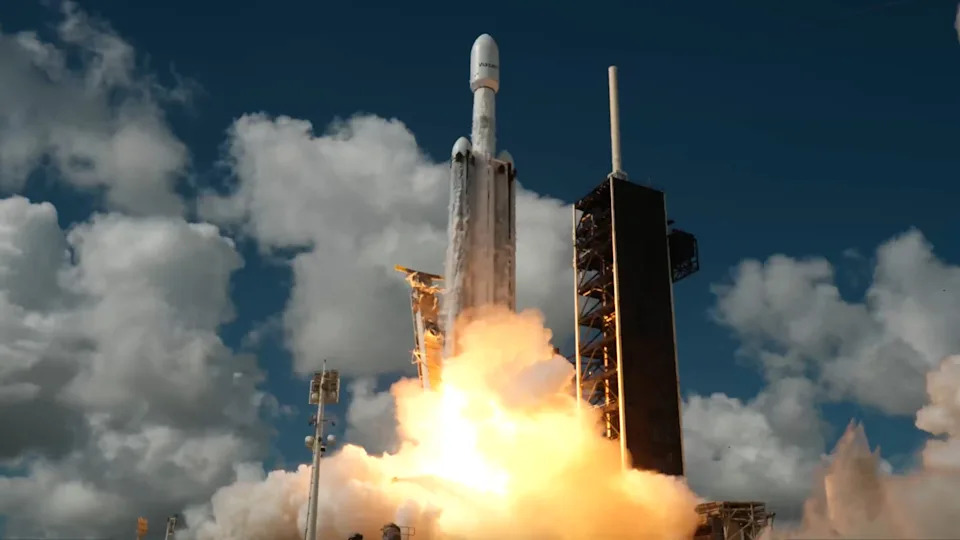
SpaceX's Falcon Heavy rocket launches the ViaSat-3 F3 satellite April 28, 2026. | Credit: Spacex
Program Context
Falcon Heavy debuted in February 2018 on a high-profile demonstration flight that carried a cherry-red Tesla Roadster into a heliocentric orbit. Since that first flight, the vehicle has completed multiple missions without failure. Falcon Heavy's previous flight was in October 2024, when it launched NASA's Europa Clipper toward Jupiter — making this launch the vehicle's return to flight after roughly 18 months.
ViaSat-3 Mini-Constellation
ViaSat-3 F3 is the third satellite in the ViaSat-3 series. ViaSat-3 F1 launched on a Falcon Heavy in April 2023 and is already providing service to airline passengers. ViaSat-3 F2 launched on a United Launch Alliance Atlas V in November 2025 and is slated to serve customers in the Americas when it becomes operational. ViaSat-3 F3 will extend the network’s coverage to deliver high-throughput broadband across the Asia-Pacific region.
"This launch marks a pivotal moment in our journey to bring fast, secure and reliable high capacity, highly flexible broadband to our commercial, defense and consumer customers," said Dave Abrahamian, ViaSat's vice president of space systems, in a company statement.
Booster Recovery And Launch Notes
Following stage separation, the two side boosters successfully returned and landed at SpaceX landing sites near Cape Canaveral about eight minutes after liftoff. The mission profile called for the central core to be expended; it was not recovered and fell into the Atlantic Ocean after completing its role in the ascent. SpaceX had originally targeted April 27 for the launch but postponed the attempt due to unfavorable weather before succeeding on April 29.
Editor’s note: This article was updated after launch to include confirmation of the liftoff and the side booster landings.
Help us improve.