
Researchers mapped ages for about 100,000 giant stars using LAMOST, APOGEE and Gaia and found that active star formation in the Milky Way is largely confined within a radius of roughly 40,000 light-years. The mean stellar age forms a U-shaped profile with the youngest stars near that radius and older populations both inward and at the disk edge. Simulations indicate a sharp drop in star-formation efficiency marks this boundary, and outer-disk stars likely reached those distances via radial migration rather than mergers.
Star Formation Drops Off About 40,000 Light-Years From the Milky Way's Center — Astronomers Puzzled
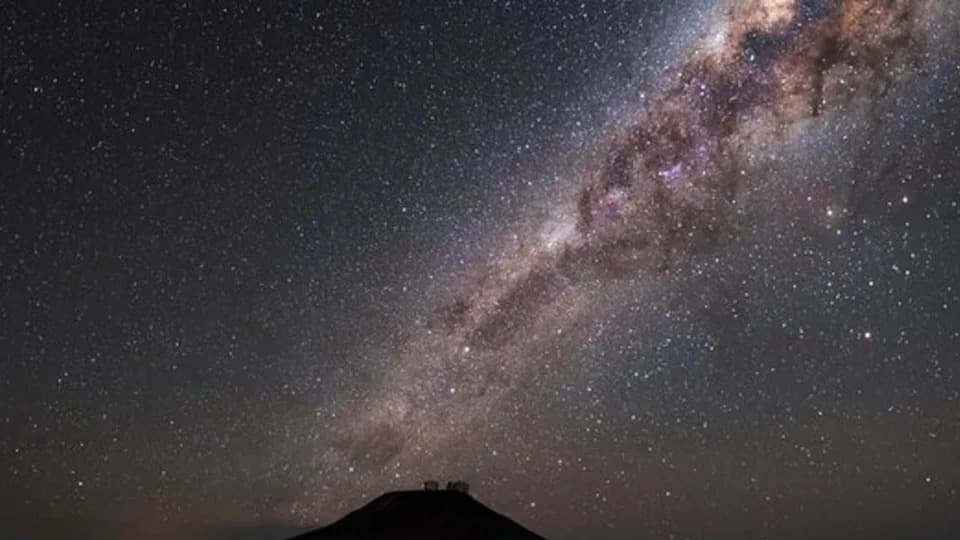
Our Milky Way galaxy's spiral disk is about 100,000 light-years wide, but star formation doesn't occur across that entire span. | Credit: A. Ghizzi Panizza/ESO
A new study identifies a surprisingly sharp outer boundary to active star formation in the Milky Way's spiral disk, at roughly 40,000 light-years from the galactic center. The finding narrows where most new stars are born, despite the Galaxy spanning at least 100,000 light-years across.
What the Team Did
Researchers led by Karl Fiteni (University of Insubria) analyzed about 100,000 luminous giant stars distributed across the Milky Way's disk. They combined spectroscopic age and temperature measurements from China's LAMOST and the APOGEE survey within the Sloan Digital Sky Survey, together with precise astrometry from ESA's Gaia mission. The analysis mapped how mean stellar ages change with distance from the galactic center.
The extent of the Milky Way's star-forming disk has long been an open question in galactic archaeology, and by mapping how stellar ages change across the disk, we now have a clear, quantitative answer.
Key Result: A U-Shaped Age Profile
The study finds a U-shaped radial age profile: average stellar ages decrease with radius from the center, reach a minimum near 40,000 light-years, then rise again toward the disk edge. For context, the Sun orbits about 26,000 light-years from the center, well inside the active star-forming zone.
This pattern is not unique to the Milky Way; other disk galaxies show similar U-shaped profiles. To probe the cause, the team ran high-resolution galaxy simulations on supercomputers to test how star formation and stellar motions shape the age distribution.
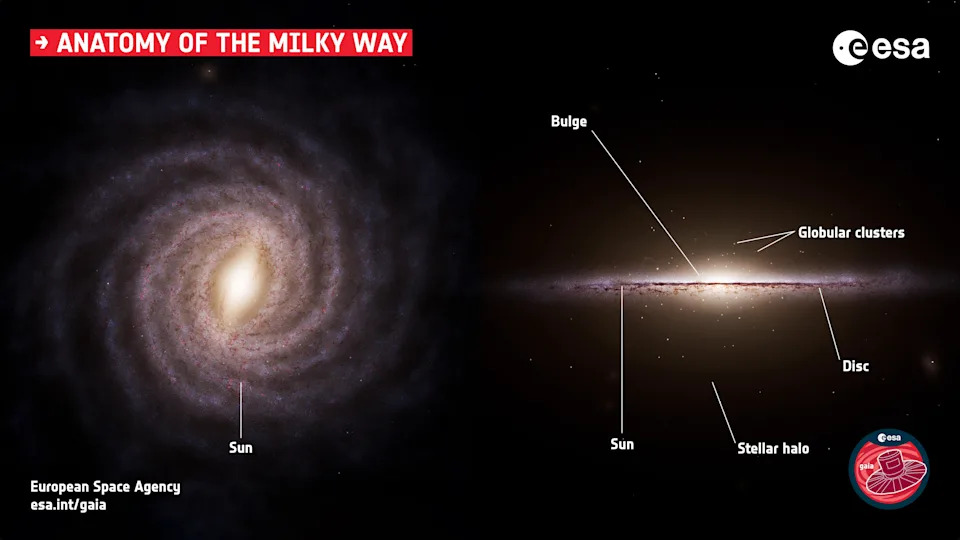
Credit: ESA/Gaia/DPAC/S. Payne-Wardenaar
Why Are There Older Stars Beyond the Boundary?
The outer-disk stars typically travel on nearly circular orbits, indicating they formed within the disk rather than being deposited by a merging satellite. The simulations point to radial migration as the principal mechanism: stars can be carried outward by the same density waves that create spiral arms, gradually reaching large radii over billions of years. This explains why the very edge of the disk can host some of the oldest stars.
A key point about the stars in the outer disk is that they are on close to circular orbits, meaning that they had to have formed in the disk. These are not stars scattered to large radii by an infalling satellite galaxy.
Why Does Star Formation Fall Off at ~40,000 Light-Years?
Simulations indicate a sharp drop in star-formation efficiency at around 40,000 light-years, creating an effective outer boundary for the active star-forming disk. The authors propose several plausible contributors: the Milky Way's central bar, which redistributes gas and can set preferred radii for accumulation; a warp in the disk, possibly caused by interactions with a dwarf galaxy, which could disturb gas densities and inhibit star formation; or a combination of structural and dynamical effects.
Publication
The results were published on April 13 in Astronomy & Astrophysics. Data sources include LAMOST, APOGEE (SDSS), and ESA's Gaia mission.
Why this matters: Knowing where stars form inside a galaxy and why star formation ends helps astronomers understand how galaxies grow and evolve over cosmic time.
Help us improve.





















