
Using NASA's TESS and the ASTEP telescope in Antarctica, astronomers have found a highly unusual planetary system around TOI‑201, about 370 light‑years away. The system includes a ~6‑Earth‑mass rocky super‑Earth (5.8‑day orbit), a 0.5‑Jupiter gas giant TOI‑201b (53‑day orbit), and a distant ~16‑Jupiter giant on a ~2,883‑day orbit. The outer planet's tilted, eccentric path strongly perturbs the inner worlds, causing observable transit‑timing shifts (about 30 minutes for TOI‑201b). Models suggest the system's transits will no longer be visible from Earth in roughly 200 years.
TESS and Antarctic Telescopes Reveal a Rare, Rapidly Changing Exoplanet System Around TOI-201
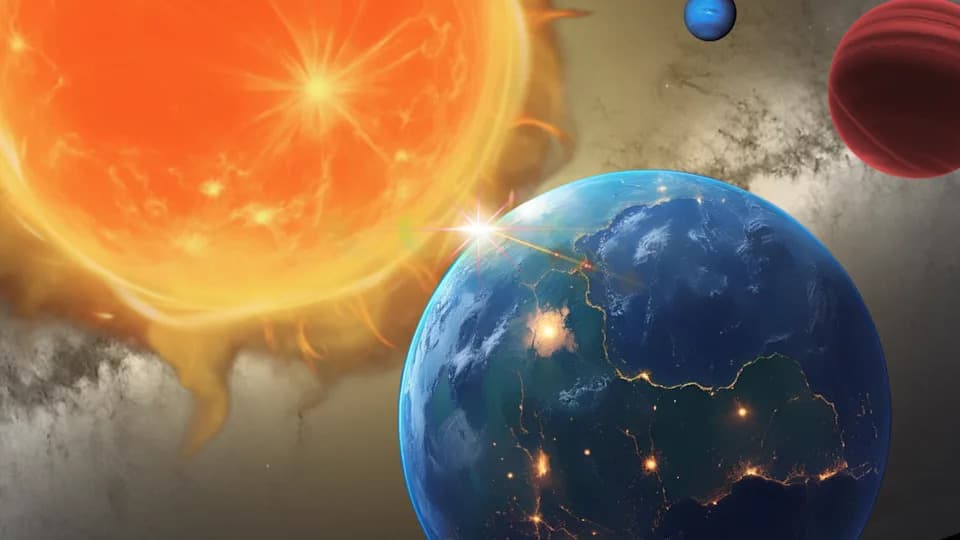
An illustration of a super-Earth exoplanet orbiting its star with very different siblings. | Credit: Robert Lea (created with Canva)
A team combining NASA's Transiting Exoplanet Survey Satellite (TESS) with the Antarctic Search for Transiting ExoPlanets (ASTEP) observatory has identified an unusually dynamic planetary system orbiting the star TOI-201, roughly 370 light-years from Earth. The system's orbital configuration is changing so quickly that astronomers can observe measurable shifts in real time—behavior rarely seen in exoplanet systems.
What Makes TOI-201 Unusual
TOI-201 is about 1.3 times the mass of the Sun and roughly 1.3 times its diameter. Its known planetary companions form a startlingly diverse trio:
- Rocky super‑Earth: ~6 Earth masses, orbital period ~5.8 days.
- TOI‑201b: a gas giant of roughly 0.5 Jupiter masses, orbital period ~53 days.
- Outer giant: a massive planet of ~16 Jupiter masses on a long, ~2,883‑day (≈7.9‑year) orbit.
'Most planetary systems appear as "peas in a pod," with planets of similar sizes and aligned orbits,' said Amaury Triaud of the University of Birmingham. 'This is not the case for TOI‑201, which contains three very different objects that interact strongly through gravity.'
The outer giant follows a tilted, highly eccentric orbit. Its gravitational influence significantly perturbs the inner planets, changing the orientation of their orbits and producing large transit-timing variations (TTVs)—the differences between expected and observed transit times when a planet crosses in front of its star.
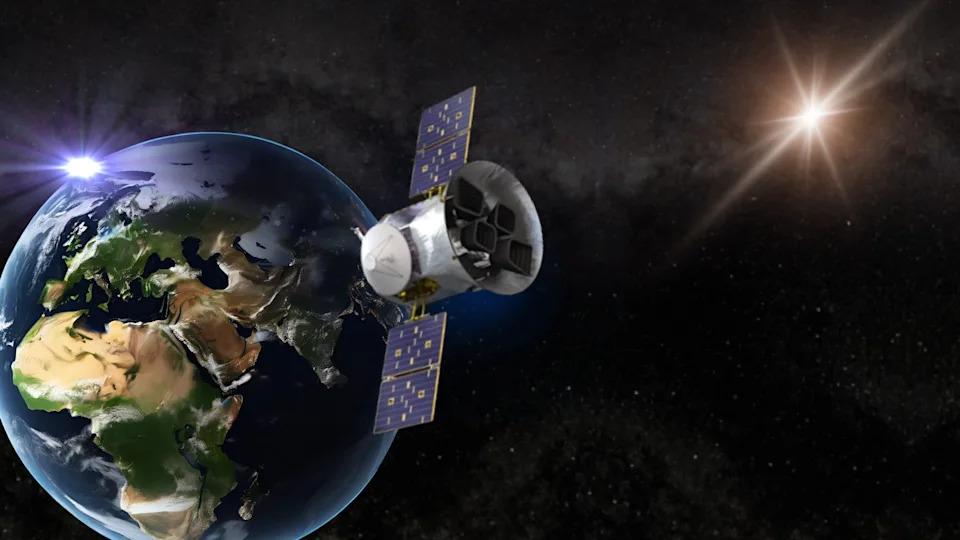
An illustration showing NASA's exoplanet hunter TESS | Credit: Robert Lea (created with Canva)
Real-Time Orbital Changes
While orbital evolution normally takes millions or billions of years, the TOI‑201 system is evolving on much shorter timescales. TESS observed a rare transit of the outer giant, and follow-up observations around the globe—crucially including continuous monitoring from ASTEP at Concordia Station in Antarctica—revealed that TOI‑201b's transits shifted by roughly 30 minutes. According to the team's models, these interactions will eventually change the viewing geometry so that, in about 200 years, the planets will no longer transit from Earth's perspective.
'In the solar system almost all planets lie in the same plane, but here each planet is different,' said Tristan Guillot of the Observatoire de la Côte d'Azur. 'This points to active orbital reorganization and gives us a glimpse into processes that follow planet formation.'
The study, led by Ismael Mireles (a PhD candidate at the University of New Mexico), was published on April 15 in the journal Science. The authors highlight that long, uninterrupted observations from a site like Concordia—benefiting from extended polar nights—were pivotal for detecting and characterizing these long‑period and dynamically active components of the system.
Why This Matters
TOI‑201 offers a rare laboratory for studying planetary dynamics in action: how massive, inclined, and eccentric companions can reshape planetary systems on human‑observable timescales. Continued monitoring will refine models of the system's future evolution and improve our understanding of how diverse planetary architectures emerge.
Help us improve.





















