NASA has set an early-September launch window for the Nancy Grace Roman Space Telescope, a $4.3 billion wide-field observatory that is under budget and ahead of schedule. The 42-foot-tall telescope matches Hubble’s mirror size but surveys far more sky, enabling discoveries of tens of thousands of exoplanets and billions of galaxies over its five-year primary mission. Remaining prelaunch tasks include deployment tests and minor solar-panel repairs; Roman will launch on a SpaceX Falcon Heavy and will also demonstrate a coronagraph for future planet-imaging missions.
NASA Sets Early-September Launch Window for Nancy Grace Roman Space Telescope
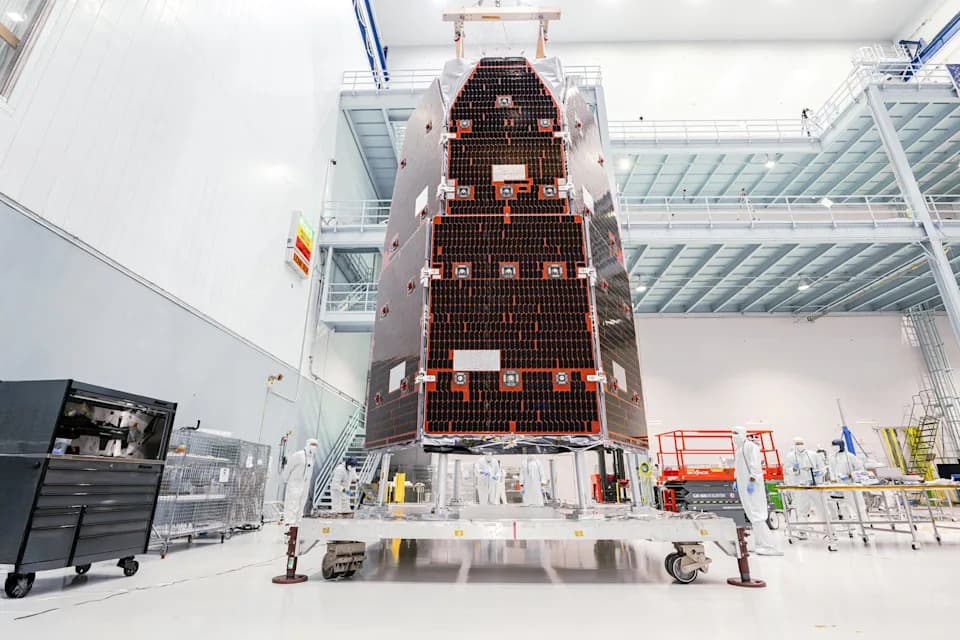
A view of NASA’s Nancy Grace Roman Space Telescope inside a clean room at the space agency’s Goddard Space Flight Center.NASA/Sydney Rohde
GREENBELT, Md. — NASA announced an early-September launch window for the Nancy Grace Roman Space Telescope, a $4.3 billion flagship observatory designed to survey the universe at unprecedented speed and help answer major cosmological questions about dark matter and dark energy.
The completed observatory—more than 42 feet (≈12.8 m) tall and 14 feet (≈4.3 m) wide, with a 7.9-foot (≈2.4 m) primary mirror—was displayed at NASA’s Goddard Space Flight Center during a press briefing. Although its mirror matches Hubble’s diameter, Roman’s instruments deliver a vastly wider field of view: Roman can survey the sky roughly 1,000 times faster than Hubble and capture about 200 times more sky in a single image. The telescope is named for Nancy Grace Roman, NASA’s former chief astronomer and an architect of Hubble.
Schedule, Status and Launch Plan
The spacecraft, valued at about $4.3 billion, is scheduled to ship to Kennedy Space Center in mid-June for final launch preparations and is set to lift off on a SpaceX Falcon Heavy in September. Roman has completed vacuum and thermal testing and is both under budget and months ahead of schedule—an uncommon success for a flagship-class science mission.
Only a few remaining checks remain before shipment: final deployment verifications (including antenna deployment rehearsals) and minor repairs to a small number of solar-panel elements, according to Jackie Townsend, Roman’s deputy project manager. After launch, the mission’s first 45 days will focus on deploying solar arrays and antennas; the next 45 days will emphasize optical calibration and instrument checkout, including the coronagraph demonstration.
Science Goals and Instruments
Over a five-year primary mission, Roman is expected to dramatically expand known catalogs: scientists estimate the telescope could discover tens of thousands of exoplanets, map billions of galaxies, and chart tens of billions of stars. Its wide-field infrared surveys will probe galaxy clustering and cosmic structure across time—critical observations for testing the standard cosmological model and exploring the nature of dark matter and dark energy.
“What would take Hubble 2,000 years to process, Roman can do in a year,” NASA Administrator Jared Isaacman said at the briefing, underlining the mission’s survey power.
Roman also carries a first-of-its-kind high-contrast coronagraph designed to block starlight and reveal faint nearby planets. That coronagraph is both a science tool and a technology demonstrator for future flagship missions such as the Habitable Worlds Observatory, which aims to image Earth-like planets around nearby stars.
Origins, Budget Path and Partnerships
The mission traces part of its roots to a 2012 donation from the U.S. National Reconnaissance Office of two surplus wide-field telescope assemblies and optics—hardware that jump-started what had been developed as WFIRST (Wide-Field Infrared Survey Telescope). Adapting that donated equipment presented engineering challenges, and project managers stress it was not a shortcut to success.
Roman also spent years operating under a strict budget cap that linked future appropriations to development milestones. Project leaders say that approach helped steady funding and reduce risk. The mission survived a proposed White House cut last year after Congress preserved the appropriation. NASA plans to study Roman's execution for lessons applicable to future flagship projects.
Roman will complement other major observatories tackling related questions, including ESA’s Euclid mission and the ground-based Vera C. Rubin Observatory.
“I very much hope, and in fact expect, that the most exciting science from Roman is going to be the things that we didn’t expect, that we couldn’t predict,” said Julie McEnry, Roman’s senior project scientist. “Those discoveries will help set the new deep questions for future missions.”
Help us improve.