
Hubble marks 36 years with a new image of the Trifid Nebula that doubles as a short time-lapse. Comparing Hubble’s 1997 observations with recent data — including images from the Vera C. Rubin Observatory — reveals measurable shifts in gas, dust, and newborn stars. The release highlights Hubble’s unique role in decades-long monitoring that complements newer telescopes like JWST.
Hubble at 36: New Time-Lapse Image Reveals the Trifid Nebula Evolving in Real Time
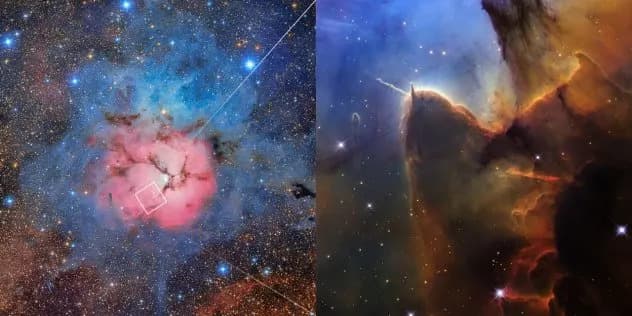
At left is a complete view of the Trifid Nebula (Messier 20 or M20) captured by the NSF-DOE Vera C. Rubin Observatory in Chile. A white box in the lower-left portion of the pink region shows the area the NASA/ESA Hubble Space Telescope targeted, and Hubble’s new image is featured at right. (Image: NASA, ESA, STScI. Image processing: J. DePasquale (STScI))
The Hubble Space Telescope is marking its 36th year in orbit with a striking new view of a familiar stellar nursery — and a reminder that the cosmos is active, not static. To celebrate the milestone, scientists from NASA and the European Space Agency revisited a target Hubble first imaged in 1997: the Trifid Nebula, a turbulent star-forming region about 5,000 light-years from Earth in the constellation Sagittarius.
The anniversary release focuses on a small but rich portion of the nebula, revealing young stars embedded in clouds of gas and dust. Brilliant starlight carves through the surrounding material, lighting delicate ridges and dark lanes that give the Trifid its trademark three-lobed appearance.
Side-by-Side Time-Lapse: Space and Ground Join Forces
A side-by-side comparison pairs Hubble’s long-term optical observations with fresh data from the Vera C. Rubin Observatory in Chile. The combined views showcase how space- and ground-based telescopes complement one another for studying dynamic objects and make subtle changes easier to detect.
By comparing images taken nearly three decades apart, astronomers can see measurable shifts: clouds of gas and dust have moved, and newborn stars are actively reshaping their surroundings.
Although newer observatories such as the James Webb Space Telescope now probe the universe in unprecedented infrared detail, Hubble remains uniquely valuable for long-term optical and ultraviolet monitoring. Its decades-spanning record lets researchers track gradual changes in nebulae, variable stars, and other evolving phenomena — something only a mission with Hubble’s longevity can provide.
Why this matters: Observing the Trifid Nebula over decades gives scientists a near-real-time look at star formation and how young stars sculpt their natal environments, improving models of stellar evolution and the lifecycle of interstellar matter.
Help us improve.





















