
New combined Webb, Hubble and Keck observations produced the first full reflectance spectrum of Uranus's rings and reveal striking differences between the two outermost rings. The mu-ring is dominated by water-ice particles traced to the small moon Mab, while the nu-ring contains ~10–15% carbon-rich organics likely produced by impacts on unseen rocky moonlets. These contrasting compositions suggest multiple, distinct sources for ring material and point to more hidden moons; resolving the remaining questions will likely require a close-up spacecraft mission.
Mysterious Rings of Uranus Point to Hidden Small Moons — New Webb, Hubble and Keck Data Reveal Contrasting Origins
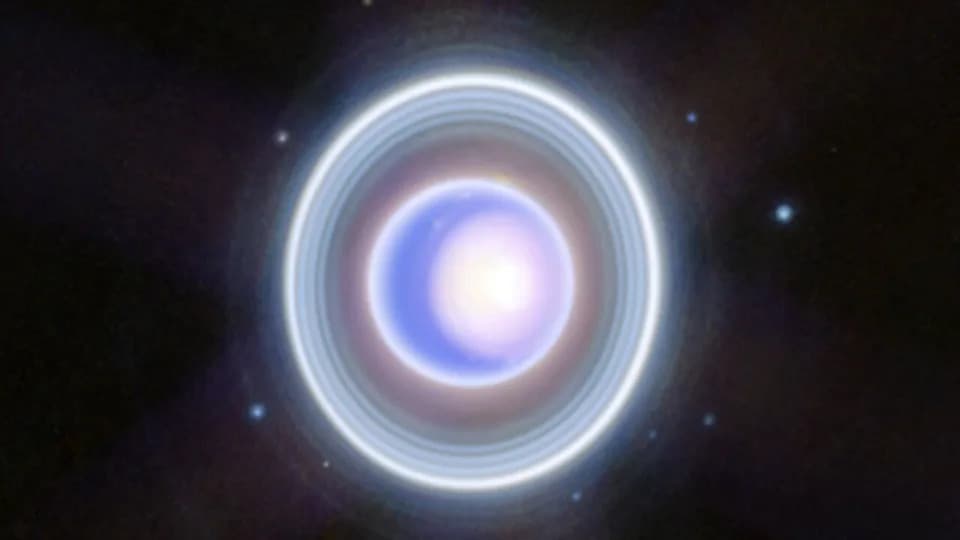
An image of Uranus from NIRCam (Near-Infrared Camera) on the NASA/ESA/CSA James Webb Space Telescope shows the planet and its rings. . | Credit: NASA, ESA, CSA, STScI
New combined observations using the James Webb Space Telescope, the Hubble Space Telescope and Keck Observatory have revealed surprising differences in the composition of Uranus's two outermost rings, suggesting they are fed by distinct—and partially unseen—moonlets orbiting the ice giant.
Unlike Saturn's bright, intricate rings, Uranus's ring system is faint and was first detected in 1977 when the rings briefly blocked starlight during stellar occultations. Voyager 2 provided the first images during its 1986 flyby, and later surveys with Hubble and the 10-meter Keck telescopes uncovered additional faint rings, bringing the total to 13. The two outermost rings, named mu (μ) and nu (ν), were identified in observations taken between 2003 and 2005 by a team led by Mark Showalter of the SETI Institute.
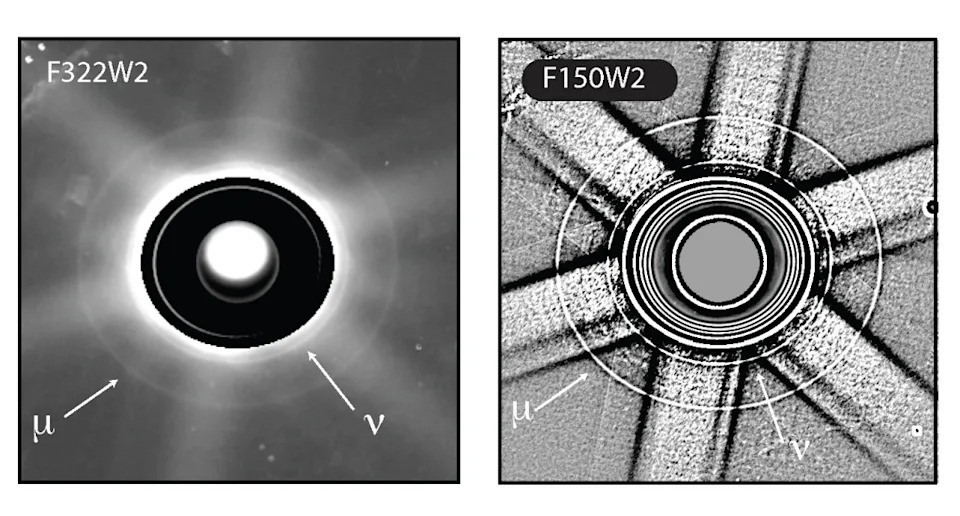
Two views of Uranus's outermost rings, as imaged by the JWST in February 2025. In the image on the left, the brightness of Uranus and its main rings is reduced 100 times. On the right, a high-pass filter has been employed to better see the mu- and nu-rings. | Credit: NASA/ESA/Image processing: Imke de Pater, Matt Hedman
New Spectrum Sheds Light on Ring Composition
By adding infrared measurements from James Webb to the earlier optical data from Hubble and Keck, a team led by Imke de Pater (UC Berkeley) produced the first complete reflectance spectrum of Uranus’s rings—a measurement of how the rings reflect sunlight across wavelengths. The spectrum confirmed that the mu- and nu-rings differ markedly in color and composition, which points to different origins for the particle populations that make up each ring.
"By decoding the light from these rings, we can trace both their particle size distribution and composition, which sheds light on their origins, offering new insight into how the Uranian system and planets like it formed and evolved," said Imke de Pater in a statement.
Mu Ring: Icy and Blue
The reflectance data show the mu-ring is dominated by water-ice particles, giving it a blue appearance. This is similar to Saturn’s E-ring, which is replenished by geysers on the icy moon Enceladus. The icy material in Uranus’s mu-ring can be traced to Mab, an irregular moon roughly 12 kilometers (7.5 miles) across that Mark Showalter discovered in 2003. Why Mab appears to be unusually icy while many neighboring inner moons are rockier and dustier remains an open question.
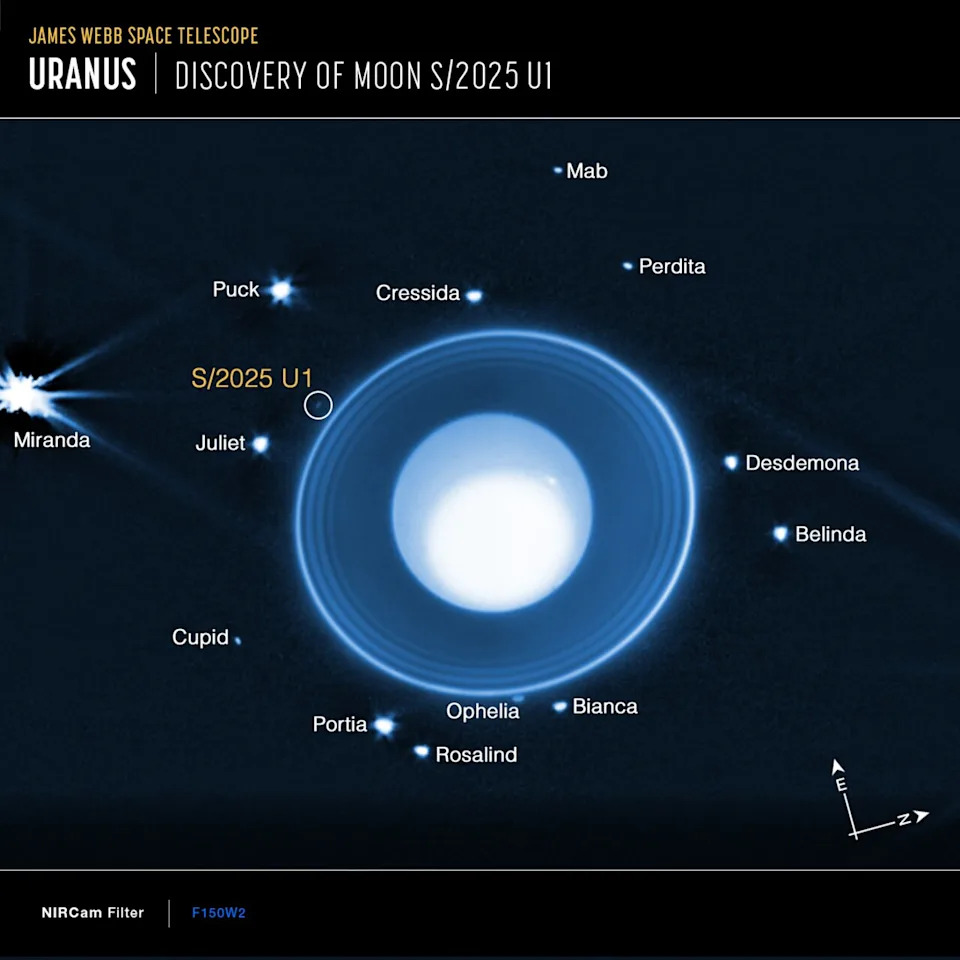
Uranus's inner moons including Mab (top) | Credit: NASA/ESA/CSA/STScI/M. El Moutamid (SWRI)/M. Hedman (University of Idaho)
Nu Ring: Redder and Richer In Organics
By contrast, the nu-ring is redder and "dirtier": the team finds roughly 10–15% of its reflective material is carbon-rich organic compounds typical of bodies in the outer solar system. De Pater and colleagues conclude the nu-ring is likely fed by micrometeorite impacts and collisions that liberate dust from small, unseen rocky moonlets orbiting among the known inner moons.
"The nu-ring material is sourced from micrometeorite impacts on and collisions between unseen rocky bodies rich in organic materials, which must orbit between some of the known moons," de Pater said. "One interesting question is why the parent bodies sourcing these rings are so different in composition."
There are tentative indications that the mu-ring’s brightness has varied subtly over time, though the cause and significance of that change are not yet understood. Given the small sizes and low brightness of the suspected parent bodies, direct confirmation and detailed study will most likely require close-up observations by a dedicated spacecraft mission.
Returning to Uranus has strong scientific backing: the most recent Decadal Survey from the U.S. National Academy of Sciences ranked a Uranus mission as the top planetary priority, though such a mission remains contingent on funding. The team's findings were published on April 16 in Journal of Geophysical Research: Planets.
Help us improve.





















