
The Lyrid meteor shower peaks on Wednesday, April 22, 2026, with an expected 10–20 meteors per hour under largely moonless skies. Early morning around 5 a.m. is likely the best viewing window when Lyra rises higher. The shower is produced by debris from Comet C/1861 G1 (Thatcher), last seen in 1861 and returning around 2276. For best results, go to a dark site, let your eyes adapt, and be patient—photographers will need specialized gear.
Lyrid Meteor Shower 2026 Peaks April 22 — Catch Spring’s Moonless ‘Shooting Stars’
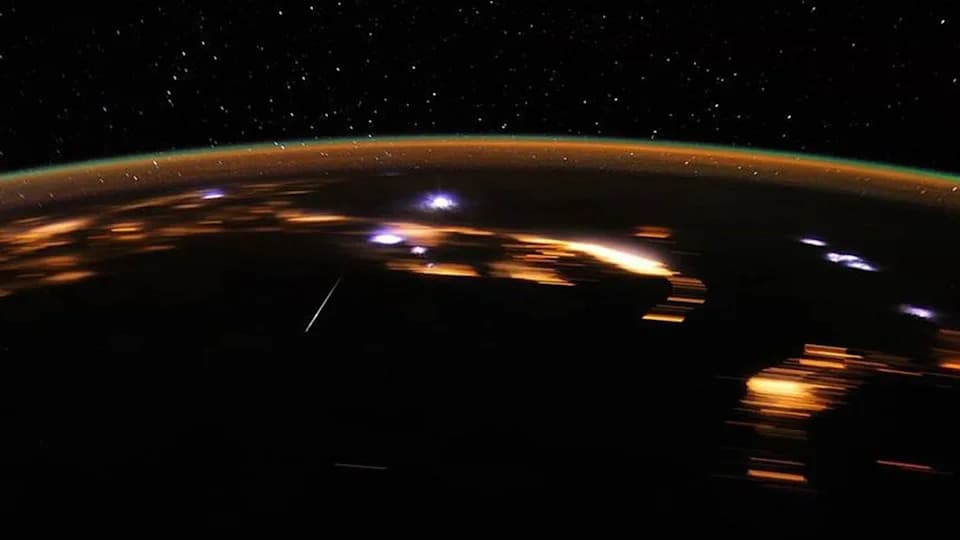
"Shooting stars" from the Lyrid meteor shower as seen from the International Space Station. | Credit: NASA/JSC/D. Pettit
The Lyrid meteor shower, one of the oldest recorded celestial displays, returns in spring 2026 with its peak expected on Wednesday, April 22. Observers in North America and Europe can look forward to 10–20 meteors per hour under favorable, mostly moonless skies — and the occasional bright fireball that leaves a lingering train.
When To Watch
The Lyrids run from April 14 through April 30, with the highest activity forecast on April 22, according to the American Meteor Society. There are two good viewing windows that day: the hours after sunset and the predawn period, but the best conditions are typically in the early morning (around 5 a.m.) when the shower’s radiant in the constellation Lyra climbs higher above the horizon.
Why Moonlight Won’t Be a Problem
A new moon occurs on April 17, so the moon will be a thin crescent by April 22 and largely out of the sky during the prime predawn viewing hours. Although a sliver of moonlight may be visible after dark on April 22, the moon will set in the west as Lyra rises in the east, minimizing interference with viewing.
What Causes the Lyrids
The Lyrids originate from debris shed by Comet C/1861 G1 (Thatcher). Earth passes annually through that debris stream, and particles burn up in our atmosphere, producing streaks of light we call meteors. Comet Thatcher completes an orbit roughly every 415.5 years; it last visited the inner solar system in 1861 and is not expected to return until about 2276, per NASA.
Notable Characteristics
Though the Lyrids’ typical hourly rate is lower than richer showers like the Perseids or Geminids, they are known for fast, bright meteors and occasional unpredictable outbursts. Historical spikes — reported in 1803, 1922, 1945 and 1982 — reached rates near 100 meteors per hour, but such events are rare and difficult to predict.
Viewing Tips
For the best experience: choose a dark location well away from city lights, check local weather and a light-pollution map, allow at least 20–30 minutes for your eyes to adapt to the dark, and be patient — meteors can appear anywhere in the sky. The shower is best enjoyed with the naked eye; binoculars or telescopes restrict your field of view and make it harder to catch fast-moving meteors. Photographers will need a wide-angle lens, a sturdy tripod, and long exposures (plus patience) to capture streaks and fireballs.
Quick reminder: Peak activity is predicted, not guaranteed. Bring warm clothing for predawn hours and give your eyes time to adjust for the most satisfying show.
Help us improve.





















