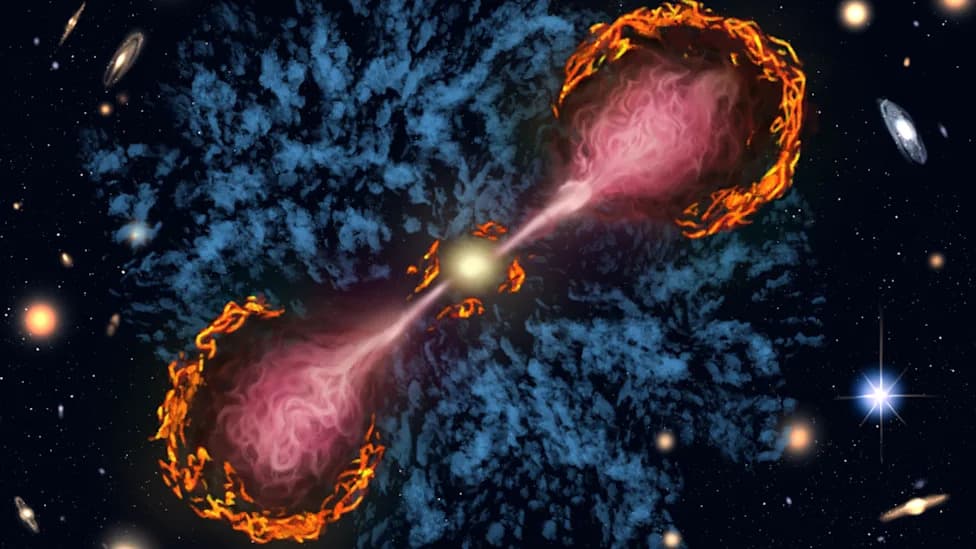
The jets of Cygnus X-1 are bent by the strong stellar wind of its companion, producing a reproducible, orbital-phase-dependent “dancing” pattern. Re-analysis of VLBI radio data and long-term archival images allowed researchers to infer the jets' momentum and make a direct, instantaneous measurement of kinetic power: ≈3.6 × 10^37 erg/s with a launch speed ≈0.52c. The jets carry roughly 10% of the accretion energy and are aligned with the binary to within 8.2°, validating long-term calorimetric estimates used in galaxy-evolution models.
“Dancing” Jets From Cygnus X-1 Reveal Instantaneous Black-Hole Power
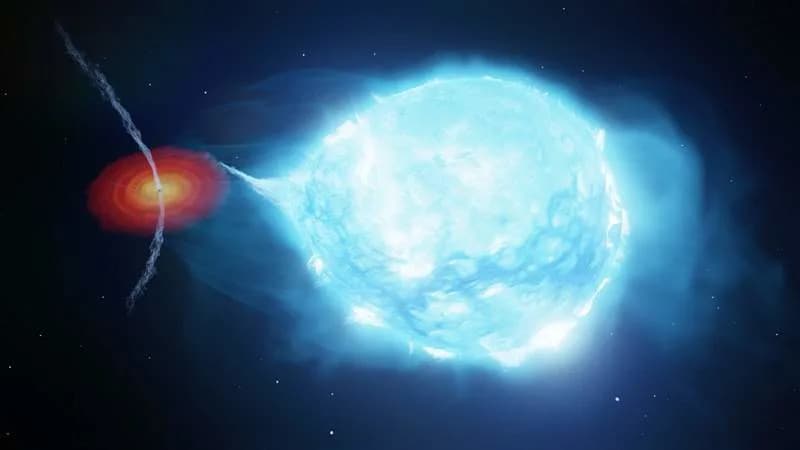
The strong stellar wind from the supergiant star pushes the jets launched by the black hole away from the star. This causes the jet direction to vary as the black hole and the supergiant star move around their orbit. (CREDIT: ICRAR)
A detailed radio study of the X-ray binary Cygnus X-1 shows the system’s twin jets are swept aside by the strong wind of its massive companion, producing a repeating, phase-dependent “dancing” pattern. By modeling how the stellar wind bends the jets, astronomers have for the first time measured the jets’ kinetic power directly and in real time.
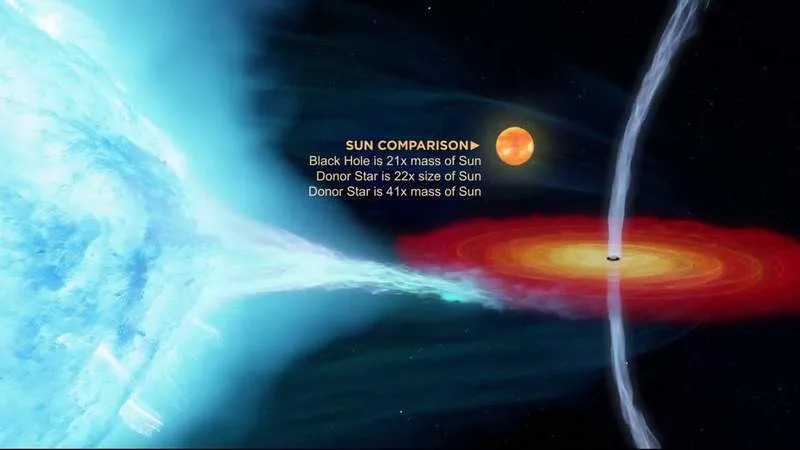
Artist’s impression of the Cygnus X-1 binary system, showing how the wind of the supergiant star bends the black hole’s jets away from the star as the objects move in their orbit around one another. (CREDIT: International Centre for Radio Astronomy Research (ICRAR))
How they did it. The team re-analysed very long baseline interferometry (VLBI) data from a 2016 campaign — combining six 8.4 GHz observations from the Very Long Baseline Array (VLBA) with three 5 GHz epochs from the European VLBI Network (EVN) — and compared them with archival radio images spanning 18 years. The VLBI technique links widely separated radio dishes so they act like a single, planet-sized telescope, resolving jet structure close to the black hole.

A model-independent demonstration of bent jets in Cygnus X-1. (CREDIT: Nature Astronomy)
What they found. The approaching and receding jets are deflected in opposite directions, each pushed away from the donor O-type supergiant’s wind. That pattern rules out a simple symmetric precession model and instead matches a wind-bending scenario in which the dense stellar outflow deflects the jets near their base while the black hole’s orbital motion winds that deflection into a helical shape.

Jet trajectories for each of the VLBA observations in 2016, determined from our physically motivated jet model. (CREDIT: Nature Astronomy)
Knowing the wind’s momentum flux and measuring the jet bending allowed the researchers to convert geometry into physics. The team reports an instantaneous jet kinetic power of roughly 3.6 × 10^37 erg s⁻¹ (about the combined luminosity of 10,000 Suns) and a launch speed near 0.52c (≈150,000 km s⁻¹). They estimate the jets carry off about 10% of the liberated accretion energy.

In the above figure, Ψ is the bending angle of the jet. The misalignment angle θ is measured clockwise in the z-x plane (in the same plane as the bending angle), with a positive angle denoting the jet pointed away from the star. For θ = 0 the jet would be launched along the z-axis. (CREDIT: Nature Astronomy)
"A key finding from this research is that about 10 per cent of the energy released as matter falls in towards the black hole is carried away by the jets," said lead author Dr. Steve Prabu. "This is what scientists usually assume in large-scale simulated models of the Universe, but it has been hard to confirm by observation until now."
Alignment and broader implications. Models that include a strongly tilted jet predict dramatic, asymmetric behaviour that is not seen. The team therefore places a conservative upper limit of 8.2° on the misalignment between the jet axis and the binary orbital plane, consistent with Cygnus X-1’s low eccentricity and low peculiar velocity — signs the black hole formed with only a small natal kick. The measured instantaneous power also agrees with long-term, time-averaged estimates from the surrounding radio nebula, supporting the use of calorimetric methods in other systems.
Because black-hole jets are central ingredients in galaxy-formation simulations — where they heat and displace gas over vast scales — this direct, real-time measurement provides a crucial observational anchor. The result strengthens confidence that the assumptions used to model black-hole feedback in both stellar-mass and supermassive systems are on the right track.
System facts. Cygnus X-1 lies at about 2.22 kiloparsecs and contains a black hole of roughly 21.2 solar masses orbiting an O-type supergiant every 5.6 days.
The study is published in Nature Astronomy.
Help us improve.