
The Full Moon occurs when Earth is nearly between the Sun and Moon, fully illuminating the Moon’s near side. The next Full Moon — the Flower Moon — peaks at 1:23 p.m. EDT on May 1, 2026. This article lists every 2026 Full Moon (with times and traditional names), highlights eclipses and supermoons, and includes detailed April 17–24 observing notes with rise/set times and viewing tips. Check a local almanac or planetarium app for exact times at your location.
2026 Full Moon Calendar — When To See Each Full Moon, Names, Eclipses and Observing Tips
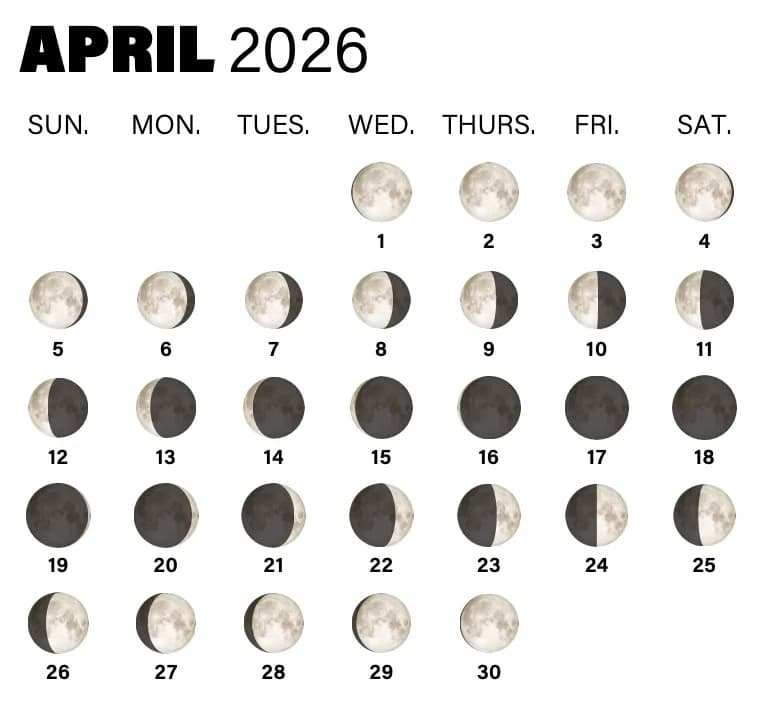
Note: Moon phases in the calendar vary in size due to the distance from Earth and are shown at 0h Universal Time. Credit: Astronomy: Roen Kelly
The Full Moon occurs when Earth lies nearly directly between the Sun and the Moon, allowing the Moon’s near side to be fully illuminated by sunlight. As the Moon orbits Earth, the angle of sunlight changes and produces the familiar sequence of lunar phases.
Next Full Moon: The Flower Moon reaches peak illumination at 1:23 p.m. EDT on Friday, May 1, 2026.
2026 Full Moon Dates (All Times Eastern)
- Saturday, Jan. 3 — 5:03 a.m. — Wolf Moon*
- Sunday, Feb. 1 — 5:09 p.m. — Snow Moon
- Tuesday, March 3 — 6:38 a.m. — Worm Moon | Total lunar eclipse
- Wednesday, April 1 — 10:12 p.m. — Pink Moon
- Friday, May 1 — 1:23 p.m. — Flower Moon
- Sunday, May 31 — 4:45 a.m. — Blue Moon
- Monday, June 29 — 7:57 p.m. — Strawberry Moon
- Wednesday, July 29 — 10:36 a.m. — Buck Moon
- Friday, Aug. 28 — 12:19 a.m. — Sturgeon Moon | Partial lunar eclipse
- Saturday, Sept. 26 — 12:49 p.m. — Corn Moon
- Monday, Oct. 26 — 12:12 a.m. — Hunter’s Moon
- Tuesday, Nov. 24 — 9:54 a.m. — Beaver Moon*
- Wednesday, Dec. 23 — 8:28 p.m. — Cold Moon*
*Denotes a Super Moon (Full Moon near lunar perigee).
Weekly Observing Notes: April 17–24 (Reference Location: 40°N, 90°W)
Friday, April 17 — New Moon occurs at 7:52 A.M. EDT. Sunrise: 6:19 A.M. • Sunset: 7:41 P.M. • Moonrise: 6:04 A.M. • Moonset: 8:24 P.M. • Moon Phase: Waxing crescent (1%).
Saturday, April 18 — Look west after sunset for a striking pairing: brilliant Venus about 11° above the horizon with a delicate crescent Moon roughly 6° to its lower right. The Moon is about 1.5 days old (≈4% illuminated) and the darker part of the disk may be visible by earthshine. Sunset: 7:42 P.M. • Moonset: ~9:44 P.M. • Moon Phase: Waxing crescent (4%).
Sunday, April 19 — The Moon reaches perigee (closest approach) at 2:56 A.M. EDT at about 224,707 miles / 361,631 km. That morning it passes ~5° north of Venus (≈5:00 A.M. EDT) and later ~5° north of Uranus (≈2:00 P.M. EDT). By evening the Moon is ≈10% lit, near the Pleiades in Taurus. Sunrise: 6:16 A.M. • Moonset: 11:03 P.M. • Moon Phase: Waxing crescent (10%).
Monday, April 20 — Sunrise: 6:14 A.M. • Moonrise: 8:06 A.M. • Moon Phase: Waxing crescent (18%).
Tuesday, April 21 — Sunrise: 6:13 A.M. • Moonrise: 9:07 A.M. • Moonset: 12:16 A.M. • Moon Phase: Waxing crescent (28%).
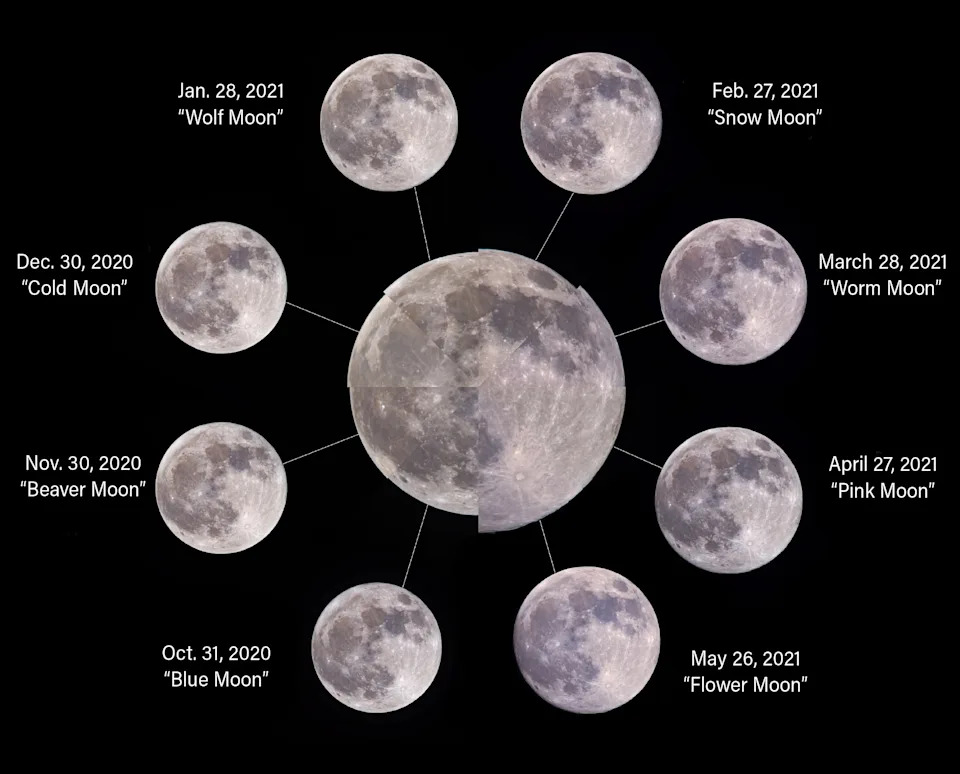
A composite of each month’s Full Moon in 2020 and 2021. Credit: Soumyadeep Mukherjee
Wednesday, April 22 — At 6:00 P.M. EDT the Moon passes ~4° north of Jupiter in Gemini. After sunset the pair will be high in the western sky with the Moon just to Jupiter’s upper right. Sunset: 7:46 P.M. • Moonset: 1:18 A.M. • Moon Phase: Waxing crescent (39%).
Thursday, April 23 — First Quarter at 10:32 P.M. EDT. Sunrise: 6:10 A.M. • Moonrise: 11:31 A.M. • Moonset: 2:07 A.M. • Moon Phase: First Quarter.
Friday, April 24 — The waxing Moon is in eastern Cancer near the Beehive Cluster (M44), a great binocular target even with lunar glare nearby. Through a telescope, examine the terminator for features such as Mare Serenitatis and the crater Posidonius. Sunrise: 6:09 A.M. • Moonrise: 12:45 P.M. • Moonset: 2:45 A.M. • Moon Phase: Waxing gibbous (61%).
Why The Moon Appears To Change
The main lunar phases are New Moon, Waxing Crescent, First Quarter, Waxing Gibbous, Full Moon, Waning Gibbous, Last Quarter and Waning Crescent. A synodic (lunar) month — from one Full Moon to the next — averages about 29.5 days. Although the Moon is precisely full at one instant, it appears essentially full to most observers for roughly three days centered on that instant.
Named Full Moons — Origins And Meanings
Many traditional Full Moon names come from Native American, Colonial American and other North American folklore. They reflect seasonal changes and natural events:
- Wolf Moon (January) — Named for wolves howling in winter.
- Snow Moon (February) — Associated with heavy winter snowfall.
- Worm Moon (March) — Signals earthworms returning as the ground thaws.
- Pink Moon (April) — After spring pink wildflowers.
- Flower Moon (May) — Celebrates abundant blooms.
- Strawberry Moon (June) — Marks the strawberry-harvest season.
- Buck Moon (July) — When bucks grow new antlers.
- Sturgeon Moon (August) — Named for abundant sturgeon in some regions.
- Corn Moon (September) — Around corn harvest time.
- Hunter’s Moon (October) — Linked to pre-winter hunting season.
- Beaver Moon (November) — Beavers preparing for winter.
- Cold Moon (December) — Reflects winter cold.
Special Moon Terms
- Super Moon: A Full Moon near lunar perigee (closest approach) that appears slightly larger and brighter.
- Blue Moon: The second Full Moon in a calendar month with two Full Moons (roughly every 2.7 years); not actually blue except under unusual atmospheric conditions.
- Black Moon: An informal term for certain New-Moon patterns (e.g., the second New Moon in a month or the third of four New Moons in a season).
- Harvest Moon: The Full Moon nearest the autumnal equinox; it often provides extended evening illumination for harvest activities.
Tides And The Moon
Moon’s gravity pulls on Earth’s oceans, creating tidal bulges. During Full and New Moons, the Sun, Earth and Moon are aligned and their combined gravity produces spring tides — higher high tides and lower low tides.
About The Phase Dates In This Post
The full-moon list above is the complete set of Full Moons for 2026 (Eastern times). Daily rise/set times and moon illumination percentages in the April observing notes are given for the reference location 40°N, 90°W and for 10:00 p.m. local time where noted. For precise local times and a full phase-by-phase calendar for your location, consult a trusted astronomy almanac or planetarium app.
Originally published by Astronomy Magazine. This version clarifies the weekly observing notes, tightens language, and corrects inconsistencies while preserving the published Full Moon calendar and key sky-event information.
Help us improve.





















