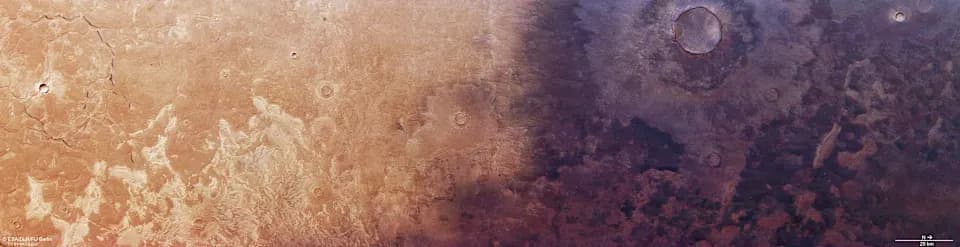
New HRSC imagery from ESA’s Mars Express reveals a dark, volcanic-hued region expanding across Utopia Planitia, contrasting with adjacent rust-colored sands. Comparison with 1976 Viking photos shows a clear expansion over decades rather than millennia. Scientists believe strong winds are redistributing volcanic ash or removing surface dust to expose darker rock; the photo also hints at buried water ice and impact features.
Dark Volcanic Wave Appears to Spread Across Mars’ Utopia Planitia
ESA/DLR/FU BerlinSign up for Today in Science, a free daily newsletter from Scientific American and join a community of science-loving readers.
Volcanic-colored material appears to be advancing across Mars’ Utopia Planitia at a pace that surprised researchers. A new orbital image from the European Space Agency’s Mars Express, taken with its High Resolution Stereo Camera (HRSC), shows a sharp boundary between rust-colored modern sands and darker terrain stained by ancient volcanic minerals.
Striking Change Since Viking
An aside-by-aside comparison with NASA’s Viking orbiter photos from 1976 reveals a noticeable increase in that dark area. Surface changes on Mars typically take place over geologic timescales, so observing such a visible expansion across decades is notable and worth investigation.
What’s Causing the Darkening?
Planetary scientists say strong Martian winds are the most likely driver. The winds could be transporting loose deposits of volcanic ash across the plain, or they may be stripping away a thin veneer of lighter dust and sand to expose darker igneous rock beneath. Both processes would produce the effect of a spreading dark patch and have been invoked to explain similar changes seen elsewhere on Mars.
The image also reveals shadowed fractures and shallow pits that hint at substantial volumes of buried water ice, and it captures multiple impact craters surrounded by ejecta from their explosive formation. Together, these features underline the region’s complex geological and climatic history — including the possibility that Utopia Planitia once hosted a large body of water.
Continued Value From Mars Express
Launched in 2003, ESA’s Mars Express continues to supply high-resolution imagery more than two decades after arrival. Each new picture provides fresh clues about Mars’s ancient, more Earth-like past and helps scientists track active surface processes today.
Image credit: ESA/DLR/FU Berlin
Help us improve.