Zodiacal light is a faint, pyramid-shaped glow caused by sunlight scattering off interplanetary dust and may be visible this spring across the Northern Hemisphere. New analysis of Juno spacecraft dust impacts suggests a significant fraction of that dust may originate near Mars and be shaped by Jupiter's gravity. Look toward the western horizon about 90 minutes after sunset from a dark site between late February and early May, preferably on a new-moon night for the best chance to see it.
Spot Zodiacal Light This Spring: How and When to See the Ghostly Pyramid Over California Skies
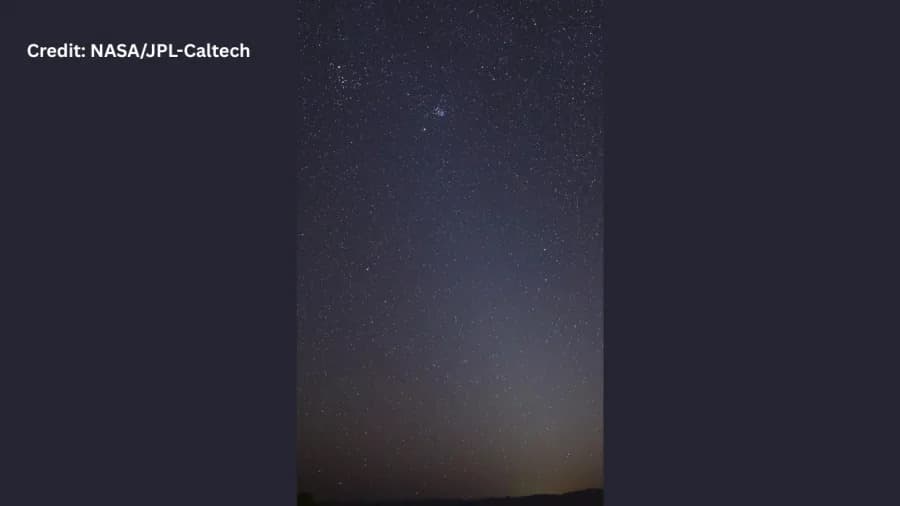
A faint, pyramid-shaped glow known as zodiacal light may be visible in the early-evening sky this spring across the Northern Hemisphere, including California. Though it can resemble the first light of dawn or the last glow of dusk, this soft cone of light is sunlight scattered by tiny dust particles in the inner solar system.
What Is Zodiacal Light?
Often called "false dusk" or "false dawn," zodiacal light appears as a smooth, triangular beam rising from the horizon after sunset or pointing upward before sunrise. Unlike the star-rich, textured band of the Milky Way, the zodiacal glow looks hazy and diffuse — more like a ghostly cone stretching up from the horizon.
Where Does the Dust Come From?
Scientists at NASA's Jet Propulsion Laboratory explain that zodiacal light is produced when sunlight reflects off a broad cloud of interplanetary dust lying roughly in the plane of the Solar System. For decades researchers attributed much of this dust to comets and asteroid collisions. Newer research, however, points to an additional, surprising contributor: Mars.
A study published with the American Geophysical Union and highlighted by NASA used dust-impact detections from the Juno spacecraft — launched in 2011 and still active — to map dust distributions through the inner solar system. The team reports a dust band extending outward to roughly Mars' orbit, shaped in part by Jupiter's gravity.
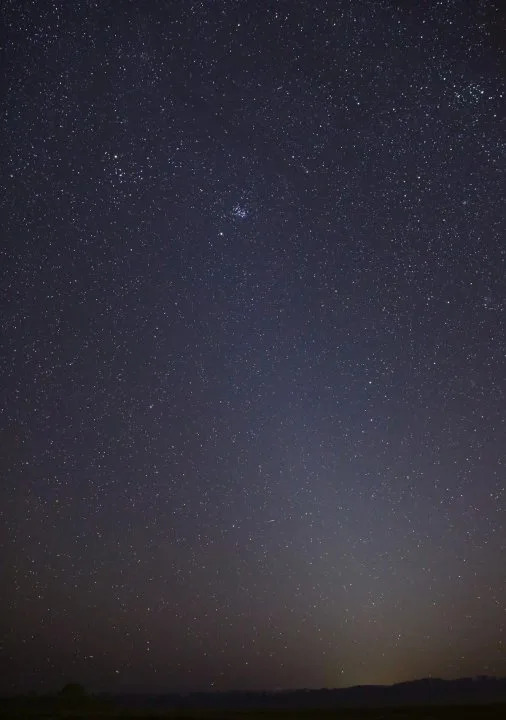
This photo shows the zodiacal light as it appeared on March 1, 2021, in Skull Valley, Utah. (Credit: NASA/JPL-Caltech)
"The profound influence of the gravity barrier indicates that the dust particles are in a nearly circular orbit around the Sun," said John Leif Jørgensen, a professor at the Technical University of Denmark and a co-author of the study. "And the only object we know of in almost circular orbit around 2 AU is Mars, so the natural thought is that Mars is a source of this dust."
Mars is a famously dusty planet with frequent storms, and researchers suggest surface dust may be lofted and eventually escape into space to join the zodiacal cloud. The exact mechanisms by which particles overcome Mars' gravity are still under investigation.
When And Where To Look
Spring is one of the best seasons for Northern Hemisphere observers to see zodiacal light. The glow is most likely around the March equinox, with viewing opportunities generally from late February through early May, though sightings are never guaranteed.
- Timing: Face the western horizon roughly 90 minutes after sunset to spot the evening form; before dawn it appears near the eastern horizon.
- Location: Choose a dark site well away from city lights with a clear, low horizon.
- Moon Phase: Avoid moonlit nights — new-moon windows are ideal because the glow is very faint.
Although zodiacal light can be mistaken for early dawn or lingering twilight, it's simply sunlight scattered by billions of minute dust grains orbiting the Sun. It's not evidence of extraterrestrial activity — just a subtle and unusual celestial display that rewards patient stargazers.
Try to catch it while conditions are favorable: clear skies, a dark location, and the right timing can make this elegant solar-system feature visible to the naked eye.
Help us improve.