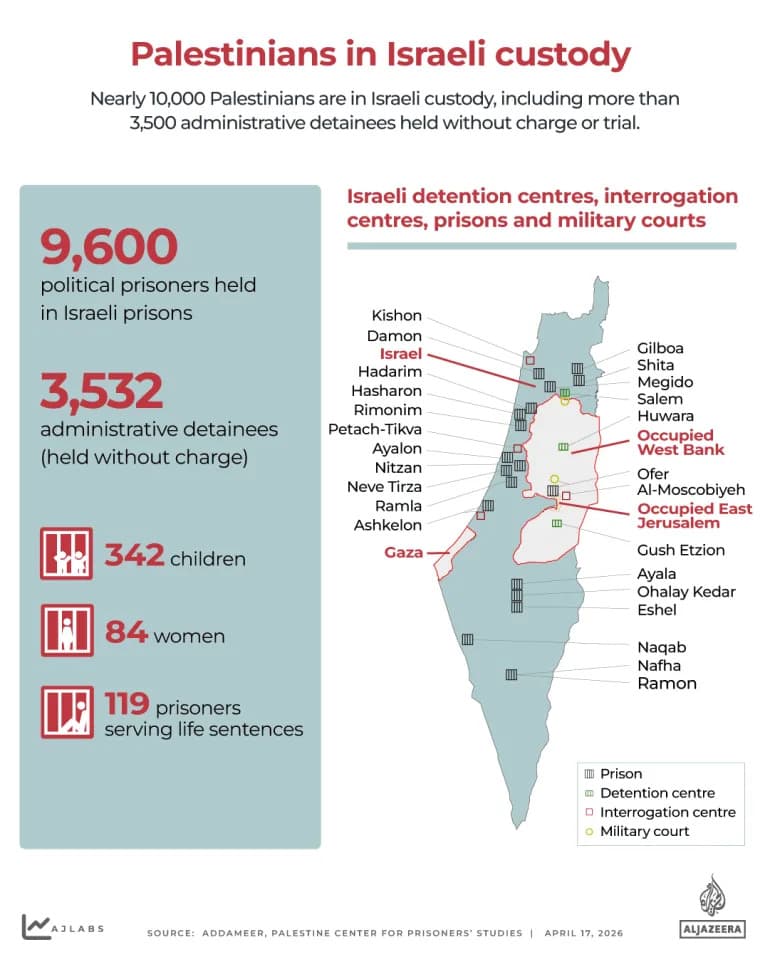
Palestinian Prisoners’ Day, observed on April 17, commemorates the 1971 release of Mahmoud Bakr Hejazi and the subsequent 1974 designation of the day by the Palestinian National Council. As of early April, roughly 9,600 Palestinians were detained—including 3,532 administrative detainees, 342 children and 84 women—according to Addameer. The recent Israeli law permitting the death penalty for Palestinians tried in military courts has drawn international condemnation, with rights groups and the UN warning it is discriminatory and may breach international law. Critics also point to a roughly 96% conviction rate in military courts and longstanding allegations of coerced confessions and ill-treatment.
Palestinian Prisoners’ Day — April 17, 1971: History and Today's Crisis as New Death-Penalty Law Sparks International Outcry
INTERACTIVE-Palestinians in Israeli custody -1776338314
Each year on April 17 Palestinians observe Palestinian Prisoners’ Day to remember thousands of men, women and children held in Israeli detention. This year’s commemoration is taking place against the backdrop of a newly approved Israeli law that would allow military courts to impose the death penalty on Palestinians convicted of deadly attacks — a measure that rights groups and international officials say is discriminatory and may violate international law.
Origins of the Day
April 17 became associated with Palestinian detainees after the first prisoner exchange between Israeli and Palestinian representatives, when Mahmoud Bakr Hejazi was released on April 17, 1971. In 1974 the Palestinian National Council formally designated April 17 as Palestinian Prisoners’ Day. Since then the date has been used to draw national and international attention to the plight of Palestinians under Israeli occupation.
INTERACTIVE-Palestinians in Israel's administrative detention-1776338341
Who Is Detained?
According to prisoners’ rights group Addameer, as of early April more than 9,600 Palestinians were being held by Israeli authorities, either inside Israel or in territory under Israeli control. The breakdown reported includes:
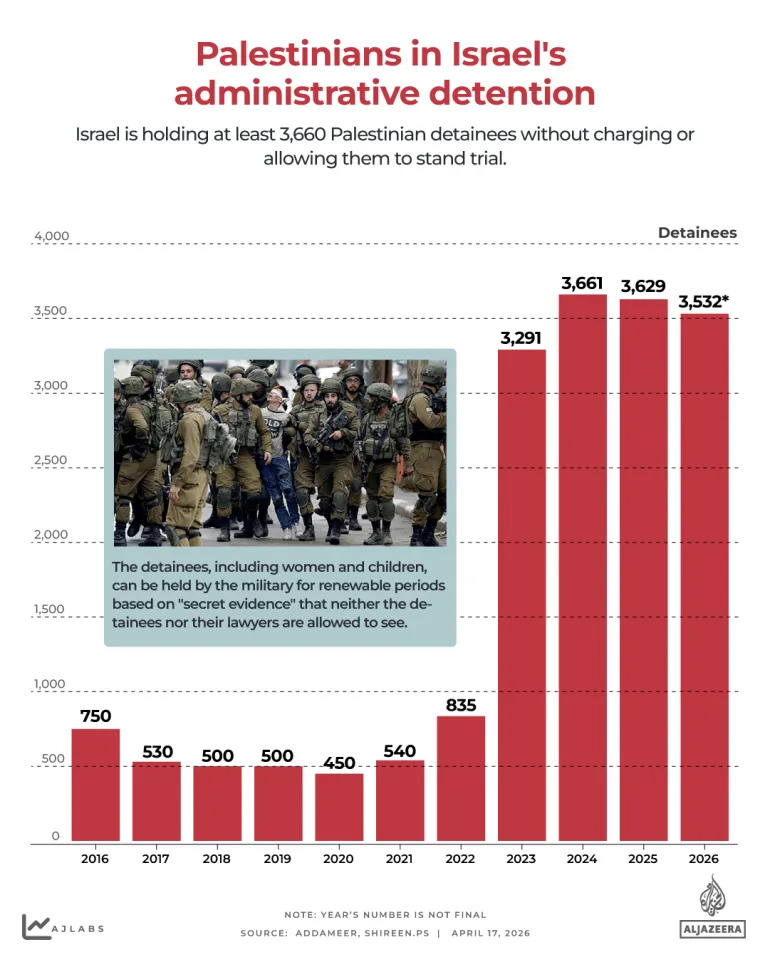
- 3,532 held under administrative detention — held without charge or trial and subject to six-month renewable orders
- 342 children
- 84 women
- 119 serving life sentences
Administrative Detention and Military Courts
Administrative detention is a long-standing policy that allows authorities to detain people without formal charges for successive six-month periods. Israeli authorities argue the measure is used while intelligence is gathered, but critics and rights groups say it is frequently abused, denying detainees basic due-process protections.
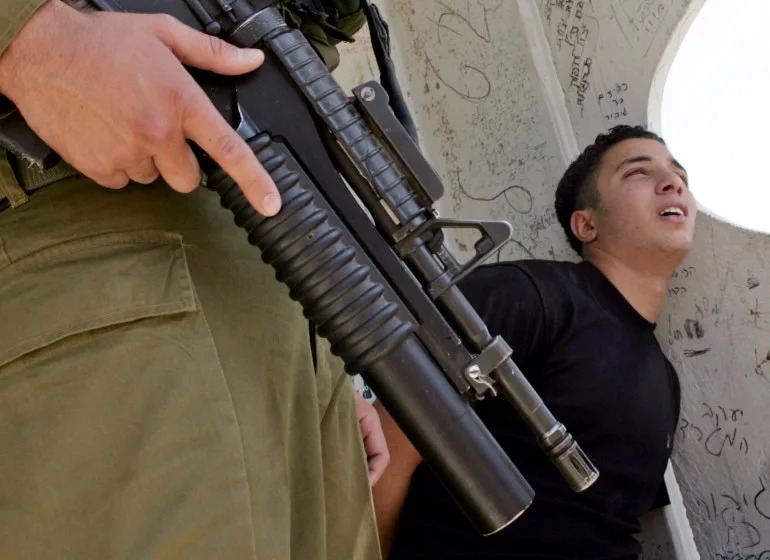
An Israeli soldier guards Palestinian Hasan Khalifeh, 15, after he was arrested near the occupied West Bank city of Nablus on August 29, 2005 [Abed Omar Qusini/Reuters]
Palestinians from the West Bank and East Jerusalem are typically tried in Israeli military courts rather than civilian courts. International law permits military courts in occupied territory in limited circumstances, but critics point to a dual legal system: Israeli settlers in the West Bank and East Jerusalem are subject to Israeli civil law, while Palestinians are subject to Israeli military law administered by soldiers and officers.
Children and Allegations of Ill-Treatment
Israel is one of the few countries that regularly try children in military courts; Addameer reported 342 children in detention in early April. Child-rights groups say many arrested minors face harsh interrogation practices, are questioned without a parent or lawyer present, and in some cases are pressured into confessions or used to extract fines from families.
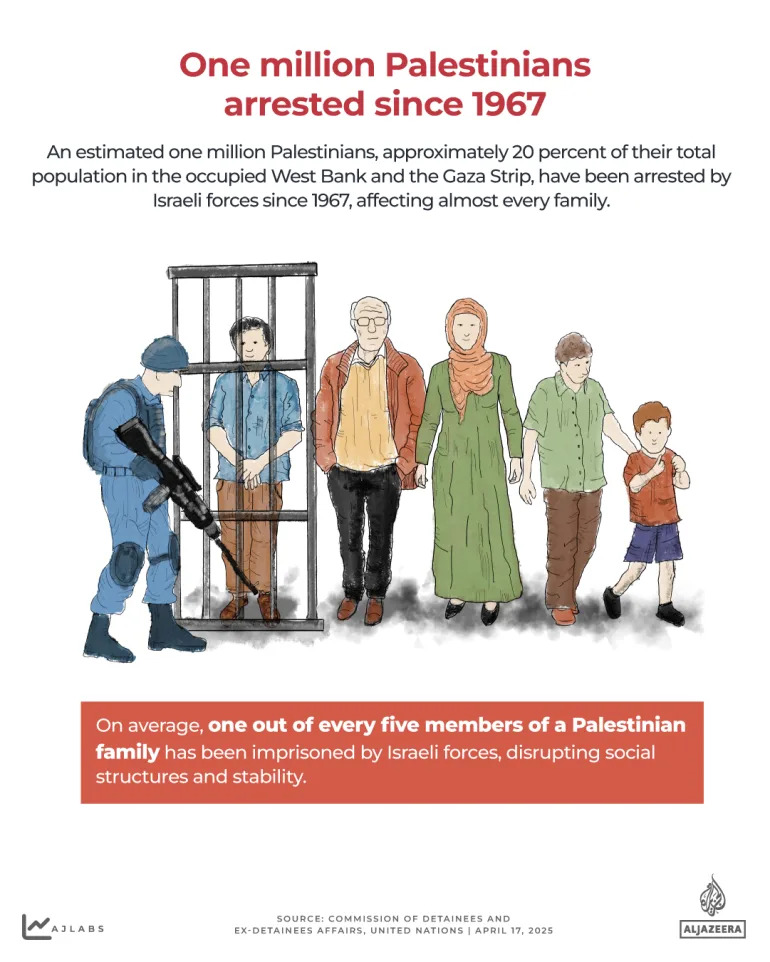
INTERACTIVE - One million Palestinians detained since 1967-1776338370
The New Death-Penalty Law
The Israeli Knesset approved a law on March 30 that will allow military courts to impose the death penalty on Palestinians convicted of killing Israelis in acts labeled "terror." The law is meant to apply to Palestinians from the West Bank who are tried in military courts and does not introduce the same penalty for Jewish Israelis who kill Palestinians. Critics say this explicit targeting compounds existing legal inequalities.
The Palestinian Authority condemned the bill as "a war crime against the Palestinian people," arguing it violates safeguards in the Fourth Geneva Convention. The United Nations human rights chief warned the measure could amount to a war crime. Rights group B'Tselem highlighted that conviction rates for Palestinians in military courts run around 96 percent and cautioned that many convictions depend on confessions obtained under pressure or during abusive interrogations.
Long-Term Impact
Detention policy has shaped Palestinian life for decades. The Palestinian Commission of Detainees and Ex-Detainees Affairs estimates that since 1967 Israeli forces have detained roughly one million Palestinians — about 20 percent of the Palestinian population — meaning one in five Palestinians has been imprisoned at some point. Families and communities report ongoing trauma, fragmentation and deep-seated resentment as a result.
“For many families, arrests have become an inevitability.” The systemic use of detention has left long-term social and psychological scars across generations.
As arrests and military operations continue, thousands remain behind bars and many observers fear that mass detention is being used as a tool of control rather than merely a security response. Palestinian Prisoners’ Day remains a focal point for calls to uphold due process, end discriminatory practices and seek the release or fair treatment of detainees.
Help us improve.