
Look east in the pre-dawn hours to catch Mercury, Mars, Jupiter and Neptune lined up in the sky. The alignment began April 16 and runs nearly to the end of the month, with the best viewing from April 18–24. Observers typically have only a 20–40 minute window before sunrise, and a telescope is required to see Neptune. Choose a dark site with a low eastern horizon and never point optics near the Sun.
Pre-Dawn Planet Parade: How to See Mercury, Mars, Jupiter & Neptune This Week
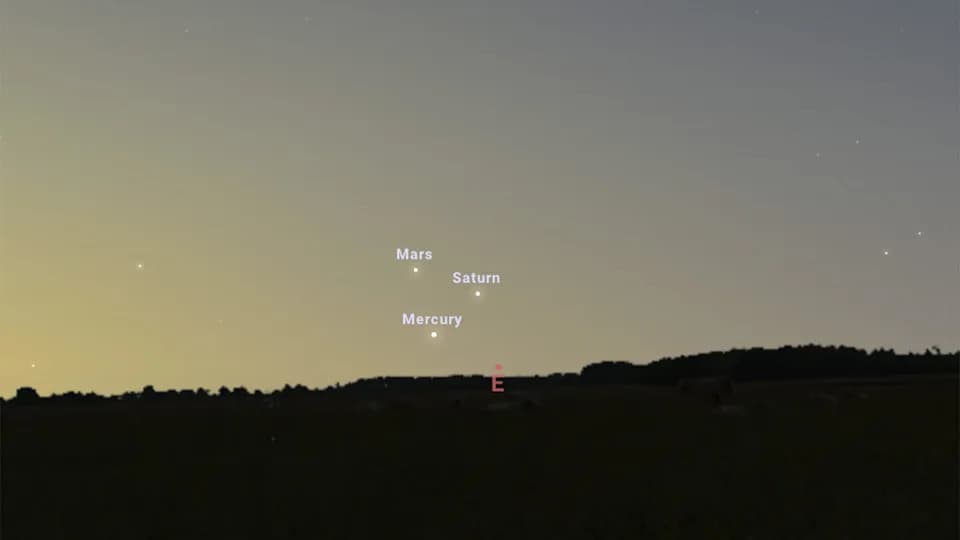
The four planets will be visible just before sunrise on the eastern horizon.Stellarium
Space activity has picked up this month, from meteor showers to the historic Artemis II mission. Stargazers have one more treat in April: a pre-dawn planet parade in which Mercury, Mars, Jupiter and Neptune appear close together above the eastern horizon.
When To Look
The alignment began on Thursday, April 16 and continues nearly through the end of the month. The best window to try is Saturday, April 18 through Friday, April 24, when the four planets are most tightly grouped. Because the Sun rises quickly after the planets appear, observers typically have only about 20–40 minutes each morning (depending on your location) to spot them before daylight washes out the view.
Timing And Elevation
Timing depends on your elevation and local sunrise. At higher elevations, aim for just before 6:00 a.m. local time; at sea level, wait until just after 6:00 a.m. when the planets have cleared the horizon. Check your local sunrise time and weather so you know how much of the window you’ll have.
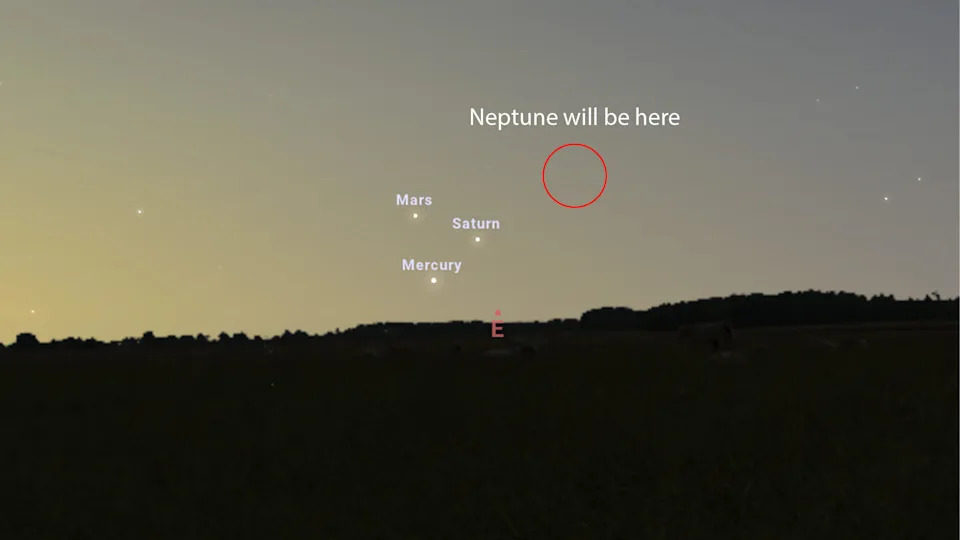
Neptune won't be visible to the naked eye, but it'll be close to the other three planets.Stellarium
What You’ll Need
Telescope: Necessary to see Neptune, which is too faint for the naked eye. Even with a scope, locating Neptune takes practice and a steady mount.
Binoculars: Helpful for picking out the brighter planets (Mercury, Mars and Jupiter) and for scanning the horizon, though binoculars alone are unlikely to reveal Neptune clearly.
Viewing Tips
- Find a site with a very low, clear eastern horizon and as little light pollution as possible — the darker the sky, the easier the viewing.
- Bring a star-chart app or planetarium app to confirm planet positions and help you locate Neptune with a telescope.
- Use a tripod and allow optics to acclimate to outdoor temperatures for a steadier view.
Safety
Do not look at or near the Sun through binoculars or a telescope. The planets appear just before sunrise — optics can concentrate sunlight and cause serious eye injury if pointed toward the Sun.
“Mercury is, as always, close to the Sun and hard to see,” said Geza Gyuk, senior director of astronomy at Chicago’s Adler Planetarium. “That proximity makes the earliest moments of dawn the most critical, and a very low eastern horizon can make the difference in whether you spot the inner planets.”
Seeing four planets so near each other is uncommon and always a treat for amateur and professional astronomers alike. If you miss it, similar configurations will occur in future years, but each alignment has its own timing and challenges.
Help us improve.





















