
Researchers analyzed millions of all-sky camera detections and discovered a compact meteor stream of 282 meteors whose orbit plunges nearly five times closer to the Sun than Earth. Atmospheric fragmentation patterns indicate particles are moderately fragile, consistent with thermal cracking of an asteroid's surface. The finding reveals a previously hidden, disintegrating near-Earth asteroid and highlights how meteor observations complement telescopic searches. NASA's NEO Surveyor, launching in 2027, may locate the parent body.
Hidden Meteor Stream Reveals an Asteroid Being Shredded by the Sun
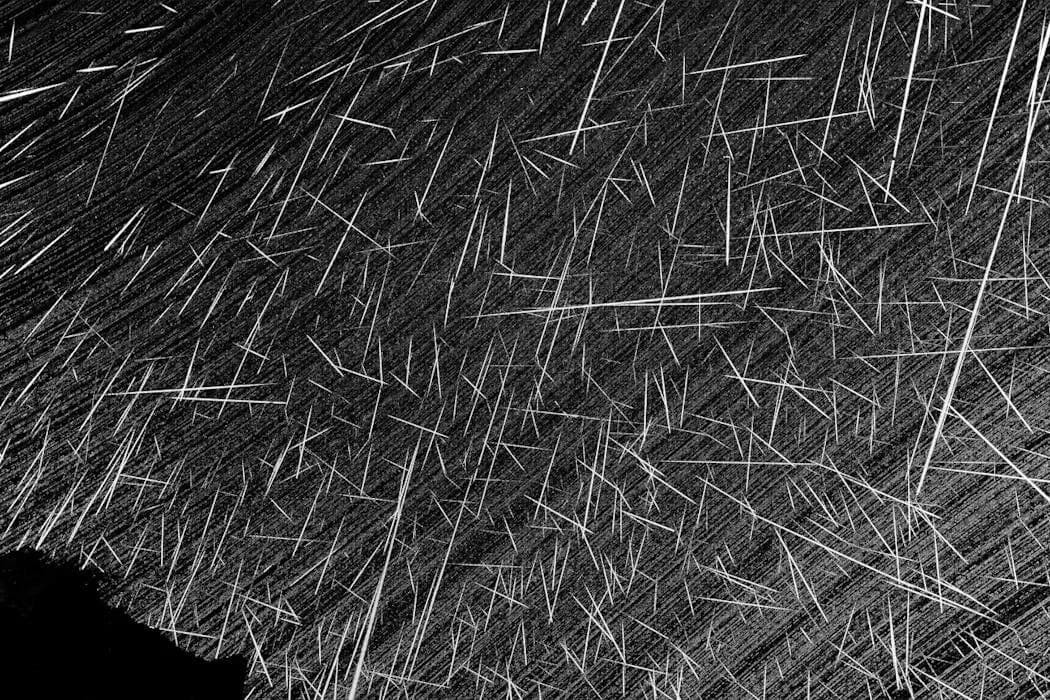
This composite image shows the Geminid meteors, captured in 2020 using Global Meteor Network software. Aleksandar Merlak
Every night, automated all-sky cameras around the world watch for fleeting streaks of light. I am one of the planetary scientists who analyze those meteors, and in March 2026 I published a paper describing a new, compact meteor stream that points to an asteroid literally being baked apart by the Sun.
Using millions of meteor detections from wide-field camera networks in Canada, Japan, California and Europe, I identified a distinct cluster of 282 meteors. Their orbits follow an extreme path that carries debris almost five times closer to the Sun than Earth, and their observed breakup behavior in the atmosphere reveals important clues about their origin.
What Meteors Tell Us
When a grain- or sand-sized fragment enters Earths atmosphere, its surface vaporizes almost instantly and becomes an ionized, glowing trail we call a meteor. Larger and brighter events are called bolides or fireballs. Typical entry speeds exceed 15 miles per second, and for tiny grains the luminous event lasts only a fraction of a second.
Most small dust and pebble material in the inner solar system comes from comets — icy bodies whose ices sublimate near the Sun and release vast amounts of dust. Asteroids, by contrast, are generally rocky remnants formed closer to the Sun and lack those volatile ices.
How Asteroids Become Active
We describe a small body as "active" when it sheds dust, gas or fragments because of external drivers such as solar heating, impacts, or rotational breakup. For comets, sublimation of ices is usually the cause. For asteroids the triggers are more varied: thermal fracture from intense sunlight, impacts by micrometeoroids, rotational disruption, tidal forces during close planetary encounters, or release of trapped gases.
Notable examples include 3200 Phaethon, the parent of the Geminid meteor shower, and transient activity observed at asteroid Bennu by NASA's OSIRIS-REx mission. In many cases those events are first noted by telescopes as a fuzzy coma or tail; meteor streams provide a complementary detection method because they reveal debris after it has already separated from its parent body.
What We Found
The cluster of 282 meteors I identified stands out as a recently formed stream. Analysis of how these meteors fragment on entry indicates they are moderately fragile — stronger than typical cometary dust but weaker than intact asteroidal rocks. That intermediate strength is consistent with surface material that has been thermally cracked and weakened by repeated close passes to the Sun.
Interpretation: Intense solar heating is likely cracking the parent asteroid's surface, releasing dust and gas and causing the body to gradually crumble and shed fragments that now intersect Earth's orbit.
Why This Matters
Meteor observations are a uniquely sensitive probe of small, dark or otherwise invisible objects that telescopes can miss. By detecting newly formed streams we can infer recent activity, identify hidden near-Earth populations, and improve our understanding of how small bodies evolve under extreme solar heating.
Beyond the scientific value, mapping these hidden populations matters for planetary defense. The parent body of this new stream has not yet been identified, but NASA's NEO Surveyor mission, planned for launch in 2027, is specifically designed to find dark, Sun-approaching asteroids and is a promising tool to locate the source.
Note: This article summarizes results published in the Astrophysical Journal in March 2026. The study used camera-recorded meteor trajectories and fragmentation behavior to infer the age, origin and physical properties of the stream.
Help us improve.





















