Using Gaia data and a new physics-driven algorithm called StarStream, researchers have identified 87 candidate stellar streams in the Milky Way's outskirts—more than quadrupling the previously known sample. Many candidates are linked to surviving globular clusters, enabling direct comparisons between streams and their progenitors. Several streams show unexpected shapes or high mass-loss rates, and upcoming observatories (Rubin, Roman, DESI) will help confirm and study these discoveries.
Hidden Stellar Streams Uncovered: 87 New Candidates at the Edge of the Milky Way
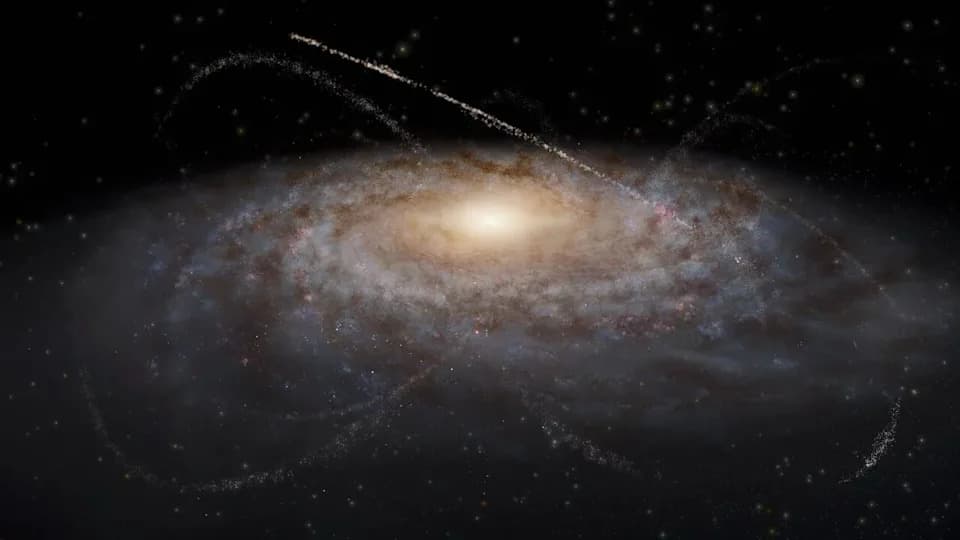
This artist's impression shows a myriad of stellar streams in and around the Milky Way. These stretched-out remnants of dwarf galaxies and star clusters showcase gravitational interactions between stars, clumps of dark matter, and the entire galaxy. | Credit: RubinObs/NOIRLab/SLAC/NSF/DOE/AURA/J. daSilva, M. Zamani
A team of astronomers has identified dozens of faint, ribbon-like star streams in the outer reaches of the Milky Way using data from the European Space Agency's Gaia mission. The discovery—driven by a new physics-based search algorithm—more than quadruples the number of candidate streams tied to surviving star clusters and offers fresh ways to probe our Galaxy's history and its elusive dark matter halo.
What Are Stellar Streams?
Stellar streams are long, arcing filaments of stars formed when compact star clusters or small galaxies orbiting the Milky Way lose stars under the Galaxy's tidal forces. Over time those escaped stars trace the orbit of the progenitor, creating a visible record of past gravitational interactions.
How the Discovery Was Made
The study, led by Yingtian "Bill" Chen of the University of Michigan, used a new algorithm called StarStream that looks for the dynamical signatures of streams using a physics-based model rather than relying solely on visual pattern recognition. Applying StarStream to Gaia observations collected since 2014, the team identified 87 candidate stellar streams associated with globular clusters—compact, ancient clusters of stars that orbit the Galaxy.
"It's like riding a bike with a bag of sand, only the bag has a hole in it," said study co-author Oleg Gnedin, a theoretical astrophysicist at the University of Michigan. "Those grains of sand are like the stars left behind along their trajectory."
Key Findings and Surprises
Previous searches had found fewer than 20 such streams, often by chance. The expanded candidate list reveals several unexpected features:
- Many streams do not match the textbook image of thin, neatly aligned trails—some are shorter, broader, or misaligned with their parent cluster's orbit.
- A subset of diffuse globular clusters appears to be shedding stars at unusually high rates, suggesting they may be nearing complete tidal disruption.
- Not every candidate will be confirmed: some detections have lower confidence because of background contamination from unrelated stars.
Why This Matters
Because stellar streams retain a record of the gravitational forces that shaped them, they are powerful tracers of the Milky Way's mass distribution, including its dark matter halo. A larger, more diverse sample of streams—especially ones that can be linked to surviving globular clusters—gives astronomers a stronger statistical basis for mapping the Galaxy's mass and testing models of dark matter.
Next Steps
The authors note that the StarStream algorithm can be adapted easily to new data. Upcoming facilities—such as the Vera C. Rubin Observatory, NASA's Nancy Grace Roman Space Telescope, and the Dark Energy Spectroscopic Instrument (DESI)—will provide deeper, higher-precision observations that can confirm which candidates are true streams and refine measurements of their properties.
The research is described in a paper published March 23 in The Astrophysical Journal.
Help us improve.