
NASA's XRISM has measured winds from the starburst galaxy Messier 82 moving at about 2 million mph (3.21 million km/h) by detecting X-ray emission from superheated iron in the galaxy's core. The central gas reaches roughly 45 million °F (25 million °C), and the galaxy appears to eject material at a rate equal to seven Suns per year. That rate creates a mass-balance puzzle: the measured hot wind can account for about four solar masses per year of outflow, leaving three solar masses unexplained. Continued XRISM observations aim to resolve the discrepancy and improve models of starburst-driven winds.
NASA's XRISM Detects 2 Million MPH Winds Blowing From Starburst Galaxy M82
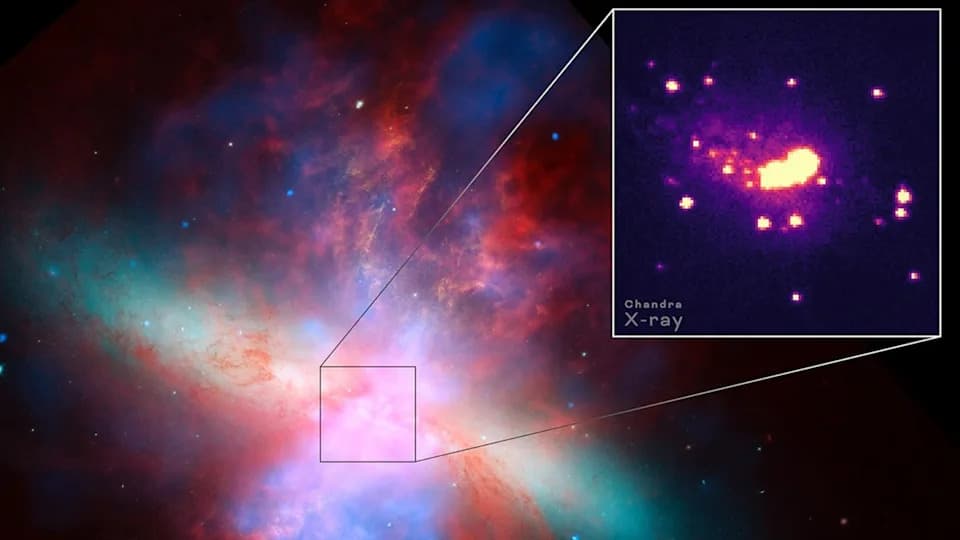
The cool wind of galaxy M82 drives gas and dust up to 40,000 light-years from its core, as shown here using data from NASA's Chandra X-ray Observatory and Hubble and Spitzer space telescopes. The inset shows a Chandra view of the galaxy's central region, where a cauldron of stellar activity kick-starts the larger-scale outflow. | Credit: NASA’s Goddard Space Flight Center; X-ray: NASA/CXC/JHU/D.Strickland; Optical: NASA/ESA/STScI/AURA/The Hubble Heritage Team; Infrared: NASA/JPL-Caltech/Univ. of AZ/C. Engelbracht; XRISM Collaboration et al. 2026
NASA's X-ray observatory XRISM has measured extraordinarily fast winds streaming from the center of the starburst galaxy Messier 82 (M82), revealing new details about how intense star formation drives galactic-scale outflows.
Powerful, Superheated Winds
Using the Resolve instrument, XRISM detected X-ray emission from superheated iron at M82's core and measured wind speeds of roughly 2 million miles per hour (about 3.21 million km/h). The central plasma reaches temperatures near 45 million °F (25 million °C), producing pressure that helps push gas outward from the galaxy's heart.
What Is M82?
Located about 12 million light-years away in the northern constellation Ursa Major, M82—often called the Cigar Galaxy—is a classic starburst galaxy, forming stars at roughly ten times the rate of the Milky Way. The galaxy is known for cooler, dusty outflows that extend roughly 40,000 light-years and have been imaged by observatories including Hubble, JWST, Chandra and Spitzer.
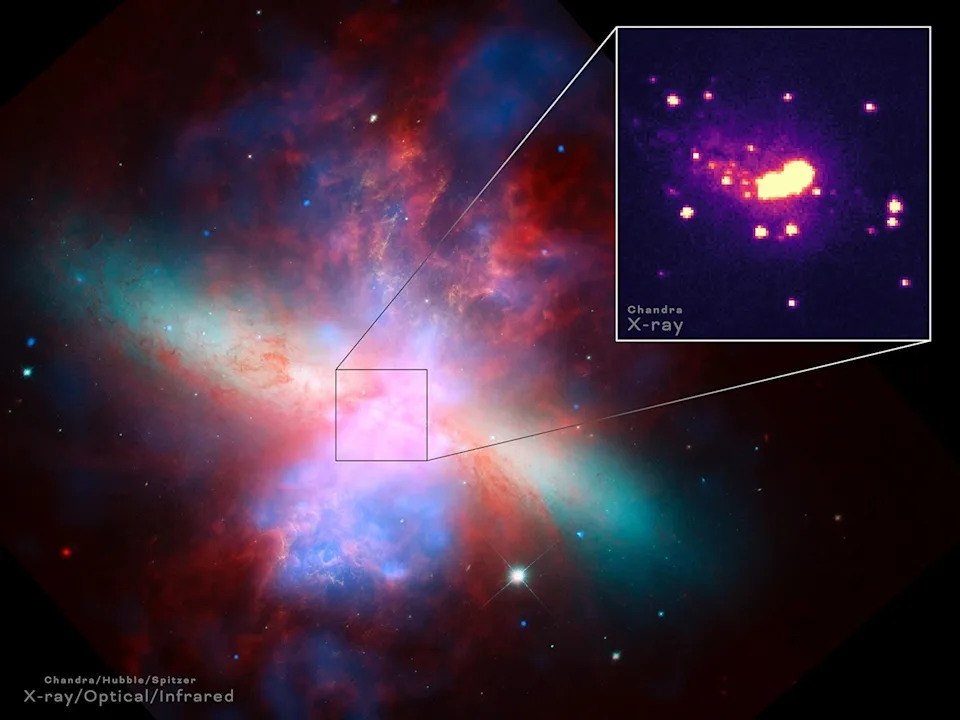
A full version of the image of M82 captured by NASA's Chandra X-ray Observatory and Hubble and Spitzer space telescopes. | Credit: NASA’s Goddard Space Flight Center; X-ray: NASA/CXC/JHU/D.Strickland; Optical: NASA/ESA/STScI/AURA/The Hubble Heritage Team; Infrared: NASA/JPL-Caltech/Univ. of AZ/C. Engelbracht; XRISM Collaboration et al. 2026
Connecting Winds, Stars and Cosmic Rays
The XRISM team aimed to link these hot X-ray winds to the intense stellar activity at M82's center and to test whether cosmic rays—high-speed charged particles—contribute significant pressure to drive the larger, cooler outflows. Some theoretical models propose the same processes that launch the hot wind also accelerate cosmic rays, making them an important driving force.
"The classic model of starburst galaxies like M82 suggests that shock waves from star formation and supernovas near the center heat gas, kick-starting a powerful wind," said Erin Boettcher of the University of Maryland and NASA's Goddard Space Flight Center. "Prior to XRISM, we didn't have the ability to measure the velocities needed to test that hypothesis. Now we see the gas moving even faster than some models predict, more than enough to drive the wind all the way to the edge of the galaxy."
A Mass-Balance Puzzle
XRISM's observations imply the galactic center is ejecting material equivalent to about seven Suns per year. However, the measured hot wind speed can account for carrying roughly four solar masses per year into the larger, cooler outflow—leaving a discrepancy of roughly three solar masses per year that the team has yet to explain.
"If the wind blows steadily at the speed we've measured, then we think it can power the larger, cooler wind by driving out four solar masses of gas a year. But XRISM tells us much more gas is moving outward," said Edmund Hodges-Kluck. "Where do the three extra solar masses go? Do they escape out of the galaxy as hot gas some other way? We don't know."
XRISM will continue observing M82 to help resolve this puzzle and refine theoretical models of starburst-driven winds. As Skylar Grayson of Arizona State University notes, many classic models were developed in the 1980s; XRISM now provides the precision needed to test and improve them.
Publication: The team's results were published in the journal Nature on March 25.
Help us improve.





















